
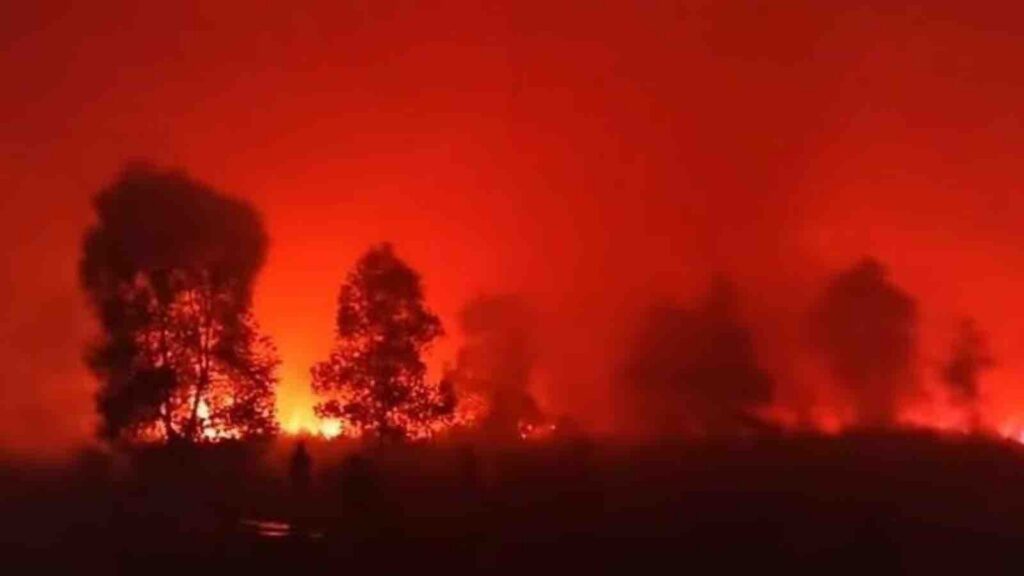

Firefighters in East Lampung battle a growing forest fire with largely manual equipment as officials monitor the national park’s wild elephants and other wildlife.
LAMPUNG, Indonesia — A forest and land fire burning through Way Kambas National Park in East Lampung has spread across an estimated 673.4 hectares, with flames continuing to move toward another part of the conservation area on Saturday, Aug. 22, 2026.
The latest police data put the affected area at 673.4 hectares as the fire continued around Jati 3 in Kuala Penet Resort, SPTN Region III Kuala Penet, Braja Selebah District. Flames that had previously been concentrated around Jati 3 were reported to be spreading toward Rawa Mbah Sapon, around Grid 7 S.
Lampung Police spokesperson Senior Commissioner Yuni Isawandari Yuyun said a joint team remained at the site, working to extinguish the fire and prevent it from spreading farther.
RELEVANT SUSTAINABLE GOALS
Firefighters Confront Large Flames in Difficult Terrain
Conditions on the ground have made containing the blaze difficult.
The fire is burning in an area that vehicles cannot easily reach, while the flames have been reported as still large and high.
The 29 personnel deployed to the operation include 14 members of the forest police and Masyarakat Mitra Polhut, or MMP; 10 officers from Braja Selebah Police; and five Indonesian military personnel from Way Jepara Koramil.
Despite the scale of the fire, crews have been relying on manual equipment.
Their tools include Alpa spray tanks and wooden fire beaters known as gepyok.
Firefighters are now preparing a water pump machine, or Alkon, to support the next stage of the response.

The fire remained active on Saturday in the southern section of Way Kambas National Park.
Its movement from Jati 3 toward Rawa Mbah Sapon has made preventing further expansion the immediate priority for authorities working inside the conservation area.
The Way Kambas National Park agency is concentrating its efforts on extinguishing the flames and keeping them from reaching other parts of the park.
At the same time, authorities continue collecting data to establish the effects of the fire more accurately.
Wild Elephants Monitored in Northern Way Kambas
The expanding fire has also raised concern about wildlife living within the national park.
Zaidi, head of the Way Kambas National Park agency, said that as of Saturday afternoon there had been no reports of elephants or other wildlife being directly affected by the blaze.
Zaidi confirmed that the active fire was located in Kuala Penet Resort in the southern part of the national park.
The separation between the monitored elephants in the north and the fire in the south has not removed the need for continued attention to wildlife as firefighting operations continue.
Videos circulating on social media show flames burning vegetation inside Way Kambas that has dried during the dry season. Those conditions are an important concern as the park moves further into this year’s dry period.
Dry vegetation can accelerate the spread of forest and land fires, increasing the need for vigilance across the protected area.
For now, officials remain focused on controlling the existing blaze before it can extend into other parts of the park.
January Fire Burned More Than 2,600 Hectares
The latest emergency is not the first major fire to affect Way Kambas National Park this year.
A previous fire occurred in January 2026, when more than 2,600 hectares were reported burned.
The recurrence adds urgency to monitoring fire risks during the current dry season, particularly as vegetation becomes increasingly dry and capable of carrying flames more rapidly.
The present response is therefore taking place against the backdrop of an earlier, substantially larger burned area within the same conservation landscape.
With the latest fire still burning, authorities have yet to complete a full assessment of its consequences. The immediate task remains containment.
Joint personnel are continuing firefighting operations on the ground while additional water-pumping equipment is being prepared. Officials are also tracking conditions inside the national park and compiling information needed to determine the damage more precisely.
For Way Kambas, the continuing fire places renewed attention on the vulnerability of conservation areas during the dry season. The response now depends on stopping the flames from moving beyond the affected zone while keeping watch over the wildlife and habitat that the national park exists to protect.