
The tech sector’s rush to guarantee electricity for giant new data centers optimized for artificial intelligence is pushing Amazon, Google, Microsoft and other tech infrastructure providers to consider dedicated power sources that are “behind the meter,” bypassing long grid connection times.
Those arrangements — along with the sector’s growing reliance on natural gas generation — raise doubts about the tech giants’ ability to deliver on its aggressive emissions reduction pledges.
“What has to go behind the meter is something that is baseload, and that thing is probably going to be gas,” said Benjamin Baker, managing partner at infrastructure investment firm GDEV Management.
Close to 80 percent of planned projects being built behind the meter — next to or on data center campuses — use natural gas generation technology including fuel cells and heavy duty turbines, according to an analysis by Rabobank.
Microsoft, for example, has contracted with Nscale in West Virginia for an 8-gigawatt natural gas microgrid to power an AI campus, starting in 2027. It has also proposed a deal with Chevron and Engine No. 1 for another 2.5 gigawatts in Texas.
The West Virginia project alone would boost Microsoft’s annual emissions by 40 percent, estimates research firm Cleanview. The U.S. industry’s rapid buildout would release at least 24 million metric tons of additional greenhouse gases into the atmosphere annually and drain at least 731 million cubic meters of water, according to an analysis by Cornell University.
Climate target pressure
Microsoft’s natural gas contracts have sparked speculation that it is stepping back on its pledge to match its annual electricity consumption with carbon-free power. The company said it is taking a “portfolio approach” to the energy it sources for data centers and remains committed to its goals.
“Fulfilling our carbon commitments requires ongoing effort to review and refine our approach as markets mature, policy environments evolve and emerging innovation solutions scale,” said Microsoft Chief Sustainability Officer Melanie Nakagawa in one of several statements shared with Trellis.
Although Microsoft’s situation has drawn the most public scrutiny in recent weeks, Amazon and Google face the same dilemma: how to reduce emissions while collectively spending more than $130 billion per quarter on new data center construction and opting for the most readily available electricity supply.
“There is plenty of unabated natural gas being proposed,” said Ryan Kammer, research manager for industrial innovation with energy strategy nonprofit Great Plains Institute. “We need an all hands on deck approach to find opportunities to lower the carbon intensity.”
Natural gas + carbon capture
Those concerns have inspired Amazon, Google and Microsoft to contract with geothermal and nuclear developers, but gas-fired power plants equipped with carbon capture have the most potential to scale, according to a March analysis by Boston Consulting Group (BCG).
These projects can deliver electricity in less than three years if they are behind the meter, are still eligible for tax incentives and don’t have the permitting baggage faced by solar and wind projects under the current U.S. administration.
“The advantage is speed, at least on paper,” said Alex Dewar, managing director and partner with BCG. “The downside is that you don’t have the grid as a backstop.” For that reason, BCG anticipates that many behind-the-meter projects will eventually become grid-connected.
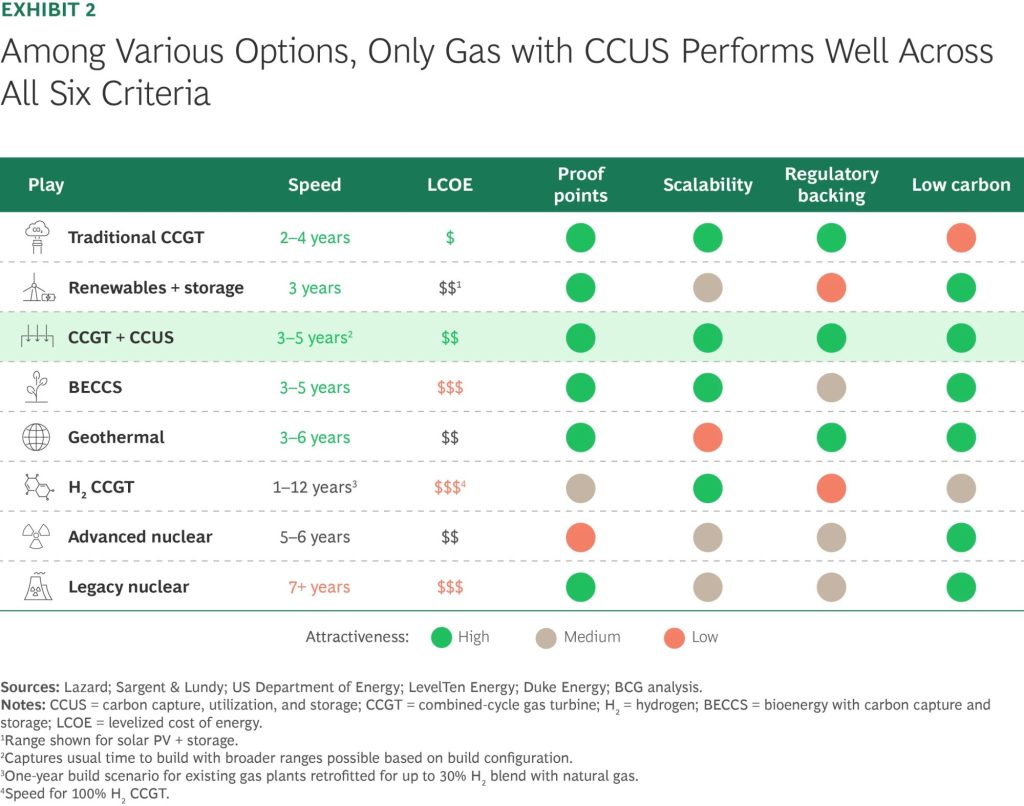
Natural gas plants abated with carbon capture have a higher carbon intensity than geothermal or nuclear generation, but they reduce life-cycle emissions by more than 70 percent on a per-kilowatt basis compared with unabated natural gas generators, according to the BCG analysis.
Carbon capture and storage isn’t available everywhere, but significant storage capacity exists in the Gulf Coast, parts of the Midwest, Oklahoma and West Texas.
So far, Google is the only big cloud company to have announced a power purchase agreement for natur
Read More