

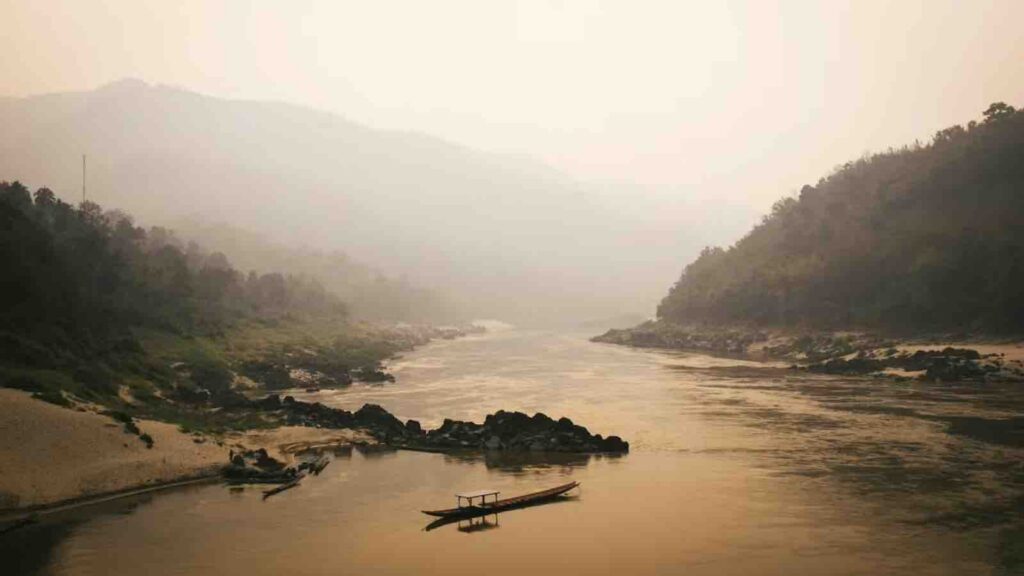

According to Thailand’s Pollution Control Department, sediment samples collected in March from three monitoring stations along the Mekong mainstream in the northern provinces of Chiang Mai and Chiang Rai contained arsenic concentrations ranging from 73 to 296 milligrams per kilogram.
Thai authorities have detected dangerous levels of arsenic contamination in sediment from the Mekong River and several of its northern tributaries for the first time, raising fresh concerns over the growing environmental toll of unregulated mining activities upstream in Myanmar.
The findings mark a significant escalation in pollution concerns surrounding one of Asia’s most important transboundary rivers, which supports millions of people, thousands of species and critical regional food systems across Southeast Asia.
According to Thailand’s Pollution Control Department, sediment samples collected in March from three monitoring stations along the Mekong mainstream in the northern provinces of Chiang Mai and Chiang Rai contained arsenic concentrations ranging from 73 to 296 milligrams per kilogram.
The department considers arsenic levels below 10 mg/kg broadly safe for aquatic life, while concentrations above 33 mg/kg are classified as dangerous.
The results, published in mid-April, represent the first confirmed detection of arsenic contamination on the Mekong mainstream itself after more than a year of heavy metal pollution reports from tributaries linked to the river.
RELEVANT SUSTAINABLE GOALS
Contamination Spreading Through Tributaries in Northern Thailand
Authorities also found elevated arsenic levels in sediment collected from the Kok, Sai and Ruak rivers, major tributaries connected to the Mekong system.
According to Thailand’s Pollution Control Department, contamination levels in those rivers ranged from below the 33 mg/kg safety threshold to as high as 57 mg/kg.
Officials warned that the contamination appears to be spreading through the broader river network.
The findings have triggered growing anxiety among riverine communities that depend on the Mekong and its tributaries for food, drinking water, fishing and local livelihoods.
Thai authorities have already issued warnings to some communities along the Mekong in Chiang Rai, advising residents to limit fish consumption from the rivers. Some communities were urged to avoid contact with the water entirely.

Unregulated Mining in Myanmar Under Growing Scrutiny
Environmental researchers and regional observers have increasingly linked heavy metal pollution in the Mekong Basin to rapidly expanding unregulated mining operations in northeastern Myanmar.
A mining boom focused on gold, rare earth elements and critical minerals has intensified across parts of Shan state near Thailand’s border.
Using satellite imagery analysis, the Stimson Center identified 833 unregulated mines across the Mekong River Basin.
Among them, 86 are believed to be rare earth mining sites, identified through distinctive blue tarpaulin leaching ponds associated with in situ mining operations.
More than half of those rare earth mines reportedly opened between 2024 and 2026.
Rare earth elements have become strategically important for military technology, aerospace manufacturing, electric vehicles and the global clean energy transition. However, their extraction often involves environmentally destructive methods.
The mining process commonly injects toxic chemical solutions into mountainsides, liquefying underground materials before separating rare earth elements in leaching ponds.
China, the world’s leading producer and processor of rare earth minerals, imposed significant restrictions on domestic rare earth mining operations in 2009 because of environmental damage concerns. Mining activities subsequently expanded into countries including Myanmar, Mongolia and Malawi.
Mekong Ecosystem Faces Growing Environmental Pressure
The pollution threat comes at a time when the Mekong River is already under severe ecological stress.
More than 50 million people across the Lower Mekong Basin rely on the river for water, fisheries and livelihoods.
The river is also one of the world’s major biodiversity hotspots, supporting around 20,000 plant species alongside extensive aquatic and terrestrial wildlife.
Among the species dependent on the river system are the critically endangered Mekong giant catfish and the endangered Irrawaddy dolphin. Fewer than 100 Mekong Irrawaddy dolphins are believed to remain.
The basin also supports approximately 1,200 bird species, 800 reptile and amphibian species, and 430 mammal species.
In recent years, the river system has faced mounting pressure from hydropower dam construction, overfishing, deforestation, land-use change and contamination from agricultural chemicals.
Scientists and environmental groups now warn that expanding critical mineral and rare earth mining may push parts of the river ecosystem closer to irreversible damage.
Seasonal Rainfall May Be Spreading Pollution Downstream
Researchers monitoring mining activities say seasonal weather patterns may be worsening contamination flows through the basin.
Regan Kwan, who helped develop the Stimson Center’s mining monitoring platform for mainland Southeast Asia, said heavy rainfall may increase the risk of leaching ponds overflowing at mining sites.
The stronger river flows can then carry toxic contaminants farther downstream.
“The results look concerning and serious,” Kwan said in comments to Mongabay.
He added that while governments should prioritize immediate support for communities dependent on the river, the situation highlights the urgent need for long-term and consistent water testing throughout the Mekong Basin.
“There is now more data than a year ago when the mines on the Kok River were discovered, but it still feels like governments aren’t responding accordingly,” he said.
Kwan also noted that major uncertainties remain regarding the long-term ecological impacts of mining pollution on plants, fish and wildlife across the basin.
Regional Coordination Challenges Limit Response
The transboundary nature of the Mekong River complicates efforts to regulate pollution and coordinate responses across countries.
A representative from the Mekong River Commission said current evidence suggests arsenic contamination appears locally concentrated in Chiang Rai and that there is “no indication of immediate basin-wide impacts.”
The commission said it facilitates data exchanges and cooperation between governments but does not conduct independent field testing.
“With the information currently available, there is no confirmed evidence establishing a direct link between the observed conditions in the Mekong River and mining activities in any specific country or area,” the representative said.
However, the commission acknowledged that the Kok-Sai-Ruak river network may represent one pathway requiring further investigation.
The Mekong River Commission’s authority extends across Cambodia, Laos, Thailand and Vietnam, while China and Myanmar remain dialogue partners outside its direct regulatory control.
Meanwhile, resource limitations continue to hinder environmental monitoring in parts of the region.
Cambodia’s Ministry of Environment had not responded to inquiries at the time the report was published, while Heng Kong said Cambodia currently lacks the budget needed for heavy metal testing.
The detection of arsenic contamination in the Mekong mainstream has intensified broader questions about the environmental costs of the global demand for critical minerals and rare earth elements.
As governments and industries accelerate clean energy and high-technology transitions, Southeast Asia is increasingly becoming a major extraction frontier for strategic minerals essential to modern economies.
Environmental experts warn that without stronger regulation, monitoring and cross-border cooperation, the ecological and human costs of that transition could increasingly be exported downstream to vulnerable communities and fragile ecosystems across the Mekong Basin.
You may also be interested in :
Chemical Spill Pollutes Cisadane River, Disrupts Clean Water Supply In Tangerang