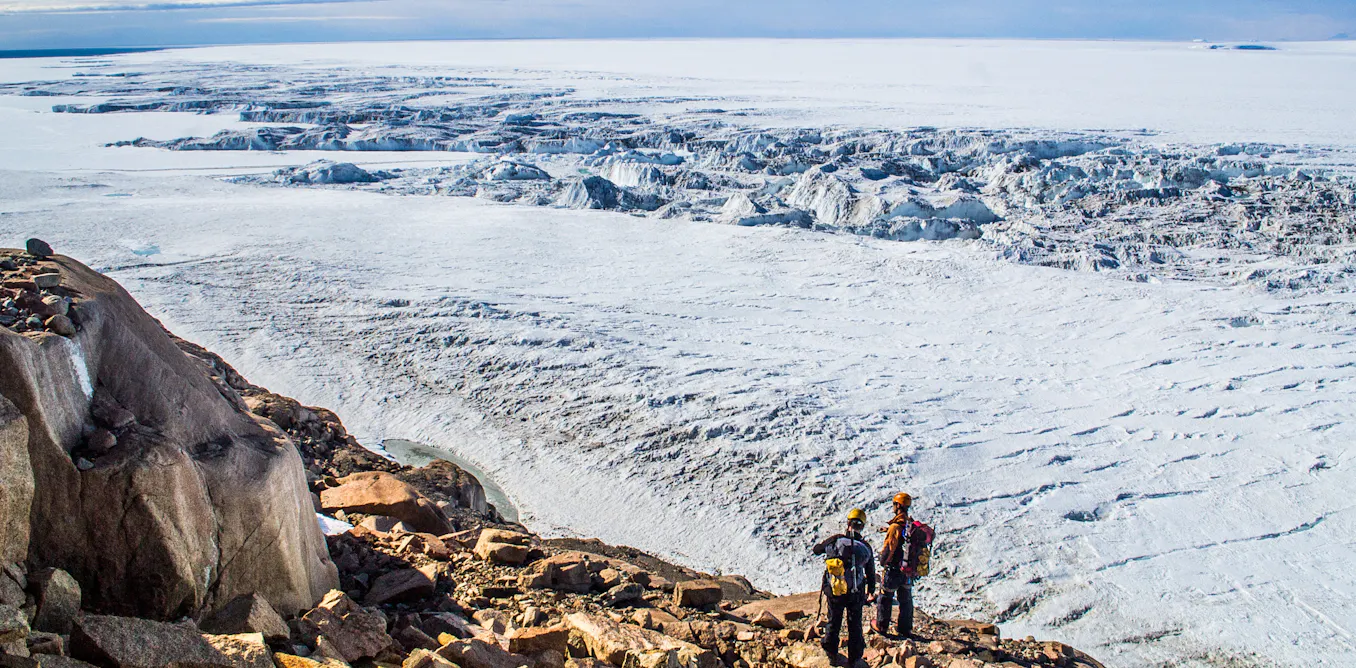

In 2015, the world agreed to work to hold climate change below 1.5°C. But that goal is no longer possible.
Earth will pass 1.5°C by 2030. Some years are already over 1.5°C warmer than the pre-industrial average. This means we are set for climate overshoot – heading for even more dangerous levels of climate change.
Are there ways of temporarily going past 1.5°C and then pulling carbon dioxide back out of the atmosphere to return us to a safer temperature? In a September report, experts from the United Nations Environment Programme point out this would rely on sustained net-negative emissions, likely to be slow and uncertain.
We might assume net-negative emissions would mean planetary systems will start to return to a climatic “safe operating space” of the relatively stable 11,700 years prior to our time, during which human civilisation developed and flourished.
Ice sheets regulate the climate in three ways. They reflect solar energy back to space, due to their great height which cools the atmosphere and influences global wind patterns. They also regulate the climate via ocean circulation through their input of cold fresh water, and their control on sea levels.
Concerning new research shows the world’s ice will keep melting, even if we reach net-negative emissions quickly.
Ice has a memory
Many parts of the cryosphere have a long memory. So if the melting of glaciers and ice sheets hits critical thresholds, it will lock in centuries of sea-level rise – even if the world’s emissions have become net-negative.
New research shows the world’s sea ice, snow and permafrost are already outside the previously stable climatic envelope, meaning that losses may be irreversible. The authors find that land ice as a whole (the combination of glaciers and ice sheets) has not yet crossed into unsafe territory. However, because land ice responds slowly, enough losses are now locked in to cause dangerously advancing sea levels by the end of the century.
Almost 90% of the world’s land ice is locked up in Antarctica. Scientists published research this year showing that current rates of Antarctic ice loss strongly predict its contribution to sea level rise over the next three to five decades, after which it may accelerate. The predictability identified in this research does not reduce long-term risk, but merely provides us with a defined period in which to act with greater confidence. Improvements in observational systems and ice sheet model developments will directly translate into more reliable sea level projections for short-term planning horizons.
Land ice in other areas are also showing signs of rapid change. Glaciers are retreating at accelerating rates across nearly every part of the planet. In the European Alps, Switzerland’s glaciers lost 5.5% of their ice this year alone. Since 2021, almost 20% of these glaciers have melted. Melt rates between 2022-26 are more than double any five-year period previously monitored. Globally, glaciers are predicted to lose about 40% of their current mass even if global temperatures stablise at current conditions, and considerably more under future warming scenarios.
In August, over 130 million cubic metres of rock and ice broke away from the Himalayan mountain Langtang Lirung in Nepal. The resulting ice avalanche triggered devastating flooding, leaving thousands of people dead or missing. Ice melt likely contributed, as melting permafrost makes mountain slopes less stable, while glacier retreat can also de
Read More