The initiative supports the development of the Peusangan Elephant Conservation Initiative (PECI), launched in 2025 by WWF-Indonesia in partnership with Indonesia’s Ministry of Forestry and PT Tusam Hutani Lestari.
A major new research partnership is taking shape in Indonesia, as conservation groups, financial institutions and academic bodies join forces to protect one of the country’s most endangered species.
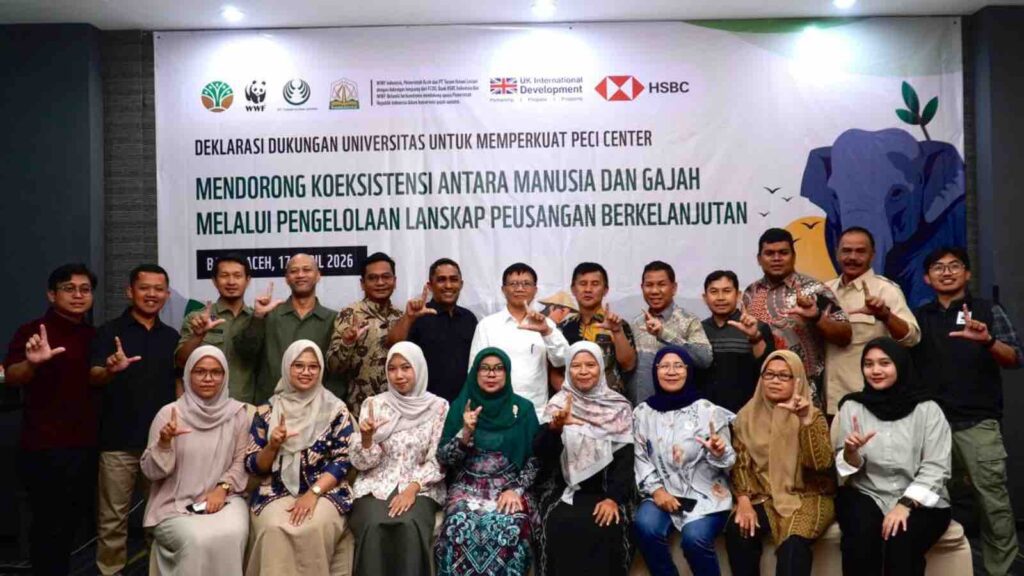
WWF-Indonesia, HSBC Indonesia and PT Tusam Hutani Lestari have partnered with six universities from Indonesia and abroad to advance research on Sumatran elephant conservation in the Peusangan Landscape, located in Aceh Province.
The collaboration is part of a broader push to strengthen long-term conservation strategies through science, innovation and cross-sector coordination.
RELEVANT SUSTAINABLE GOALS
Building the Peusangan Elephant Conservation Initiative
The initiative supports the development of the Peusangan Elephant Conservation Initiative (PECI), launched in 2025 by WWF-Indonesia in partnership with Indonesia’s Ministry of Forestry and PT Tusam Hutani Lestari.
At the center of the effort is the planned PECI Center, envisioned as a hub for research, knowledge-sharing and multi-stakeholder collaboration focused on protecting Sumatran elephants.
Support from HSBC Indonesia is helping to accelerate this effort, with a focus on building scalable conservation models.
Universities Take a Central Role
Researchers say academic institutions will play a critical role in shaping effective conservation outcomes.
“Universities play a strategic role as multidisciplinary research centers to address the challenges of Sumatran elephant conservation in Aceh,” said Dewi Lestari Yani Rizki.
By bringing together expertise from multiple disciplines, the collaboration aims to develop best practices grounded in scientific evidence.
A key area of research will address one of the most pressing conservation challenges: human-elephant conflict.
According to Abubakar, participating institutions have already outlined a joint action plan that includes strategies to mitigate conflict while supporting sustainable livelihoods.
“Research will focus on mitigating human-elephant conflict and developing sustainable economic activities in the Peusangan Landscape, including education, training, and policy advocacy,” he said.
Private Sector Steps In to Support Conservation
The involvement of the private sector is seen as essential to scaling conservation efforts.
Nuni Sutyoko said the partnership is designed to create a model that can be replicated in other regions
“Through collaboration with universities and WWF, we aim to ensure this model can be expanded and serve as an example of sustainable human-elephant coexistence,” she said.
The PECI program is also supported by the Indonesian and UK governments, reflecting growing international interest in landscape-based conservation approaches.
These efforts aim not only to protect wildlife but also to strengthen the resilience of forest-dependent communities that share habitats with endangered species.
As pressures on biodiversity continue to rise, the Peusangan initiative represents a coordinated approach that blends research, policy, community engagement and private sector support.
By focusing on both ecological protection and human livelihoods, the partnership seeks to build a sustainable path forward for Sumatran elephant conservation — one that could serve as a model for similar efforts across Southeast Asia.
You may also be interested in :
Harmful Investments Outpace Nature Protection By 30 to 1 – New UNEP Report