
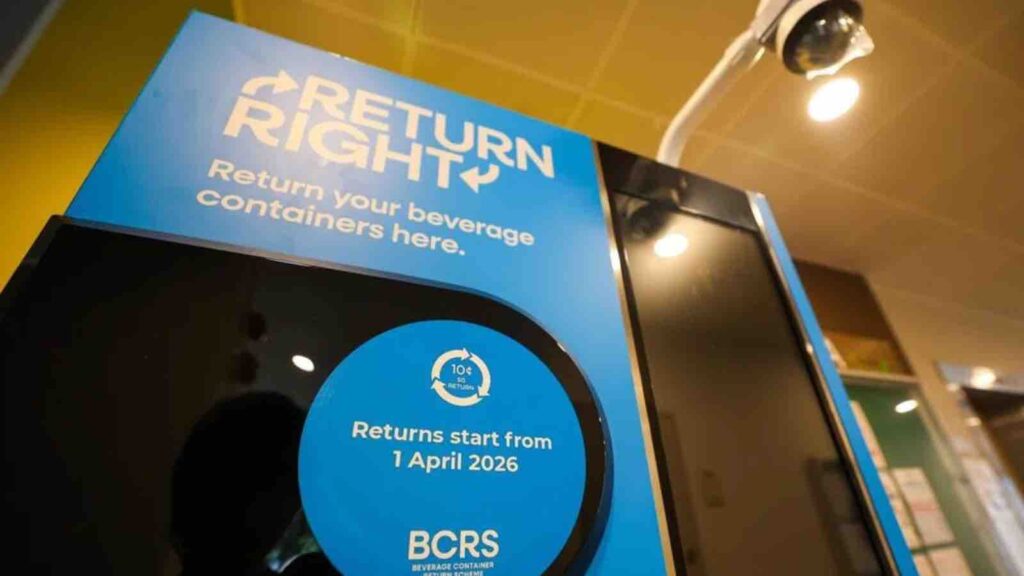

Nationwide Reverse Vending Machines aim to transform waste management and support circular economy.
Starting 1 April 2026, Singapore will introduce its Beverage Container Return Scheme (BCRS), requiring consumers to pay a S$0.10 deposit on pre-packaged drinks sold in plastic bottles and metal cans ranging from 150ml to 3 litres.
The deposit will be refunded when empty containers bearing a BCRS deposit mark are returned through a network of more than 1,000 Reverse Vending Machines (RVMs) installed at supermarkets, housing estates and other public locations. The scheme is designed to raise recycling rates, reduce waste and strengthen Singapore’s shift toward a circular economy.
RELEVANT SUSTAINABLE GOALS
How the Deposit and Refund System Works
Under the new policy, consumers will pay a 10-cent deposit per eligible beverage container at the point of purchase. The amount can be reclaimed by scanning and returning empty containers at designated Return Right machines.
Refunds will be issued digitally through EZ-Link cards, concession cards or DBS PayLah! wallets, providing a cashless incentive for participation.
Only containers displaying the official deposit mark will be accepted by the machines. Operators have emphasised that containers must be emptied before being returned, as RVMs are able to detect residual liquid and will reject items that are not fully drained.

Six-Month Transition Period May Cause Initial Confusion
From 1 April to 30 September 2026, both containers with and without the deposit mark will remain on retail shelves, creating a transition phase that recycling operators say could lead to confusion.
Some consumers may assume that all plastic bottles and metal cans are eligible for refunds, but only marked containers will qualify. SG Recycle founder and chief executive Mervin Ng noted that users may attempt to return ineligible containers during this period, only to have them rejected by the machines.
The deposit mark system will be fully implemented from 1 October 2026, when all qualifying beverage packaging is expected to carry the label.
Extensive Network of Return Points Across the Island
More than 1,000 reverse vending machines will be operational by April, with SG Recycle deploying around 380 units in northern and western areas such as Jurong and Clementi.
Return points will also be located at over 430 supermarkets and retail outlets, as well as at HDB void decks, hawker centres and major grocery chains including FairPrice and Giant.
Authorities estimate that more than 90 percent of Housing and Development Board households will be within a five-minute walk of a machine. Plans are in place to expand the network to 2,000 machines over time.
Operators involved in the rollout — including SG Recycle, TOMRA and RVM Systems — say public awareness campaigns will be critical to ensure smooth implementation.
Phil Parbury, operations director at TOMRA, said industry partners are working closely with BCRS Limited to ensure consumers understand how to identify eligible containers and claim refunds.
Singapore’s National Environment Agency (NEA) has also pledged to expand outreach efforts by deploying ambassadors, increasing publicity and distributing informational materials at stores and food and beverage outlets.
Lessons from a previous pilot scheme conducted by NEA and beverage company F&N Foods from late 2019 — which collected more than 16.5 million beverage containers — are being used to address issues such as misuse of machines and low awareness.
Targets to Match High-Performing Global Recycling Systems
The BCRS aims to achieve a minimum 60 percent return rate in its first year, with a longer-term goal of reaching 80 percent by 2029, according to NEA.
Dr Jovan Tan, a lecturer at the Engineering Design and Innovation Centre at the National University of Singapore, said meeting these milestones would place Singapore among the world’s leading deposit return systems.
Countries such as Norway, often cited as the gold standard, consistently achieve return rates of over 92 percent through similar schemes.
Recommended by a Citizens’ Workgroup in 2019, the BCRS represents Singapore’s second Extended Producer Responsibility (EPR) scheme, requiring beverage producers and retailers to ensure proper collection and recycling of packaging.
By encouraging consumers to return empty containers in exchange for a deposit refund, the system aims to increase recycling rates, reduce waste sent for disposal and create a cleaner stream of high-quality recyclable materials.
Similar producer-led schemes have been successfully implemented in countries such as Norway, Denmark and Lithuania, providing a model for Singapore’s approach.
As the BCRS takes effect nationwide, policymakers, industry operators and consumers alike will be watching closely to see whether the initiative can deliver the behavioural shifts needed to support long-term waste reduction and sustainable resource use.
Lead image courtesy of Lianhe Zaobao
You may also be interested in :
Taiwan To Launch Circular Label for Plastics and Textiles in March Under 2050 Circular Economy Plan