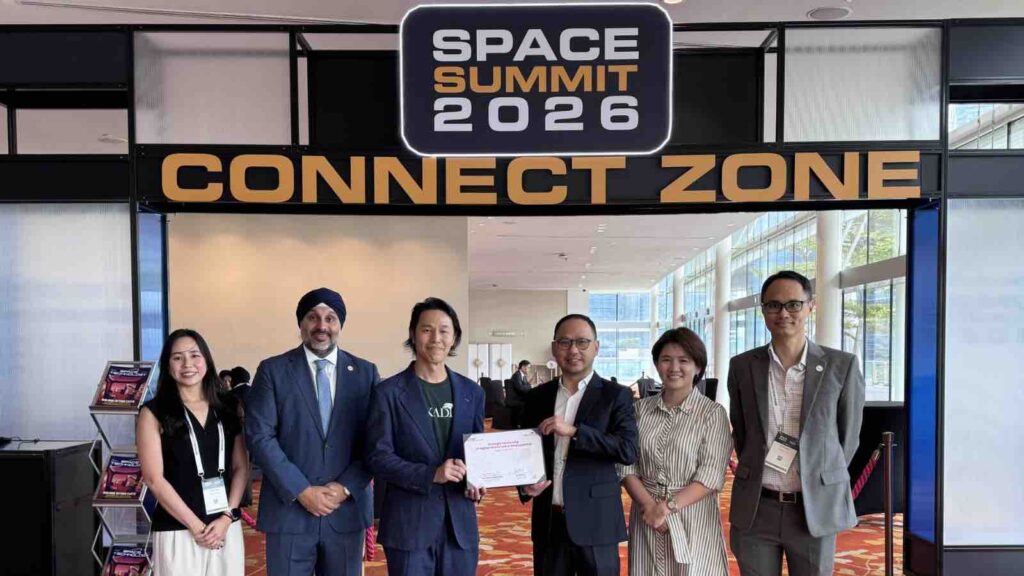

Arkadiah Technology and Golden Agri-Resources launch five-year project using satellites, LiDAR and AI to improve forest carbon transparency.
SINGAPORE — A new partnership unveiled at the inaugural Singapore Space Summit 2026 is aiming to reshape how forest carbon is measured in Southeast Asia, a region home to some of the world’s most complex and climate-critical tropical landscapes.
Arkadiah Technology and Golden Agri-Resources (GAR) announced a five-year strategic collaboration to advance forest carbon measurement using satellite technology, Light Detection and Ranging (LiDAR) and artificial intelligence. The project will focus on Indonesia, beginning with a landscape in West Kalimantan.
The initiative is supported by the Singapore Economic Development Board (EDB) and the Office for Space Technology and Industry Singapore (OSTIn).
RELEVANT SUSTAINABLE GOALS
Addressing a Regional Measurement Gap
Southeast Asia contains roughly 15 per cent of the world’s tropical forests, ecosystems that play a critical role in removing and storing carbon from the atmosphere. Yet widely used forest carbon measurement tools have often been developed for more uniform landscapes, making them less effective in the mosaic forest systems common across the region.
This limitation has created challenges for accurately evaluating forest carbon stocks and changes over time, raising concerns about transparency and credibility in forest carbon initiatives.
The partnership between Arkadiah and GAR seeks to address these gaps by deploying advanced Digital Monitoring, Reporting and Verification (DMRV) technologies tailored specifically to Southeast Asia’s ecological complexity.

Building Digital Twins of Tropical Forests
At the centre of the collaboration is the creation of high-resolution digital twins of forest landscapes. Using a combination of high-resolution satellite imagery, aerial and ground-based LiDAR scanning, AI-enabled geospatial modelling and hydrological assessments, the partners aim to establish scientifically rigorous baselines for land cover, biomass and carbon stock.
These three-dimensional forest models will be monitored over time, allowing changes in forest condition and carbon sequestration to be tracked with greater precision. The approach is designed to overcome the limitations of manual biomass measurements, which can be slow, costly and prone to error.
By strengthening measurement accuracy, the project aims to support forest conservation and restoration efforts while producing high-integrity carbon data.
A Five-Year Collaboration in Indonesia
The project announced at the Singapore Space Summit marks the start of a five-year collaboration, with initial implementation in West Kalimantan, Indonesia. The long-term timeframe is intended to enable continuous monitoring rather than one-off assessments, strengthening confidence in reported outcomes for both climate and nature.
Haryanto Kurniawan, Head of Carbon and Renewables at GAR, said the initiative reflects the need for data-driven climate action.
“Effective climate action must be guided by best-in-class data,” he said. “With Arkadiah’s technical capabilities and the support of EDB, we see an opportunity to improve transparency and integrity in measuring forest carbon while delivering real results for nature protection tailored to critical Southeast Asian landscapes.”
The initiative is supported under EDB’s Corporate Venture Launchpad programme, which is designed to help multinational companies build effective partnerships with startups.
As part of the collaboration, Arkadiah and GAR plan to jointly publish technical insights from the project, sharing methodologies and lessons learned to guide best practices in high-integrity forest carbon measurement and monitoring.
Reuben Lai, Chief Executive of Arkadiah, said the partnership reflects a broader ambition to raise standards across the region.
“We are proud to support GAR with advanced DMRV technologies that combine LiDAR, AI and satellite analytics,” he said. “This partnership reflects our commitment to raising the bar for high-integrity climate solutions across Southeast Asia.”
Strengthening Singapore’s Role in Carbon Services
EDB said the collaboration demonstrates how established companies and startups can work together to deliver globally relevant sustainability solutions.
Chen Yiwen, Vice President at EDB, said such partnerships strengthen Singapore’s position in emerging carbon services and climate technology.
“GAR and Arkadiah’s partnership shows how established companies can seamlessly work with startups in Singapore to innovate, stay competitive and produce high-quality solutions that serve global needs,” she said. “It also creates a repeatable model that can be applied across industries and markets.”
While the project is still at an early stage, its launch marks a notable milestone for forest carbon measurement in Southeast Asia. By combining space-based technologies, advanced analytics and long-term collaboration, the initiative aims to improve confidence in forest carbon data at a time when scrutiny of nature-based climate solutions is intensifying globally
Lead image courtesy of Golden Agri-Resources (Golden Agri-Resources and Arkadiah have signed a five year agreement to advance forest carbon measurement for Southeast Asia.
Pictured left to right: Cheryl Tan, Senior Manager, EDB; Dalvir Singh, Director, OSTIn; Reuben Lai, CEO, Arkadiah Technology; Haryanto Kurniawan, Head of Carbon and Renewables, Golden Agri-Resources; Chen Yiwen, Vice President, EDB; Bin Boon Song, Assistant Vice President, EDB)