New law safeguards 61,204 hectares of pristine reefs in the Pacific Coral Triangle, hailed as a lifeline for marine life and coastal communities. The Panaon Island Protected Seascape is expected to benefit both marine biodiversity and coastal communities that depend on the reefs for food security, tourism, and storm protection.
The Philippines has taken a historic step to protect one of its most biologically rich marine areas. On August 29, President Ferdinand Marcos Jr. signed into law the creation of the Panaon Island Protected Seascape, safeguarding 61,204 hectares (151,200 acres) of thriving reefs and surrounding waters off the coast of southern Leyte.
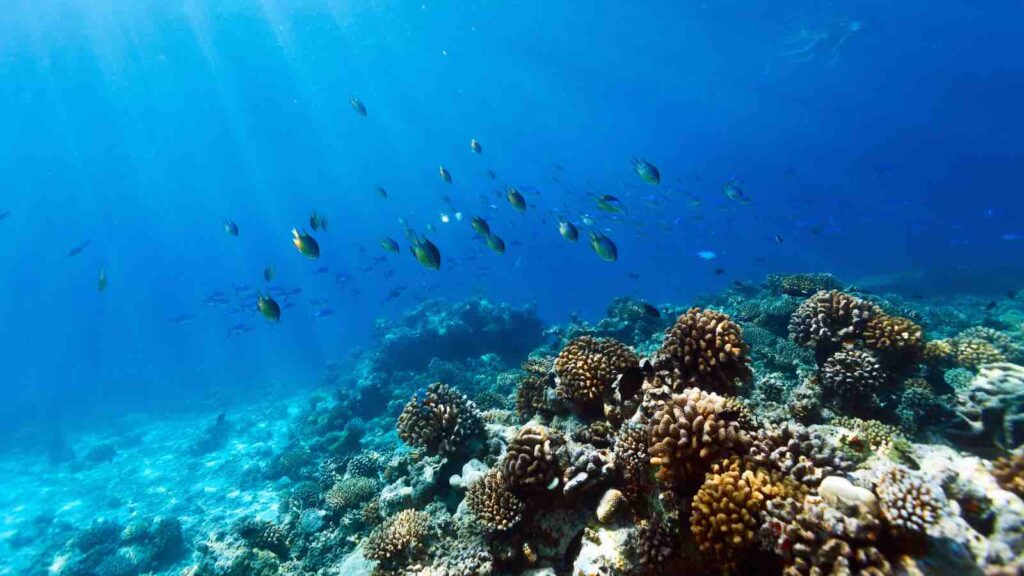
Panaon sits within the Pacific Coral Triangle, a region dubbed the “Amazon of the Sea” for its unmatched marine diversity. Scientists say the corals around the island are among the healthiest and most climate-resilient reefs in the world.
“This is one of the rare places where coral reefs remain in excellent condition, and we now have a chance to keep them that way,” said Von Hernandez, vice president of Oceana Philippines, which has long campaigned for the site’s protection.
RELEVANT SUSTAINABLE GOALS
Rich Life, Fragile Balance
In 2020, Oceana led a three-week scientific expedition that revealed coral cover around Panaon was three times the national average, supporting an abundance of fish and marine species. Yet researchers also documented plastic pollutionand traces of destructive fishing practices, raising concerns about the reefs’ long-term survival without legal protection.
The waters also serve as a migration route for whale sharks (Rhincodon typus) and are home to sea turtles and the endangered Philippine duck (Anas luzonica).
“Panaon is situated in an area known as a vital corridor for marine mammals,” said Nikka Oquias, Oceana’s marine protected area campaign lead. “Its waters are teeming with life and provide important breeding and nursery grounds for fish, allowing marine life and people to thrive.”
Local Push, National Action
The passage of the law follows years of local advocacy. In May 2025, the municipality of Pintuyan staged a cultural event calling on the national government to finalize the legislation. Earlier, the bill cleared the House of Representatives and the Senate in February but had awaited presidential approval.
“This is very important for us to strengthen protection of our marine resources, not only for us today but also for future generations,” said Ricarte Estrella, mayor of Pintuyan. “The passage of the law is an essential step to implement conservation measures to ensure long-term, well-managed ecosystems.”
The legislation introduces speed limits for ships and establishes clear zoning rules for fishing, tourism, and commercial activities. A Protected Area Management Board, made up of government agencies and local community representatives, will oversee enforcement.
Certain zones will be off-limits to all commercial activity under strict protection, while others will be managed for sustainable use, balancing conservation with livelihoods such as fishing and eco-tourism.
The Panaon Island Protected Seascape is expected to benefit both marine biodiversity and coastal communities that depend on the reefs for food security, tourism, and storm protection. Conservationists say the move could serve as a model for other coral-rich nations struggling to balance economic pressures with ecological survival.
For locals, it is a moment of pride and relief. As one community leader put it during Pintuyan’s cultural festival earlier this year, protecting Panaon’s reefs means “life for the sea, and life for us.”