
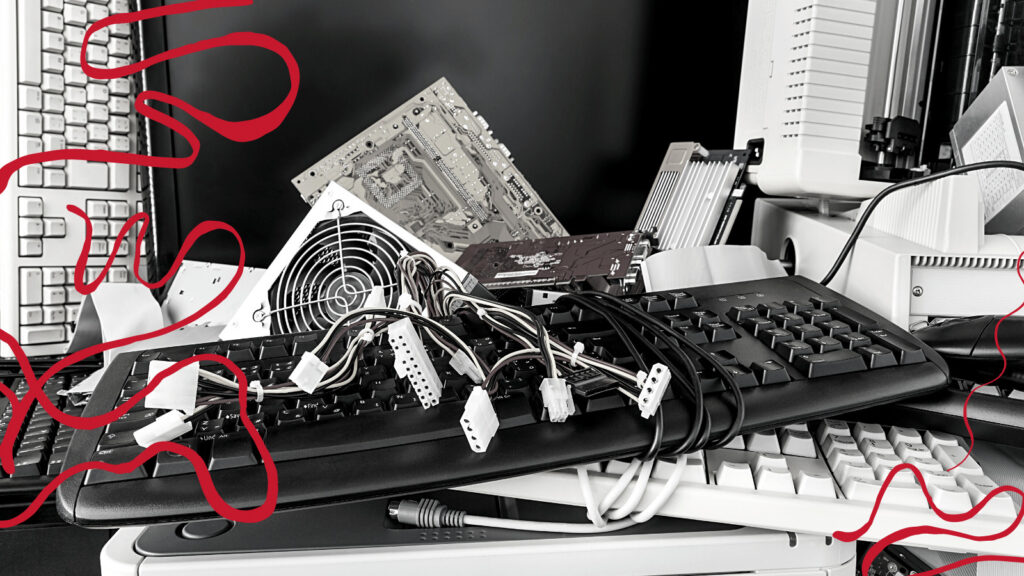

Global E-waste trade flows largely unregulated. The report estimates that 65 percent of cross-border e-waste movements — about 3.3 billion kilograms — occur without control, largely flowing from high-income countries to lower-income nations.
More than half of the world’s electronic waste is circulating across borders without proper oversight, according to The Global E-waste Monitor 2024, highlighting growing environmental and public health risks tied to the world’s fastest-growing waste stream.
The report estimates that 65 percent of cross-border e-waste movements — about 3.3 billion kilograms — occur without control, largely flowing from high-income countries to lower-income nations.
Most shipments move within and toward Europe and East Asia, often under the justification of recovering valuable materials from discarded electronics. Yet when these materials reach destinations with weaker waste management systems, they frequently end up handled by informal recycling sectors, where hazardous substances may be released into the environment.
Electronic waste can contain toxic materials such as mercury and brominated flame retardants, posing risks to both ecosystems and human health when improperly processed.
RELEVANT SUSTAINABLE GOALS
Global E-Waste Reaches 62 Billion Kilograms
The scale of the problem continues to expand rapidly. According to the report, the world generated 62 billion kilograms of electronic waste in 2022.
Yet only 13.8 billion kilograms were formally managed using environmentally sound methods.
Another 14 billion kilograms were dumped in landfills, while a large portion of the remainder is processed through informal recycling activities.
The study shows that 16 billion kilograms of e-waste were collected and recycled in formal systems in high-income and upper-middle-income countries with advanced waste management infrastructure. Meanwhile, around 18 billion kilograms were handled in lower-income countries that often lack sufficient recycling facilities, with much of the work carried out in informal sectors.
Waste managed outside formal recycling systems may not follow safe procedures, increasing the risk of toxic substances entering soil, water and air.

Cross-Border Waste Trade Requires Stronger Regulation
Researchers emphasize that clearer legal procedures are essential to distinguish between legal and illegal shipments of electronic waste.
Under the Basel Convention, a multilateral treaty regulating hazardous waste movements, cross-border shipments must follow a Prior Informed Consent procedure. This requires authorities in exporting countries to notify and obtain approval from authorities in destination or transit countries before shipments occur.
However, the process is sometimes seen as an administrative burden, which can weaken enforcement and oversight.
Indonesia Intercepts Illegal E-Waste Shipment
Concerns over the global movement of e-waste have recently surfaced in Indonesia.
In October 2025, the country’s Ministry of Environment discovered 73 containers of illegal electronic waste arriving from the United States at Batu Ampar Port in Batam.
Authorities confirmed the containers held hazardous waste classified as B107d (electronic waste) and A108d (hazard-contaminated waste). The contents included printer circuit boards, wire rubber, CPUs, hard disks and other used electronic components.
The Indonesian government plans to return the containers to their country of origin and pursue legal action against the companies involved.
“Besides administrative sanctions, the companies involved will face criminal penalties and fines as regulated under the Environmental Law,” said Rizal Irawan, Deputy for Environmental Law Enforcement at the Ministry of Environment.
Trade Agreement Sparks Debate Over E-Waste Risks
The issue has also become part of a broader policy debate linked to a trade agreement between Indonesia and the United States.
Within the Agreement on Reciprocal Trade (ART), Article 2.36 addresses “More Efficient Resource Use.” The provision states that Indonesia will encourage the recovery of critical minerals from waste.
The strategy includes developing regulations, infrastructure and technologies to expand the collection and recycling of electronic waste and used lithium-ion batteries.
Electronic devices contain important minerals such as nickel, cobalt, lithium, copper and rare earth elements, which can be recovered through recycling and used in a circular economy model aimed at reducing natural resource extraction.
However, critics warn that expanding recycling could also increase the risk of Indonesia becoming a destination for foreign electronic waste if safeguards are not carefully enforced.
Southeast Asia’s Growing E-Waste Challenge
Across Southeast Asia, the region is also facing rising volumes of electronic waste.
Data from The Global E-waste Monitor 2024, published by the United Nations Institute for Training and Research, shows that Malaysia produces an average of 12.2 kilograms of e-waste per person each year, the third-highest level in ASEAN.
This figure is significantly above the global average of 7.8 kilograms per person.
Within the region, Singapore produces the highest per-capita e-waste at 20.3 kilograms, followed by Brunei at 19.9 kilograms, while Thailand ranks fourth at 10.5 kilograms per person.
Many individuals in Malaysia are increasingly attempting to manage their personal “digital footprint” by paying closer attention to how they dispose of electronic devices.
Global E-Waste Rising Faster Than Recycling
The broader trend remains troubling. The United Nations reports that global e-waste generation is increasing five times faster than documented recycling.
Electronic waste production has already grown 82 percent since 2010, reaching 62 million tonnes in 2022. It is projected to climb another 32 percent to 82 million tonnes by 2030.
Despite the rising volumes, less than one quarter — 22.3 percent — of global e-waste was formally collected and recycled in 2022.
The result is a loss of valuable materials and increased environmental risk. The report estimates that US$62 billion worth of recoverable natural resources remains unaccounted for due to inadequate recycling systems.
Economic Opportunity in Better Recycling
Improving global recycling rates could bring significant benefits.
Researchers estimate that if countries increased e-waste collection and recycling rates to 60 percent by 2030, the economic and environmental benefits could exceed US$38 billion, including reduced health risks and improved resource efficiency.
At the same time, the world remains heavily dependent on a limited number of countries for rare earth elements, critical materials used in technologies such as renewable energy systems and electric mobility.
Recovering these materials from discarded electronics could play a key role in strengthening global supply chains while reducing environmental pressures.
As electronic consumption continues to rise worldwide, the challenge of managing e-waste responsibly is becoming one of the defining environmental issues of the digital age.
You may also be interested in :
From Junk To Lithium: How India’s E-Waste Boom is Powering A Critical Mineral Strategy