

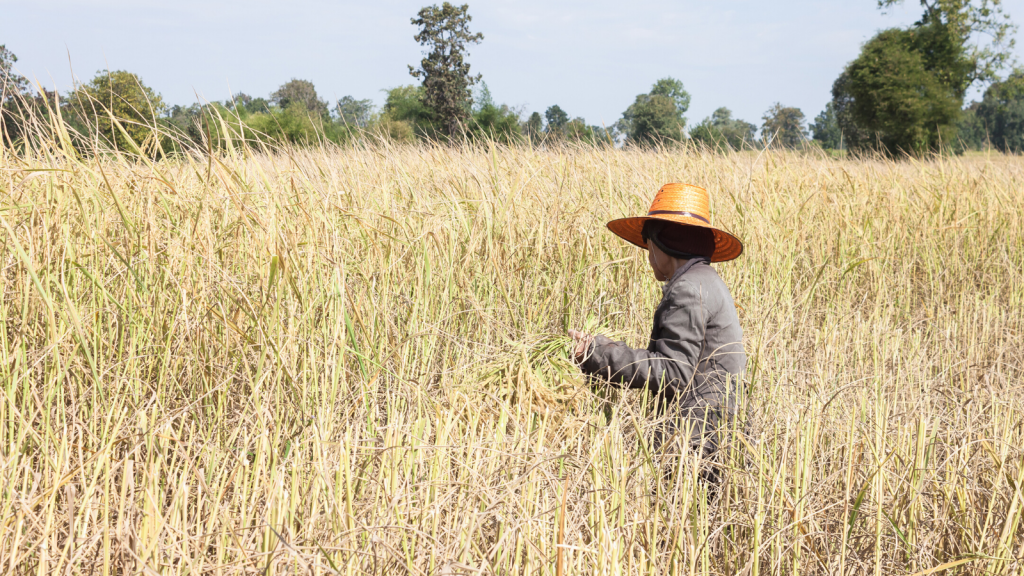

IUCN launched a new publication, titled “Agricultural support, biodiversity, and trade: Examining connections to repurpose harmful incentives,” which presented new findings on linkages between biodiversity trends and agricultural subsidies across multiple countries.
ABU DHABI — At the IUCN World Conservation Congress, the International Union for Conservation of Nature (IUCN) launched a new publication, “Agricultural support, biodiversity, and trade: Examining connections to repurpose harmful incentives,” finding a positive, statistically highly significant correlation between support to agricultural producers (per hectare of agricultural land) and the number of species threatened by agriculture(per hectare of country area).
RELEVANT SUSTAINABLE GOALS


The Numbers: Agriculture’s Global Footprint
Unveiled during a “Hot Off the Press” Forum event, the report asks:
- What is the relationship between support to agricultural producers, trade distortion, and threats to species?
- How can incentives be reshaped to be more biodiversity-friendly?
IUCN experts and economists presented cross-country findings that connect subsidy levels and agriculture-related species threats, while exploring how policy design can reduce ecological harm.

The publication’s results with a broad evidence base showing agriculture as a leading driver of land-use change and species decline:
- ~37% of the world’s land is devoted to agriculture.
- 34% of species assessed on the IUCN Red List of Threatened Species have agriculture documented as a threat.
At the same time, decades of agricultural policies and trade agreements have supported food security and poverty alleviation, while also increasing the intensity and geographic extent of production that pressures nature.
Not Either–Or: Food Security Depends on Nature
The report stresses that agriculture, food security, and nature are not inherently in tension. Agricultural productivity relies on ecosystem services—pollination, soil formation, water provision, and genetic diversity. Without intact systems, both agricultural output and global food security are at risk.
Bottom line: agricultural policies must look beyond output, trade distortion, and productivity to include nature and ecosystem services as core metrics—so food needs are met without sacrificing biodiversity, land health, or climate.
“It is only by decoupling food systems from the degradation of nature that we can hope to halt the loss of biodiversity by 2030 and achieve recovery and restoration by 2050. We need to mainstream biodiversity into agricultural policies to encourage more sustainable production practices"
Antonin Vergez,IUCN Senior Economist
The findings are directly relevant to global goals under the Kunming-Montreal Global Biodiversity Framework (KM-GBF):
- Target 18: Identify, eliminate, phase out or reform incentives harmful to biodiversity by at least US$500 billion per year by 2030.
- Targets 19 and Goal D: Repurposing harmful agricultural incentives can progressively close the US$700 billion per year biodiversity financing gap and improve biodiversity status while enabling Parties to meet their CBD commitments.
In short, eliminating perverse subsidies can both reduce pressures on species and unlock financing for conservation.
From Evidence to Action: A Call From IUCN
“It is only by decoupling food systems from the degradation of nature that we can hope to halt the loss of biodiversity by 2030 and achieve recovery and restoration by 2050. We need to mainstream biodiversity into agricultural policies to encourage more sustainable production practices,” said Antonin Vergez, Senior Economist at IUCN and lead author.
Vergez added that repurposing harmful incentives is “a crucial lever for biodiversity funding,” noting the political economy of reform is under-studied and often overlooked. He invited researchers, farmers, NGOs, and policy-makers to chart national and regional pathways that better align agricultural policy with biodiversity.
IUCN’s new publication connects the dots: where per-hectare producer support is higher, agriculture-driven species threats are higher. But it also outlines a path forward—retool incentives, embed ecosystem services in policy, and finance biodiversity by meeting KM-GBF Target 18. The prize is twofold: food systems that endure and nature that recovers.
