

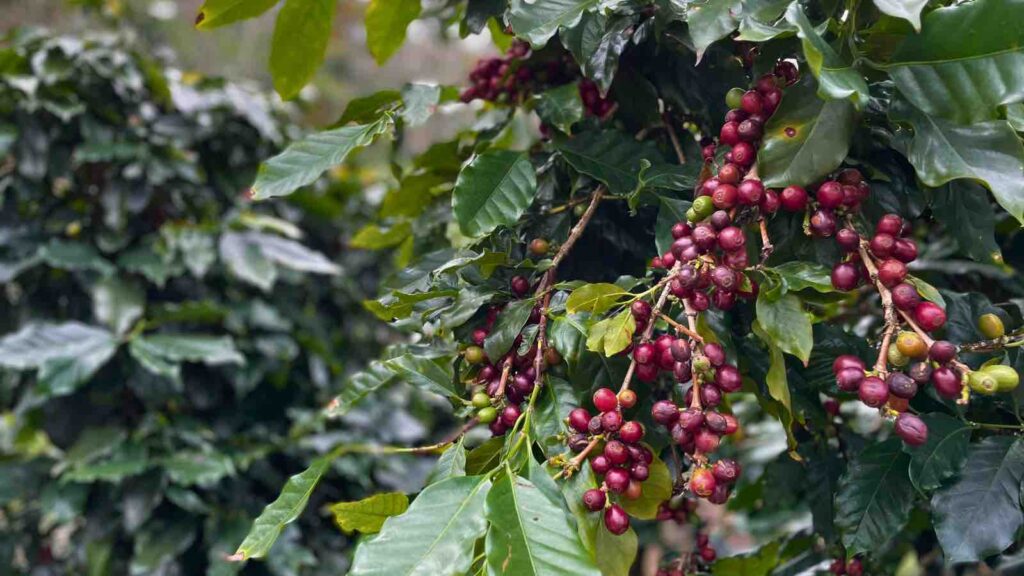

Research challenges the idea that robusta can protect the global coffee industry from climate change, finding that irrigation may be masking the crop’s vulnerability to drought in Brazil, Vietnam and India.
SAO PAULO — Robusta coffee has increasingly been presented as a potential answer to one of the coffee industry’s biggest problems: how to keep producing beans as the climate changes.
A new study challenges that assumption.
The research found that major robusta-producing areas in Brazil, Vietnam and India lack suitable climate conditions for growing the crop, while irrigation has helped conceal an important vulnerability: robusta may tolerate heat better than arabica, but it is intolerant of drought.
The findings, published late Thursday in the Wiley journal Sustainable Development, question previous assessments of robusta’s climate resilience and carry implications for farmers, traders and consumers as worldwide demand for the beans grows.
Aaron Davis, senior research leader of crops and global change at the Royal Botanic Gardens, Kew, and the paper’s lead author, described robusta’s reputation for greater climate resilience as an “internet myth” that emerged about a decade ago.
RELEVANT SUSTAINABLE GOALS

Robusta Has Become Central to the Climate Debate
Robusta has often been regarded as a cheaper filler compared with arabica beans, but its role in the global coffee market is substantial.
Tens of millions of bags are supplied to international markets every year, with the majority coming from Vietnam and Brazil.
Media organizations, farmers and researchers have frequently pointed to robusta’s ability to withstand heat as a reason it could help the coffee industry adapt to climate change.
Earlier studies have also suggested that the beans are more resistant to drought and could benefit farmers.
The new paper argues that earlier assessments of robusta’s resilience should instead be regarded as provisional at best.

Researchers Question How Earlier Studies Measured Resilience
One of the central issues raised by the research concerns how suitable growing conditions have previously been identified.
The paper cited research errors that included treating irrigated coffee farms as optimal growing areas.
That distinction matters because irrigation can provide coffee plants with water that their surrounding climate would not otherwise supply.
By looking more closely at that dependence, the researchers reached a different conclusion about robusta’s ability to withstand changing climatic conditions.
The study found that producers including Brazil, Vietnam and India lack climate suitability for robusta cultivation and rely on irrigation to provide sufficient water to the plants and maintain profitability.
Heat Tolerance Does Not Mean Drought Tolerance
The findings draw a distinction between two environmental stresses that can easily be conflated.
Robusta has greater heat tolerance than arabica. That does not mean it is resilient to a lack of water.
According to Davis, misunderstanding that difference helped establish the idea that robusta could serve as the coffee industry’s climate safeguard.
His criticism challenges a narrative that has gained importance as coffee-producing regions confront changing environmental conditions and the industry searches for varieties capable of maintaining production.
For robusta, the study suggests that heat tolerance alone cannot establish whether the crop will remain viable as the climate changes.
Irrigation sits at the center of the study’s reassessment.
The paper says irrigation can mask robusta’s drought intolerance while underpinning the profitability of production. That dependence creates its own risks.
Growers in some regions already face serious problems with the availability of water needed for irrigation, according to the study.
The researchers warned that relying on irrigation therefore carries inherent risks not only for the profitability of robusta production, but potentially for the crop’s survival.
Any expansion in robusta cultivation, the paper said, needs to account for those vulnerabilities.
Vietnam Says Climate Adaptation Is Already Urgent
The reassessment comes as major coffee-producing countries are already confronting the need to adapt.
Earlier this month, a Vietnamese coffee official told Reuters that responding to climate change was no longer a concern for the future but an urgent necessity to safeguard production.
That urgency gives the debate over robusta’s resilience practical consequences.
As global demand for the coffee grows, assumptions about where it can thrive and how much water it requires can affect decisions by producers and others across the market.
The new findings suggest those decisions need to consider both the crop’s ability to withstand heat and its vulnerability to drought.
For those advocating robusta as a way for coffee production to weather climate change, the paper presents a fundamental challenge.
Its conclusion is not that robusta lacks useful characteristics. The crop remains more heat-tolerant than arabica.
Rather, the researchers argue that its limitations must be recognized, particularly its dependence on sufficient water and the risks associated with irrigation.
For an industry seeking ways to maintain supplies over coming decades, Davis said the solution ultimately needs to go beyond relying on robusta’s perceived resilience.
You may also be interested in :
Climate Change is Adding 47 Days of Harmful Heat to Coffee Farms Each Year, And Prices Are Rising