
What should a company do when its single-largest source of emissions jumps by more than 20 percent due to a change in accounting rules?
That’s the unenviable challenge eBay is grappling with as it figures out how to report greenhouse gases generated by the trucks and airplanes that deliver goods sold on its platform — emissions that make up more than 80 percent of the company’s 2025 total footprint of 1.8 million metric tons of carbon dioxide equivalent.
None of the options that eBay has tried or is planning for are appealing: It can undergo an expensive restatement process, publish numbers that prevent apples-to-apples comparisons or risk being accused of understating its emissions. The situation is an example of the dilemma many companies face in accounting for Scope 3, which is often both the largest and the least-well–understood source of corporate emissions.
The origins of the problem
After an item is sold on eBay, sellers can print shipping labels direct from the platform. Thanks to this integration, FedEx and other carriers send eBay emissions estimates for those deliveries. If the carrier can’t provide data, eBay uses emissions factors to translate the weight of the package and distance traveled into what are known as “transport and distribution” emissions.
The emissions factors that eBay uses are developed by the Global Logistics Emissions Council (GLEC), which counts more than 150 companies, industry associations and independent experts as members. In 2023, some of those factors were increased, a consequence of new data showing that methane leaks during fossil fuel extraction and processing were higher than previously realized. When the new factors were applied to eBay’s 2024 data, emissions from shipping jumped 23 percent.
What eBay did
The original version of eBay’s 2024 impact report, published in May 2025, included the new numbers. This significantly changed the company’s Scope 3 trajectory.
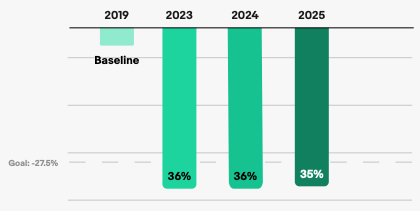
The year before, the company recorded a 36 percent drop in transport and distribution emissions since 2019, comfortably beating its goal of a 27.5 percent cut by 2030. After applying the new emissions factors, the reduction was 21 percent — still impressive, but not necessarily on track to hit the 2030 goal given that recent progress in cutting transport and distribution emissions has been slower. The change also muddled the data, because previous years’ disclosures were not recalculated using the new emissions factors.
The misalignment was noticed the following year as the sustainability team prepared eBay’s 2025 report, said Melissa Bauer, the company’s ESG and sustainability strategy lead. The 2024 report was updated using the earlier GLEC emission factors, with a footnote explaining that the change was intended to “facilitate comparability” with previous years. eBay’s 2025 report, released last month, also uses the older factors.
The company’s conundrum
The change means that readers of eBay’s reports can now make an apples-to-apples comparison of the company’s progress on Scope 3, which shows a significant and target-beating decline since its baseline year of 2019, followed by smaller increases in recent years.
eBay’s progress on transport and distribution emissions
It also means that the company is no longer using the latest science to estimate its emissions. Alan Lewis is chief technical officer at the Smart Freight Institute, the organization that oversees GLEC. He is sympathetic to eBay’s situation, noting that there are different interpretations of how Greenhouse Gas Protocol rules apply to the reporting of t
Read More