

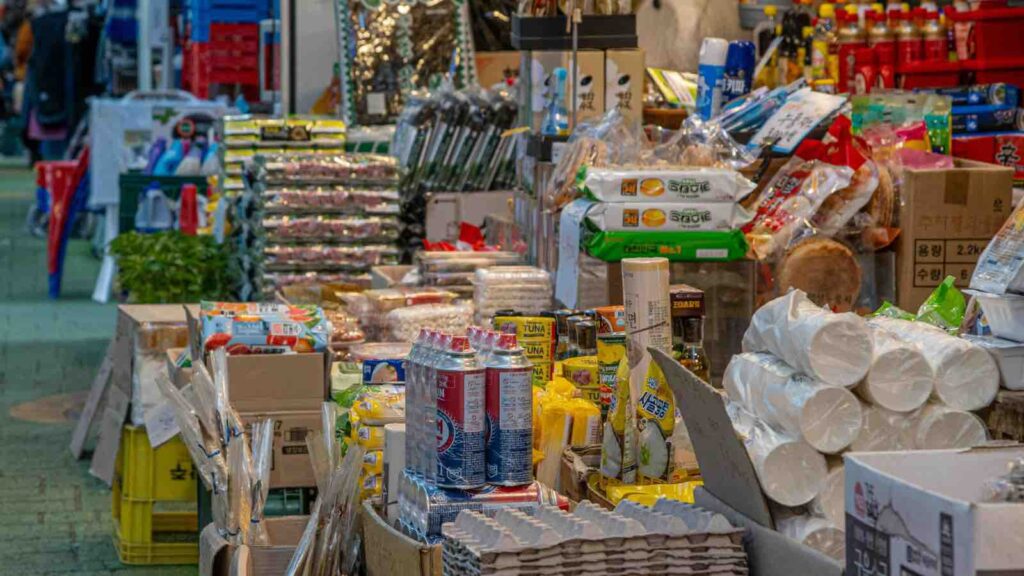

New study finds major retailers lag on methane emissions from food supply chains.
A new regional assessment has found that Asia’s leading supermarket chains are failing to address one of the most powerful drivers of climate change: methane emissions from food systems.
The study, conducted by Mighty Earth, evaluated major retailers across China, Japan, South Korea and Singapore, and found widespread gaps in how companies measure, report and reduce methane emissions tied to meat, dairy and rice products.
Among the companies assessed were DFI Retail Group, Sun Art Retail Group, Walmart China, AEON, Seven & i Holdings, FairPrice Group, Emart and Lotte Shopping. Across all eight retailers, the findings were consistent: none have set methane reduction targets or publicly disclosed methane emissions linked to their food supply chains.
RELEVANT SUSTAINABLE GOALS
A Potent Greenhouse Gas Largely Overlooked
Methane remains a critical but under-addressed climate risk.
The gas is about 80 times more powerful than carbon dioxide over a 20-year period, making it one of the fastest levers to slow near-term global warming. Yet the study found that none of the retailers assessed have formally acknowledged methane as a major component of their climate footprint.
Despite the existence of the Global Methane Pledge — which aims to reduce global methane emissions by at least 30 percent from 2020 levels — none of the companies have aligned their strategies with its targets.
The report also highlighted broader gaps, including weak transparency in emissions reporting, limited promotion of alternative proteins and a lack of action on methane linked to food waste.

Food Systems Driving Asia’s Methane Challenge
The findings come at a time when methane emissions from food production are becoming increasingly urgent across Asia.
In 2023 alone, the region emitted an estimated 4.58 billion tonnes of carbon dioxide-equivalent methane emissions.
Livestock agriculture accounts for roughly 32 percent of human-caused methane emissions globally, making meat and dairy supply chains a central concern. Demand for these products is expected to rise sharply, with the Food and Agriculture Organization and the Organisation for Economic Co-operation and Development projecting that meat and seafood consumption in Asia will increase by 78 percent by 2050.
Rice production adds another layer of complexity. Asia produces and consumes about 90 percent of the world’s rice, and flooded paddy cultivation contributes around 10 percent of global human-caused methane emissions — approximately 60 million tonnes annually.
Benchmark Reveals Limited Progress Across Retail Sector
The study represents the first regional benchmark assessing supermarkets’ role in tackling methane emissions.
Seven of the eight retailers scored below 80 percent of the total available points, with overall performance described as lacking ambition.
Japan-based AEON ranked highest, but scored just 20.5 out of 100, reflecting limited progress despite acknowledging methane’s climate impact. No concrete reduction measures have yet been implemented.
Seven & i Holdings scored 9 out of 100, placing it in the middle of the ranking.
At the bottom, FairPrice Group received a score of zero across 20 indicators, which the report described as a “total absence of action” on methane emissions and support for plant-based alternatives.
None of the retailers assessed had a publicly available deforestation- and conversion-free policy, despite the link between meat and dairy production and environmental degradation.
Transparency and Diet Shifts Seen as Key Levers
The report argues that supermarkets are uniquely positioned to influence both supply chains and consumer behavior.
Among its recommendations is a shift toward a 60 percent plant-based and 40 percent animal-based protein sales ratio by 2030. If alternative proteins reach 11 percent of the global protein market by 2035, emissions reductions could match those achieved by fully decarbonizing the aviation sector.
However, the study found that none of the retailers are actively driving plant-based sales at scale, representing what it describes as a missed opportunity.
Transparency is identified as a critical first step. The analysis, based entirely on public disclosures including company reports and the Science Based Targets initiative database, evaluates accountability through what companies choose to report.
The gap between national commitments and corporate action is also evident.
Japan, South Korea and Singapore are signatories to the Global Methane Pledge, while China has not yet published specific methane reduction targets. Yet across all four markets, retailers have not translated these commitments into measurable corporate strategies.
The report warns that as Asia’s consumption patterns evolve — particularly with rising meat demand — the region’s role in global methane emissions will continue to grow unless action accelerates.
A Critical Moment for Climate Accountability
The study arrives as global temperatures continue to rise and methane is increasingly recognized as a key driver of near-term warming.
“Rapidly cutting this greenhouse gas is one of the fastest ways to put the brakes on global warming,” said Meihua Piao of Mighty Earth.
The findings suggest that without stronger action from major retailers — particularly on transparency, target-setting and supply chain transformation — methane will remain a significant blind spot in Asia’s climate strategies.
For a region already warming at roughly twice the global average, the stakes are rising.
You may also be interested in :
Shenzhen’s Smart Food Banks Go Viral By Turning Surplus Into Support