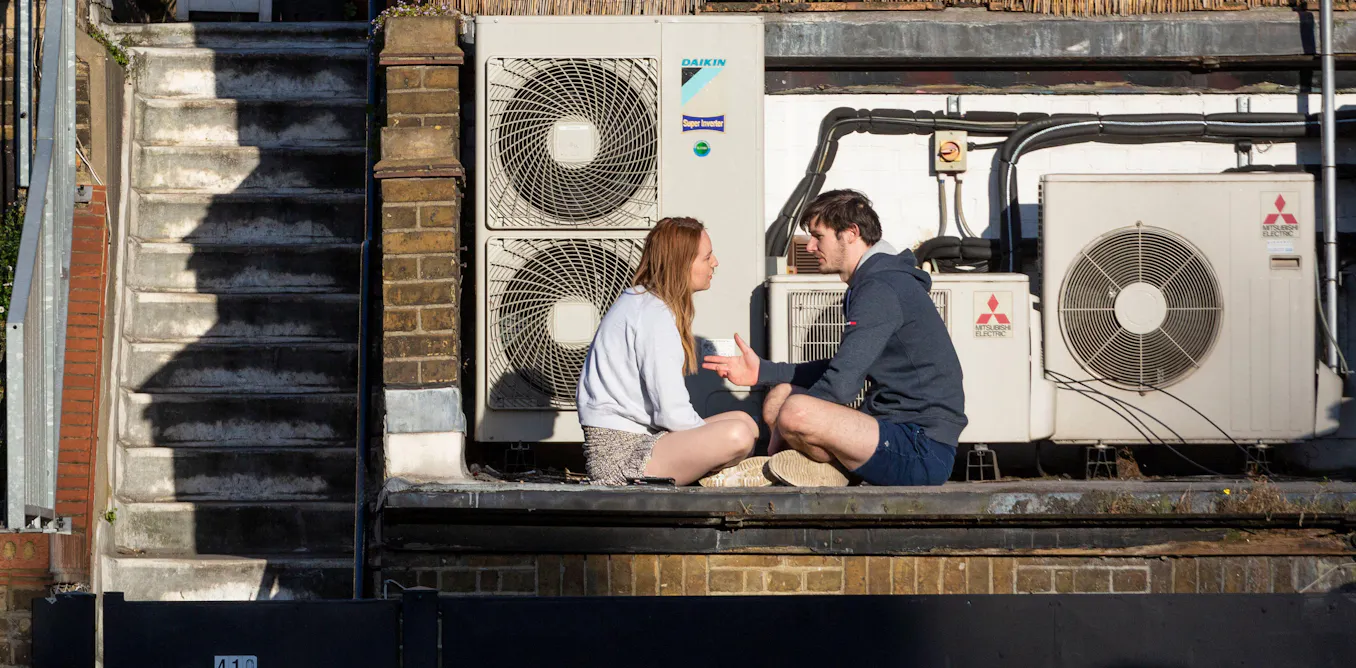

For decades, people in the UK tended to view air conditioning as something that belonged elsewhere. It was associated with office buildings, hotels and hotter countries rather than their own homes. But as summers become warmer and heatwaves more frequent, that picture is beginning to change.
Colleagues and I analysed data from the English Housing Survey, a nationally representative sample of about 16,000 households. This shows that air conditioning remains relatively uncommon, with just 4.3% of households using it in summer. That’s far below countries such as the US (nearly 90%) and Australia (around 75%).
Yet beneath this modest national average lies a far more revealing picture. Air conditioning is not spreading evenly across society. Instead, England is beginning to develop a cooling divide, one in which access to protection from extreme heat increasingly depends on where people live, how much they earn and the type of home they occupy.
During in-depth interviews we conducted with air conditioning users in the UK, people rarely described it as a luxury. Instead, they spoke about trying to sleep through hot nights, remain productive while working the next day, or protect babies or elderly relatives from dangerously high temperatures.

The geography of this emerging divide is immediately apparent. London and the east of England have by far the highest levels of residential air conditioning, followed by the East Midlands and the south-east. Northern regions remain much less likely to use cooling.
These patterns are hardly surprising. London experiences both warmer summers and a stronger urban heat island effect, where buildings and hard surfaces trap heat long after sunset. But these regional differences also show how the ability to adapt to a warming climate is likely to be distributed unevenly.
Economic inequalities are equally visible. Households in the highest income group are more than twice as likely to own air conditioning than those on the lowest incomes. Installing and running air conditioning is expensive, making it far more accessible to wealthier households.
As with the higher temperatures, those wealthier households who are more easily able to absorb the cost of air conditioning are also highly concentrated in London and the south-east.
Vulnerable groups at risk
Perhaps the most concerning finding is that several groups most vulnerable to heat currently have relatively low access to air conditioning.
Older people, lone-parent households and many lower-income families are among those least likely to use it, despite facing greater health risks during periods of extreme heat. Social and private renters also lag behind owner-occupiers, reflecting barriers such as upfront costs, landlord permissions and practical constraints on installation.
The picture is not entirely negative. Some vulnerable groups are adopting air conditioning at higher rates than the wider population. Households with babies, young children, disabled people and those living with long-term health conditions are all more likely to use air conditioning.
Given the well-established health risks that high temperatures pose for these groups, this is encouraging. It suggests that many households are taking proactive steps to protect their health.
However, this introduces another challenge. Since air conditioning uses lots of electricity, vulnerable families may find themselves f
Read More