


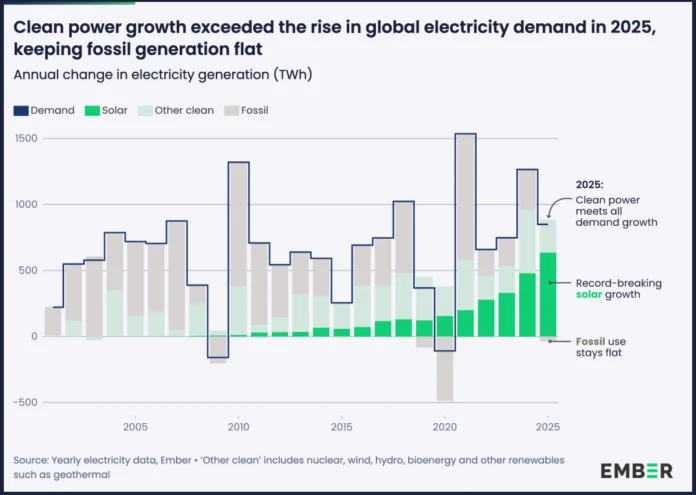
The surge in renewable electricity has been driven primarily by solar energy, which recorded its largest annual increase ever.Solar generation rose by about 636 terawatt-hours in 2025, with output growing roughly 30 percent over the year. This made solar the single biggest contributor to new electricity supply globally. According to Ember, solar alone met about 75 percent of the net increase in global electricity demand.
For the first time in history, renewable energy has overtaken coal as the world’s largest source of electricity generation.
According to new analysis by Ember, renewables accounted for more than a third of global electricity in 2025, while coal’s share fell below one-third. The shift marks a structural change in how the world produces power — and signals that clean energy is no longer peripheral, but central to the global energy system.
The milestone comes after years of investment and rapid technological scaling, reflecting how renewable energy has reached a level of deployment capable of competing directly with fossil fuels.
RELEVANT SUSTAINABLE GOALS




Solar Power Leads Record Growth in Clean Energy
The surge in renewable electricity has been driven primarily by solar energy, which recorded its largest annual increase ever.
Solar generation rose by about 636 terawatt-hours in 2025, with output growing roughly 30 percent over the year. This made solar the single biggest contributor to new electricity supply globally. According to Ember, solar alone met about 75 percent of the net increase in global electricity demand.
Wind energy also played a significant role, and together, solar and wind met approximately 99 percent of new global electricity demand growth in 2025.
“Record solar growth meant clean power sources grew fast enough to meet all new electricity demand in 2025, thereby preventing an increase in fossil generation,” the report noted — marking the first year since 2020 without a rise in fossil fuel-based electricity generation, and only the fifth such year this century.
Behind this expansion is a steep decline in costs. Over the past decade, solar module prices have fallen by more than 80 percent, making it one of the cheapest sources of new electricity in many markets.

Asia Drives the Global Shift to Renewables
Much of the momentum behind this transition is coming from Asia, particularly China and India.
China accounted for about 55 percent of global solar growth in 2025, underscoring its continued dominance in renewable energy deployment. The United States contributed around 14 percent, while India also significantly expanded its renewable capacity.
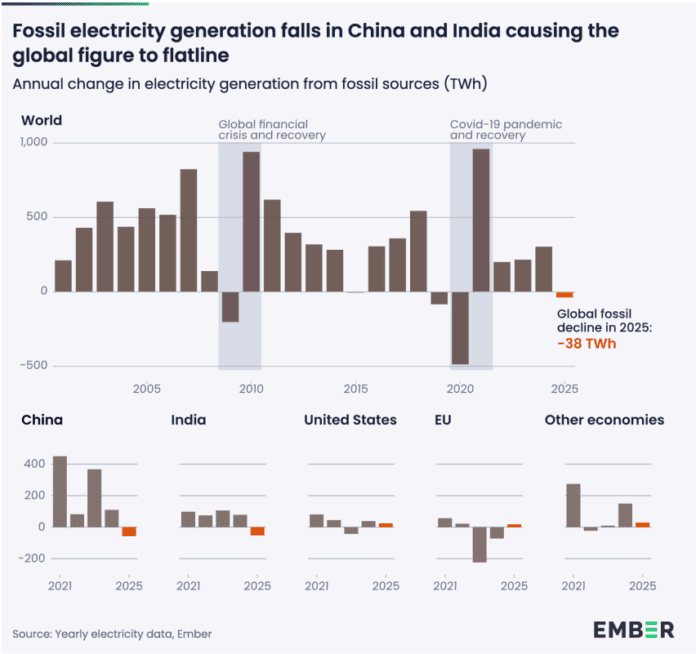
A notable development in 2025 was the simultaneous decline in fossil fuel generation in both China and India — a rare occurrence that played a key role in the global shift.
Coal generation dropped by 63 terawatt-hours worldwide, largely due to reduced output in these two countries. Together, China and India represent roughly one-fifth of global electricity demand and more than one-fifth of power-sector carbon dioxide emissions, amplifying the global impact of their transition.
Emissions Begin to Stabilize Despite Rising Demand
Even as electricity demand increased by about 2.8 percent in 2025, emissions from the power sector declined slightly.
Ember’s analysis shows that without the growth of solar and wind, emissions would have been approximately 236 million tonnes of carbon dioxide higher. The average emissions intensity of electricity generation fell to 458 grams of CO₂ equivalent per kilowatt-hour in 2025, down about 2.7 percent from 471 grams in 2024.
Projections from the International Energy Agency suggest this trend will continue. Global electricity emissions intensity is expected to decline from 445 grams of CO₂ per kilowatt-hour in 2024 to about 400 grams by 2027 — an average annual reduction of 3.6 percent.
The Grid Challenge: Managing Variable Energy Sources
The rapid expansion of renewables is introducing new challenges for power systems.
Solar and wind are variable energy sources, dependent on weather conditions. By 2030, they are expected to supply nearly 30 percent of global electricity, roughly double current levels. This will require more flexible and resilient grid systems. Key solutions include expanding grid infrastructure, increasing energy storage capacity, and improving demand-side management.
Battery storage is emerging as a critical component. Costs fell by about 45 percent in 2025 to around $70 per kilowatt-hour, while installed storage capacity additions rose by 46 percent to approximately 247 gigawatt-hours.
These systems already allow about 14 percent of solar generation to be shifted from midday to other times of the day, improving grid stability and reducing reliance on fossil fuel backup.
Major corporations are also playing a role in scaling renewable energy.
Microsoft has committed to using 100 percent renewable electricity and aims to become carbon negative by 2030. Googleis investing heavily in solar and wind projects worldwide, including partnerships in Asia to support clean energy supply for data centers.
These commitments are helping to drive demand for renewable energy and support investment in new infrastructure.
Implications for Carbon Markets and Investment
The rise of renewables is reshaping carbon markets and investment strategies.
As renewable generation expands, reliance on fossil fuels declines, reducing emissions and potentially affecting demand for certain types of carbon credits. At the same time, new opportunities are emerging in areas such as grid stability, energy storage, and renewable integration.
Investors are increasingly shifting toward clean energy infrastructure as falling costs and policy support improve the economics of renewable projects.
The fact that renewables have surpassed coal in global electricity generation marks a defining moment for the energy transition.
It signals that solar and wind are now growing fast enough to meet rising demand while reducing dependence on fossil fuels. While challenges remain — particularly around grid integration and storage — continued innovation and investment are helping to address them.
For policymakers, businesses, and investors, the message is clear: the transition to clean energy is no longer theoretical. It is underway, reshaping the global power system and setting the course for a more sustainable energy future.