


A catastrophic glacial collapse and debris flow swept through Himalayan communities near the Nepal-China border, leaving hundreds missing, destroying roads and bridges and prompting an international rescue effort.
UDIN DHUNGA, Nepal — A massive flash flood and mudslide has killed at least 160 people along the Nepal-Tibet border and left hundreds of tourists, workers and local residents missing after a torrent of water, mud and debris tore through Himalayan communities with little warning.
Nearly 24 hours after the disaster, Nepalese police reported at least 157 deaths. China’s state broadcaster CCTV reported another three people dead and 265 missing in Gyirong County in Tibet, near the international border. Xinhua reported significant casualties.
In Nepal, authorities said 403 people were missing, including 341 foreign nationals. Many were tourists and pilgrims visiting a mountainous region that draws hikers and climbers from around the world and serves as an important route for pilgrims travelling to Mount Kailash in Tibet.
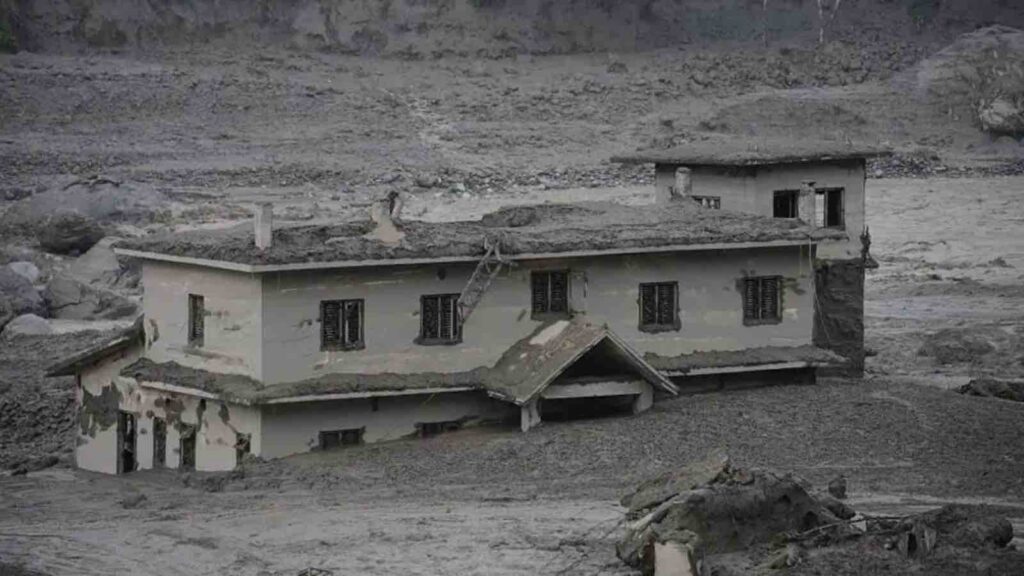
Drone footage revealed roads torn apart and buildings buried beneath cement-colored mud. In Nepal’s hard-hit Nuwakot district, images showed mud reaching what appeared to be the second floors of buildings, while vehicles lay buried and debris hung from trees and wires.
There was little time to escape.
RELEVANT SUSTAINABLE GOALS


A Wall of Water and Mud Sweeps Through Himalayan Communities
The Bhotekoshi flooded at around 9 a.m. Wednesday, Aug. 26, destroying several villages and hydropower projects in Nepal’s Rasuwa region.
CCTV footage from Tibet captured a wall of water and mud striking buildings at a border crossing.
Keshav Prasad Baral, 68, described seeing a “huge gush of mud coming straight towards us.” Speaking to Reuters while receiving treatment at a small hospital, Baral said the water continued rising until it entered his home. He tried to hold his wife’s hand, but she was swept away.
The mud eventually reached the top floor of the house before subsiding about an hour later. A helicopter arrived four or five hours afterward and rescued him.
Another woman said her family was swept away in front of her. She and her son survived by climbing onto a rooftop.
In Dhunge bazaar, resident Shoyam Rajbhandari said the flood devastated the market within half an hour as people were preparing to leave for work.
“How many people are missing or dead, we don’t know,” he said.
entire nation was “shocked and deeply distressed.”

Hundreds of Foreign Tourists and Pilgrims Are Missing
The missing include travelers from countries across the world.
Nepal Tourism Board spokesperson Sunil Sharma said 133 Indian nationals were missing while making a pilgrimage to Mount Kailash in Tibet, a sacred site for Hindus. Another 47 were from the United States, 34 from Australia, 33 from Britain and 24 from Canada.
Earlier figures had put the missing at more than 100 Indians, 54 Americans, 34 Australians and 33 Britons, alongside more than 100 Nepalese.
The U.S. State Department said it was aware of Americans affected by the disaster.
South Korean officials said nine citizens working on the construction of a hydropower plant in Nepal were among those reported missing. Malaysia’s foreign ministry said travel agencies had lost contact with 11 Malaysians believed to have been in Rasuwa district, while Russia’s embassy in Nepal said four Russian citizens reportedly in the affected area were missing.
Rasuwa was particularly busy because the local Janai Purnima festival was approaching on Friday. At least 62 missing Nepalese were among hundreds of local people trekking around Gosaikunda Lake.
Although the current monsoon period is less favorable for general trekking in Nepal, it is an important season for Mount Kailash journeys following the route through Rasuwa.
Police, Soldiers and Power Workers Among Those Unaccounted For
The missing are not limited to travelers and residents.
Dozens of Nepalese police officers and army personnel, as well as power workers, were reported missing. Nepal police spokesperson Abi Narayan Kafle said at least 28 police officials remained unaccounted for.
The disaster also severed vital transportation links in a region where steep valleys function both as travel corridors and economic lifelines.
At least 19 bridges and nearly 40 kilometers, or 25 miles, of road were swept away.
Authorities warned residents in several districts to stay away from the banks of the Trishuli, Bhotekoshi and Narayani rivers as rescue operations continued.
The eventual death toll was expected to rise as teams searched the devastated area.
What Looked Like an Earthquake Was a Glacial Collapse
Authorities initially suspected that an earthquake might have preceded the flooding.
The U.S. Geological Survey first reported a magnitude 4.4 earthquake early Wednesday about 66 kilometers, or 41 miles, north of Kathmandu near the border.
Its subsequent analysis reached a very different conclusion.
The agency said no earthquake had occurred. Instead, the seismic energy had been generated by a landslide, with its updated assessment identifying a magnitude 5.2 glacial collapse that sent debris downstream with catastrophic consequences for communities below.
The conclusion was based on information from nearby seismic stations, long-period seismic waves and satellite imagery. Experts are continuing to reconstruct the precise sequence of events.
The Kathmandu-based International Centre for Integrated Mountain Development said an avalanche from a glacier was likely responsible for the flash flood. Hydrological observations showed the exceptional speed and scale of the flood wave, with the Trishuli River rising by as much as nine meters, or 27 feet, in half an hour at one location.
The Lhende Khola River, a tributary of the Bhotekoshi, experienced maximum flooding.
Saswata Sanyal, a disaster risk reduction specialist at the climate research group, said the Lhende Khola had flooded twice in 14 months. This event, he said, was triggered by an ice-rock avalanche from a glacier on the Nepalese side that blocked the river before releasing a sudden surge downstream.
Climate Change Raises Questions, but Attribution Is Too Early
The disaster has renewed attention on the growing hazards confronting the Himalayas as temperatures rise.
Scientists know that climate change is accelerating glacier melt in parts of the Himalayan region, but they cautioned that it remains too early to determine its specific role in this disaster.
The Himalayan mountain range stretches across several South Asian countries and contains many of the world’s highest mountains and remaining glaciers. Its steep slopes and valleys are particularly vulnerable to floods and landslides.
Extreme events including intense monsoons and glacier melting have become more common amid warming caused by human-driven climate change.
Research published in Kathmandu earlier this year found that glaciers across the Hindu Kush Himalaya region are melting more rapidly, with rates of ice loss doubling since 2000.
The affected border region has experienced similar danger before.
In August last year, a glacial lake in Tibet overflowed amid high temperatures, triggering flash floods that killed nine people and damaged critical infrastructure, including a bridge connecting Nepal and China.
Sanyal said the latest disaster underscored the importance of early-warning systems in “a warming Himalaya.”
You may also be interested in :
Climate Warning Need to be Told in A Tangible Ways to Prevent Disaster