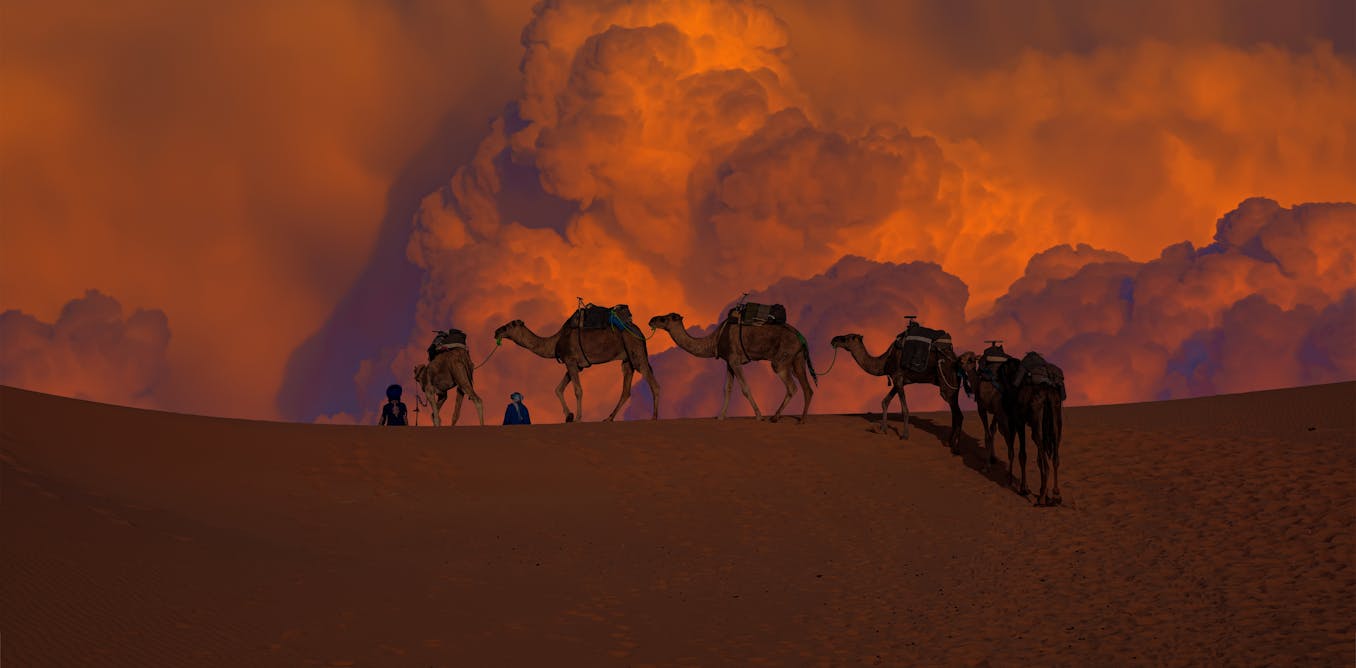
When Saharan dust reaches the UK and Europe, as a huge country-sized cloud did over the past few days, it can transform the sky. Tiny particles drifting in the atmosphere scatter blue light while allowing reds and oranges to reach us intact, producing beautiful sunsets.
But these striking displays are also a reminder of how connected the Earth is. Dust drifting over my head in England may have rested on the dry surface of the Sahara for thousands of years, before a burst of wind lifted it into the atmosphere and carried it thousands of kilometres north.
In spring, the massive temperature difference between the already-hot Sahara and still-snow-covered mountains in Europe can generate powerful low-pressure systems that sweep dust northwards.
But these familiar weather systems are not actually responsible for most Saharan dust. Instead, much of it is produced by a special kind of desert thunderstorm – a process that climate models struggle to simulate.

When faced with the question of how dust outbreaks will change as the climate warms, simulations from the latest generation of climate models suggest Saharan dust emissions could increase by up to 13% by the end of the century. If winds blow in the right direction, that could mean more dust reaching Europe.
However, the real story of how Saharan dust is generated is more complicated – and much more interesting.
Hunting the world’s biggest dust source
Some 20 years ago, colleagues and I travelled to one of the most remote places in the Sahara: the Bodélé Depression in Chad. A satellite that was intended to measure ozone also, by accident, seemed capable of measuring dust – and suggested this basin might be the world’s single biggest source of airborne dust.
At that time, there were no direct meteorological measurements – so we installed instruments across the desert to measure winds and atmospheric conditions. We discovered an astonishing wind concentrated between the Tibesti and Ennedi mountains, which we called the Bodélé low-level jet.
Near the Earth’s surface, the wind there regularly exceeded 16 metres per second – a “moderate gale” in the Beaufort wind scale, easily strong enough to lift vast quantities of fine sediment into the atmosphere.
These winds explain why Bodélé is such a big dust source. There are many such low-level jets across the Sahara, but none as grand as this one.
Nowadays, climate models can simulate these jets. While they typically underestimate their strength, these are tolerable errors – the model at least simulates the mechanism that makes the dust.
However, in the early 2010s, when we turned our attention to summer dust storms elsewhere in the Sahara, the story became far more surprising.
The hidden storms that raise most Saharan dust
During summer, the largest sources of dust shift westwards to countries like Algeria, Mali, Niger and Mauritania. To understand what drives these emissions, we deployed around 30 tonnes of meteorological equipment across the region, with the assistance of the Algerian meteorological service.
This produced some enthralling results – most notably: around 80% of Saharan dust emissions in summer are produced by thunderstorms.
These are special thunderstorms. Because the Saharan air is so dry, clouds often sit more than five kilometres above the surface. Rain falling from these storms usually evaporates long before it reaches the ground.
The evaporation cools the surrounding air, which becomes dense and plunges downwards, spreading out rapidly when it hits the surface. As it
Read More