

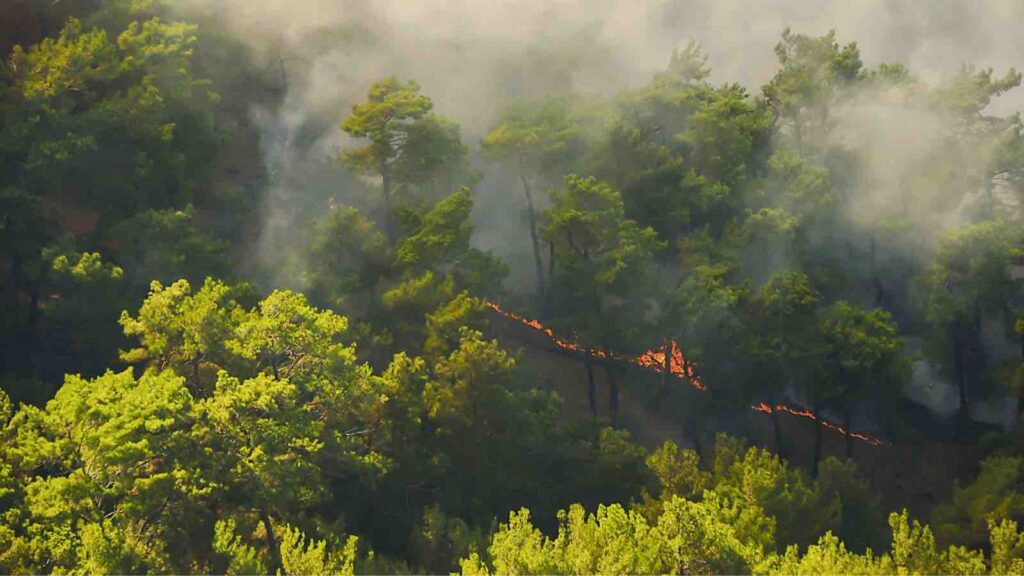

WALHI says 74% of Kalimantan hotspots are inside corporate concessions, while West Kalimantan smoke has reached Sarawak.
PONTIANAK, Indonesia — Kalimantan has become the epicenter of Indonesia’s forest and land fires through August 2026, with tens of thousands of hotspots recorded across the island and worsening haze pushing air quality in Pontianak into unhealthy territory.
The Indonesian Forum for the Environment, known as WALHI, recorded 34,262 hotspots and 33,837 hectares of burned land across Kalimantan from January through July 2026.
About 74 percent of the wildfire hotspots were detected inside corporate concession areas, according to WALHI, prompting calls for permits to be revoked and tougher law enforcement.
The Indonesian government, however, says fires within concession areas have actually declined because of legal sanctions and technical interventions, including the construction of canal blocks. Fires on small-scale community land, meanwhile, still frequently escape monitoring.
The consequences have extended beyond Indonesia. Smoke from forest and land fires in West Kalimantan was reported to have crossed the international border into Sarawak, Malaysia, from early to mid-August 2026.
RELEVANT SUSTAINABLE GOALS


Pontianak Air Quality Reaches Unhealthy Levels
The deteriorating fire situation has become an immediate public health concern in Pontianak, the capital of West Kalimantan.
On Thursday morning, Aug. 20, Pontianak recorded the worst air quality in Indonesia, according to IQAir monitoring data.
At 6:56 a.m. Western Indonesian Time, the city registered an Air Quality Index of 191, placing its air in the “Unhealthy” category. The concentration of PM2.5 reached 112 micrograms per cubic meter, or 22.4 times the air-quality standard established by the World Health Organization.
PM2.5 consists of airborne particles smaller than 2.5 microns, commonly originating from motor vehicles and factories. The particles are so small that they can be absorbed into the bloodstream through breathing and typically pose the greatest health threat.
With Pontianak’s air classified as unhealthy, IQAir recommended that residents avoid outdoor activities, keep windows closed to prevent outside air from entering and wear masks when going outdoors is unavoidable.

Pontianak Declares Wildfire Emergency
Pontianak has declared a forest and land fire emergency as authorities seek to strengthen their response to the worsening haze.
Mayor Edi Rusdi Kamtono said the emergency status was introduced to reinforce wildfire management and coordination across different sectors.
The Pontianak city administration is coordinating with the West Kalimantan provincial government, the central government, the Regional Leadership Coordination Forum, known as Forkopimda, and private-sector parties.
“This is being done to strengthen coordinated handling, both in fire prevention and in addressing the health impacts on the public,” Edi said on Monday, Aug. 10.
Smoke has been particularly noticeable across Pontianak during the morning and evening.
“Smoke haze has blanketed Pontianak,” Edi said. “Based on monitoring from Pontianak’s air-quality measuring equipment in Southeast Pontianak District, air conditions last night from around 9 p.m. to 11 p.m. were in the unhealthy category.”

Thousands of Hotspots Recorded Across West Kalimantan
A report covering West Kalimantan on Aug. 10 identified 4,041 fire hotspots. Of those, 3,560 were classified at the medium level and 352 at the high level.
Edi said the haze affecting Pontianak was also influenced by land fires in surrounding regencies, including Ketapang, Kubu Raya, Kayong Utara and Landak.
Wind direction carried smoke from those areas toward Pontianak, contributing to the deterioration in the city’s air quality.
Corporate Concessions Become Focus of Wildfire Debate
The scale of hotspots inside corporate concessions has put land management and enforcement at the center of the debate over Kalimantan’s recurring fires.
WALHI says approximately 74 percent of the tens of thousands of hotspots it identified across Kalimantan were within corporate concession areas. The finding has fueled demands for tougher enforcement and the revocation of permits.
The Ministry of Environment presents a different assessment of the trend within concessions, saying fires there have decreased as a result of legal sanctions and interventions such as canal blocking.
At the same time, the government says fires occurring on small-scale community land can still fall outside effective monitoring.
The contrasting assessments come as Kalimantan remains Indonesia’s wildfire epicenter and the effects are increasingly visible beyond the burned areas themselves.
For Pontianak residents, that impact is now in the air they breathe. With the city under a wildfire emergency, smoke arriving from surrounding districts and air pollution reaching unhealthy levels, containing the fires has become both an environmental challenge and an immediate matter of public health.
You may also be interested in :
Kalimantan Forest and Land Fires Surge as Hotspots Spread Across Corporate Concessions