

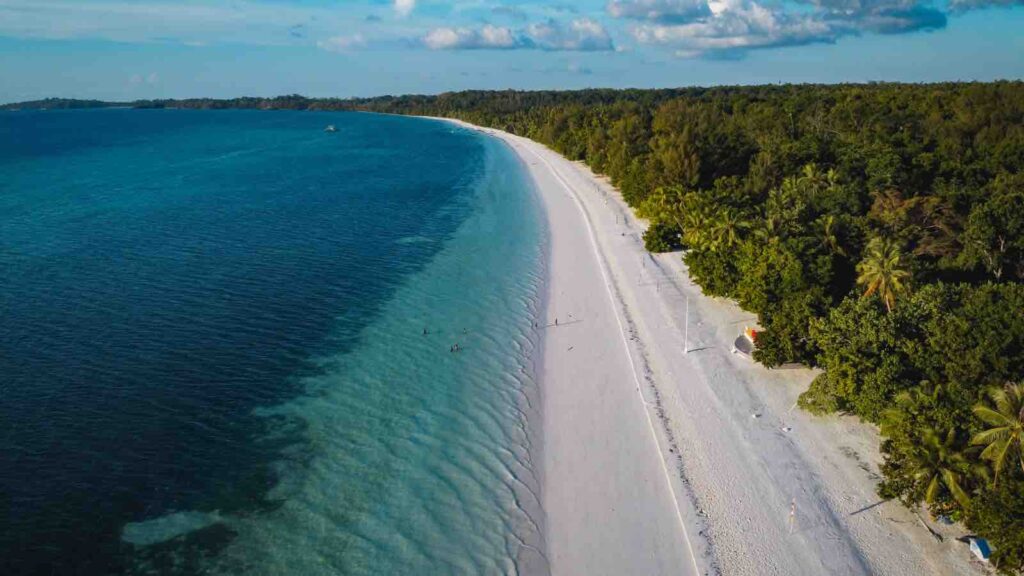

Scientific expedition finds critical migration corridor for 24 protected species, strengthening calls for new marine conservation areas.
JAKARTA — The waters of Maluku Barat Daya, a remote island chain in eastern Indonesia, have emerged as one of the world’s most resilient marine ecosystems, according to new scientific findings presented this week by WWF Indonesiaand the Ministry of Marine Affairs and Fisheries (KKP).
Results from the Integrated Biodiversity Expedition 2025, unveiled in Jakarta on Feb 5, show that the region functions as a vital migration corridor and habitat for 24 protected and endangered marine species, reinforcing its status as what officials describe as the “last stronghold” of global marine biodiversity.
RELEVANT SUSTAINABLE GOALS


A Climate Refuge in Eastern Indonesia
Koswara, Director General of Marine Spatial Management at KKP, said the expedition confirms Maluku Barat Daya as one of the most climate-resilient marine ecosystems in the world — a natural refuge at a time when ocean biodiversity is under growing pressure from global climate change.
“Researchers have been able to demonstrate that the waters of Maluku Barat Daya are the last line of defence for global marine biodiversity amid accelerating climate threats,” Koswara said during a public discussion at the ministry’s office.
The region receives nutrient-rich currents from both the Banda Sea and the Indian Ocean, creating conditions that support diverse and stable marine life.

A Migration Corridor for Endangered Species
Scientific data from the expedition identified Maluku Barat Daya as a primary migration corridor for species including blue whales, orcas, hammerhead sharks, multiple species of sea turtles, mola-mola and dugongs.
Conducted between Oct 3 and Nov 3, 2025, the expedition focused on the waters around Romang and Damer islands. One of its most significant discoveries was what researchers believe to be the largest dugong habitat ever recorded in Indonesia.
In a single area, scientists documented 32 dugongs — a concentration considered rare even at a global scale.
Seagrass Meadows and Centuries-Old Reefs
The findings also point to exceptionally healthy supporting ecosystems. Seagrass meadows, which form the primary habitat for dugongs, were found to have coverage exceeding 50 per cent, with researchers identifying nine of the 14 seagrass species known in Indonesia.
Coral reef ecosystems in the Romang and Damer waters were assessed as being in moderate to good condition, with average live coral cover reaching 51.4 per cent — significantly higher than the regional average of 34 per cent.
Further analysis revealed that some coral colonies are estimated to be 100 to 200 years old, indicating long-term ecosystem stability and resilience.
“These shallow-water ecosystems have survived for centuries,” Koswara said. “They protect coastlines, serve as spawning grounds for economically important species, and play a crucial role in Indonesia’s future.”
Indigenous Stewardship at the Core
Beyond ecological data, the expedition highlighted the central role of indigenous communities in safeguarding marine ecosystems. In Romang and Damer, traditional practices such as Sasi — customary seasonal closures — and pemali, or cultural prohibitions against harvesting certain species, remain deeply embedded.
According to WWF Indonesia, these local systems of governance have helped preserve marine resources across generations, long before modern conservation frameworks were introduced.
Candhika Yusuf, Acting Director of Marine and Fisheries Programmes at WWF Indonesia, said the expedition confirmed that many reefs in Maluku Barat Daya remain healthy even as coral bleaching affects other regions.
However, he warned that the ecosystem’s resilience is increasingly under threat from destructive fishing practices by outside actors, plastic pollution and abandoned fishing gear, known as ghost nets.
“We must strengthen community-based monitoring through local surveillance groups so that this natural wealth is not lost,” Candhika said.
KKP said the expedition’s findings will serve as a scientific foundation to accelerate the designation of Marine Protected Areas, aligning conservation goals with coastal community welfare under Indonesia’s blue economy framework.
“In this context, the results of the Romang–Damer Expedition 2025 are a critical contribution to decision-making at both national and regional levels,” Koswara said.
Lead image courtesy of Kele Project (via Getty Images) Ngurbloat Beach in Southeast Maluku, Indonesia