“Eco-anxiety” and “climate-anxiety” are the most widely known terms describing what people feel in response to being aware of the climate crisis.
We conducted a review of published academic papers including original research articles and review papers, and found surprising results on how young people aged 10-29 years actually experience being aware of global warming and climate change and its effects.
While you might have experienced climate anxiety or know about it, you might not know what it is.
Researchers do not have agreed definitions. In the papers we examined as part of our study, eco-anxiety was defined 41 times and climate-anxiety defined 24 times.
The main inconsistency between definitions of eco-anxiety stems from the extent to which it is related to anxiety. Some definitions position eco-anxiety as an extension of generalised anxiety or as having characteristics of anxiety disorders. Whereas some do not actually mention anxiety at all in the definition and may instead use concepts like “concern or worry,” which muddies the conceptual waters.
Natural disasters versus human-made disasters
Another discrepancy is whether the definitions relate to just climate-related changes, or wider environmental changes, and whether or not the feelings relate to human-caused changes only.
Some definitions consider these terms to describe experiences coming from awareness of climate and ecological change, whereas others consider “eco” and climate-anxiety to be experienced in response to more direct climate events.
In reality, all of this is likely to be going on, and our previous research has shown that eco-anxiety levels are significantly higher in US youth aged 16-24 years who self-report exposure to climate change hazards.
Although eco-anxiety and climate-anxiety are the most commonly used terms, our review found a total of 173 experiences describing how young people think, feel and behave in response to being aware of the climate crisis. They include: Solastalgia, symptoms of depression, sleep disruptions, financial strain and hope, along with other experiences not documented in the academic literature.
A breakdown of key climate change awareness concepts
As there were so many experiences described, we organised them into six interrelated categories and sub-categories (see the chart below).
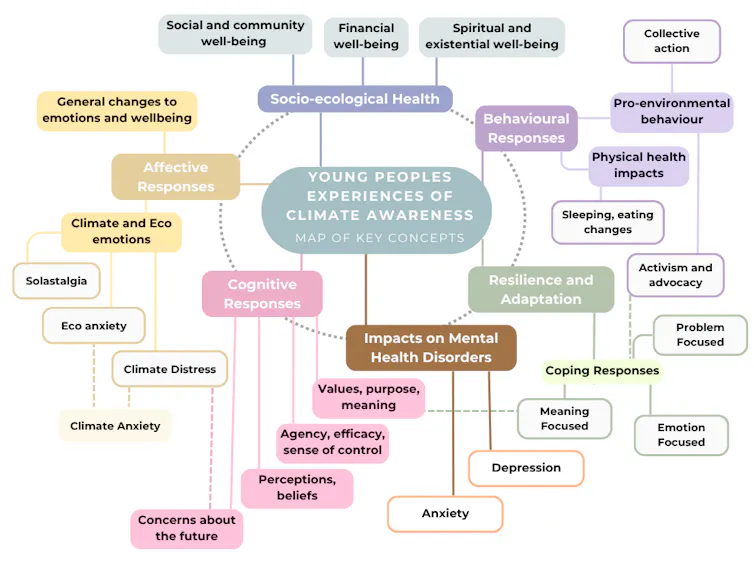
It is important to address and be inclusive of the full spectrum of young people’s experiences beyond climate-anxiety, including the impacts on physical health such as sleep, physical activity and eating behaviours, social and cultural practices, and spiritual and community wellbeing.
Climate awareness: exploring the cultural and colonial factors
Researchers like us are working with lived experience experts around the world to co‑design research and support tools that genuinely reflect the diverse ways people understand and are affected by climate change. Because awareness of the climate crisis is shaped by history, identity, place, and power, it is essential that research is developed with people whose lives are directly touched by these dynamics.
One example of how lived experience expertise has expanded the field comes from a contributor who challenged and deepened existing definitions of eco‑anxiety. They explained:
“I think we perceived [climate-anxiety] as more of an embodied and intergenerational, deep wound that comes out of colonisation, colonial legacies and something that was a lot more personal.”
Our research uncovered no existing definitions of climate change or eco-anxiety that acknowledge the impact of colonial history on individuals’ experiences of environmental distress. By collaborating with experts in lived experience, we have deepened and sharpened our understanding in this area.
Another example of our work with lived experience experts to codesign a research evaluation of The Resilience Project’s youth‑led intervention prompted us to adopt a broader definition of resilience: not simply “bouncing back”, but balancing strength, softness and self‑care so young people can sustain climate‑care activities in ways that are genuinely protective and long‑term.
The way forward
Taken together, our
Read More