Every mission to deep space is fraught with danger. A hardware failure during launch, an equipment malfunction far from Earth, or a small space rock hitting the vehicle are all scenarios astronauts will train for.
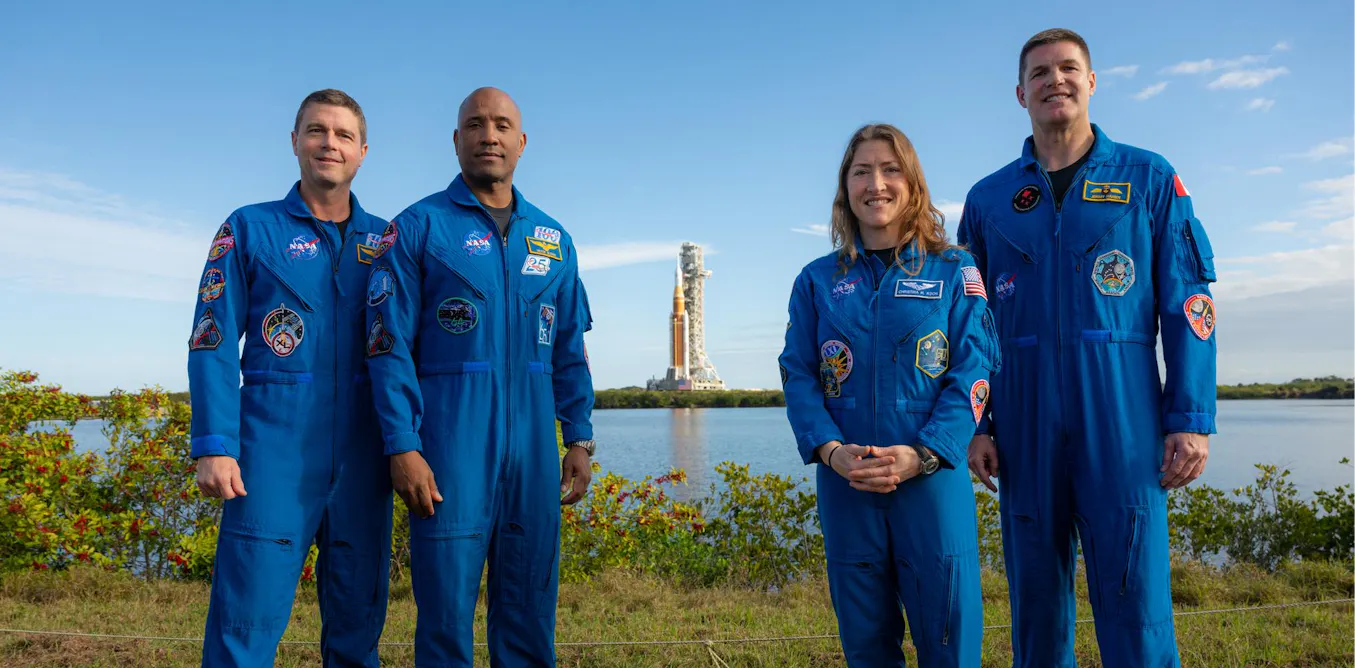
As humans set off on the Artemis II mission, visiting the Moon for the first time in more than 50 years, one persistent threat they face is from solar radiation.
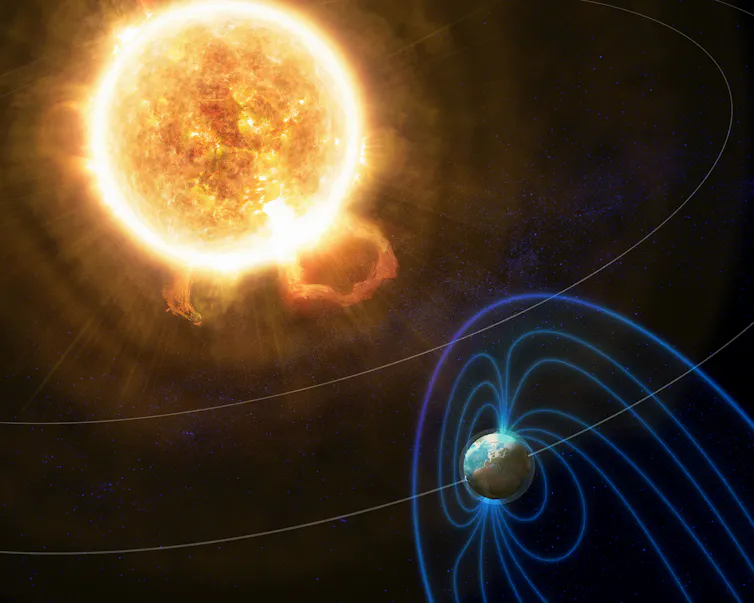
Intense bursts of radiation from the Sun, known as solar particle events, can endanger the lives of space travellers, particularly those venturing beyond low Earth orbit (LEO). During these events, high speed, charged particles stream out from the Sun and into space.
Exposure to these particles could lead to radiation sickness or, in the worst cases, prove fatal. On space stations and other crewed vehicles travelling in LEO, astronauts are afforded a high degree of protection by the magnetic bubble surrounding Earth (the magnetosphere).
But in interplanetary space, where Artemis II is headed, humans are much more exposed to outpourings of solar radiation.
The Sun’s magnetic activity fluctuates on a cycle lasting roughly 11 years. During this cycle, sunspots (areas of reduced temperature caused by intense magnetic fields) can cause eruptions known as flares, as well as solar particle events. These rise and fall in frequency with the solar cycle.

The current solar cycle reached its maximum, when the Sun is generally at its most active, in 2024 and is now in a slowly declining phase leading to the minimum, when the Sun is quietest. The current cycle should reach the minimum in 2031.
Not all solar cycles are the same and the current one has been rather undistinguished in terms of activity, as was the previous cycle that reached maximum in 2014. Recently, however, the Sun woke from its slumber.
On November 11 2025, a large solar particle event increased ground level radiation by about 145% for two hours, as measured by the University of Surrey’s neutron monitor at the Met Office station at Lerwick, Shetland.
This was also detected by University of Surrey SAIRA (Smart Atmospheric Ionising Radiation) monitors installed on two transatlantic flights and on rapid response meteorological balloon flights at Lerwick, Cambourne and near Utrecht in the Netherlands.
Work is in hand to unscramble this complex event to determine the radiation increases worldwide using the University of Surrey computer model MAIRE (Model for Atmospheric Ionising Radiation Effects). This calculates radiation levels at aviation altitudes for normal atmospheric conditions, as well as for enhanced radiation events caused by increased solar activity.
Three immediate research papers are in production to describe the radiation monitors and their calibration, to summarise the flight data and to compare the data with available models.
A close call
The solar particle event on November 11 2025 serves to tell us that, whatever the probabilities might be, the Sun can always take us by surprise.
To underline the importance of such events for deep space missions, let’s rewind the clock to 1972. At the time, the Sun was in a similar declining phase in its 11-year cycle as we are today. Then, between August 2 and August 11 1972, the Sun unleashed one of the largest solar particle events of the space age.
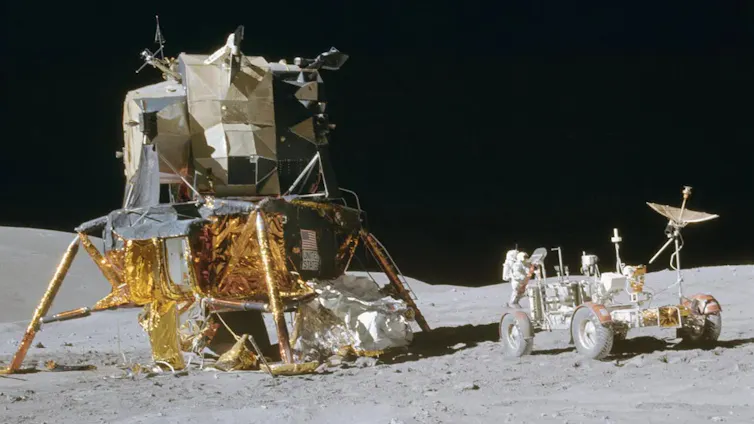
This gigantic release of charged particles from the Sun occurred in between the Apollo 16 (April 1972) and Apollo 17 (December 1972) missions to the Moon.
This event was much bigger than the one in November 2025 – by a factor of 40. If it had taken place while astronauts were in space, the radiation dose could have caused severe illness or even death.
The Apollo crews had a lucky escape. But the solar particle event made an impact on Earth. The ensuing geomagnetic storm is thought to have caused 4,000 US-laid mines to spontaneously detonate in Hanoi harbour during the Vietnam war, causing confusion and alarm on both sides.
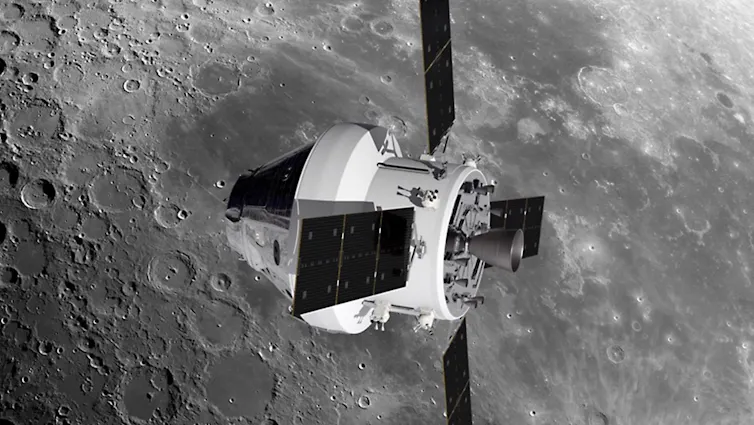
There are ways to prepare for similar events in future. The most dangerous aspect of this radiation is its high energy component, which can penetrate shielding on spacecraft. The Surrey Space Centre Space Environment & Protection team are currently working on a detector, called the High Energy Proton instrument, that definitively measures this high energy component of solar particle radiation.
It does this through the light flashes emitted when the particles transit a transparent medium at velocities exceeding the speed of light. Astronauts often report seeing such flashes of light, even with their eyes closed, that can be caused by solar particles or high-energy cosmic rays passing through the retina or optic nerve.
Read more: Why has it taken so long to return to the Moon?
Advance warning
The University of Surrey radiation detectors could now fly on a lunar orbiting mission towards the end of the decade. On this
Read More