


New International Research shows health messaging doubles support for climate policies; The research, based on a survey of around 30,000 respondents across Brazil, India, Japan and South Africa in late 2025, found that informing people about health risks linked to climate change is twice as likely to increase public backing for climate policies than messages focused on economic or environmental impacts alone.
Public concern over the health impacts of climate change is emerging as one of the strongest drivers of support for government climate action, according to a new international study backed by the Climate Opinion Research Exchange (CORE) and the Wellcome Trust.
The research, based on a survey of around 30,000 respondents across Brazil, India, Japan and South Africa in late 2025, found that informing people about health risks linked to climate change is twice as likely to increase public backing for climate policies than messages focused on economic or environmental impacts alone.
The findings come as climate-related disasters intensify globally, placing growing pressure on governments to address not only environmental damage but also mounting public health threats linked to rising temperatures, air pollution, floods, heatwaves and extreme weather.
Researchers say the results could reshape how policymakers, scientists and advocates communicate climate risks to the public.
RELEVANT SUSTAINABLE GOALS
More Than 80 Per Cent Express Concern Over Climate Change
The report, published this month, revealed widespread concern about climate change across all four countries surveyed.
More than 80 per cent of respondents said they were concerned about the impacts of climate change, while majorities in every country supported government measures designed to prevent health problems associated with the climate crisis.
The findings align with warnings from the World Health Organization, which has said that “humanitarian emergencies” linked to rising global temperatures are already increasing around the world.
According to the WHO, more than one-third of the global population is exposed to climate-related threats including wildfires, tropical storms, floods and extreme heatwaves, with these dangers intensified by human-caused greenhouse gas emissions.

Health Becomes a Powerful Climate Communication Tool
Researchers involved in the study said health concerns appear to resonate more personally and directly with the public than broader climate messaging.
Dustin Gilbreath, a researcher at CORE and one of the study’s lead authors, said people become significantly more open to climate action when they understand the direct health risks facing themselves and their families.
“If you suddenly find out that climate change is hurting your health and your children’s health, more people are rightfully more open to that argument,” Gilbreath said. “At the end of the day, we all care about our health, regardless of our political inclinations.”
The study suggests that health-focused communication may offer a less polarising and more relatable way to discuss climate change across different political and social groups.
Countries Responded Differently to Climate Health Messages
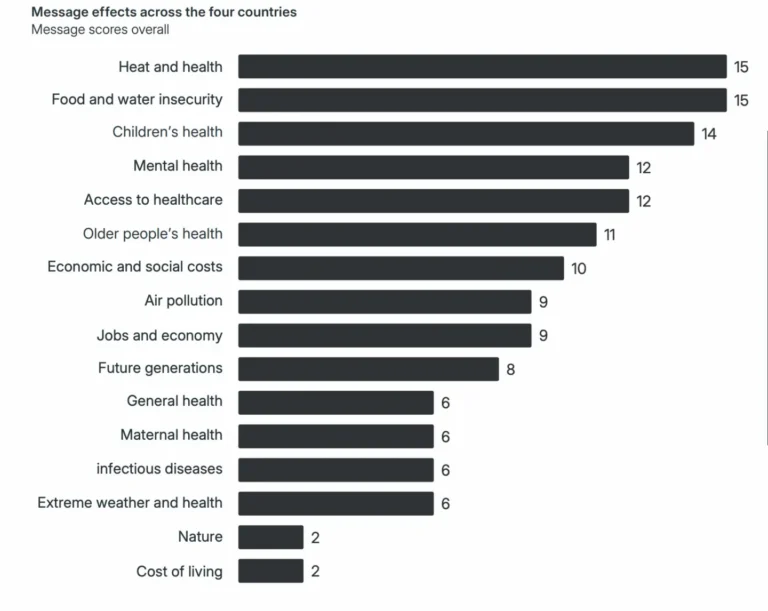
Researchers tested 16 different climate-related messages through a survey-based randomised trial, comparing responses to health-related issues such as extreme heat, infectious diseases and mental health with messages focused on jobs, nature and living costs.
While climate-related health concerns resonated strongly in all four countries, the specific issues that generated the strongest response varied significantly.
South Africa: Children’s Health and Water Security
In South Africa, messages focused on children’s health generated especially strong reactions.
Food and water insecurity also resonated widely, reflecting concerns linked to the country’s previous drought crises, including Cape Town’s near “Day Zero” water emergency between 2016 and 2018.
Researchers noted that South Africa’s relatively young population, with a median age of 28, may also influence how climate-health risks are perceived.
Brazil Responds Strongly to Mental Health Concerns
In Brazil, mental health impacts associated with climate disasters emerged as the most effective climate message.
These concerns include anxiety, stress and trauma caused by floods, storms and other extreme weather events.
The report found that 93 per cent of Brazilians surveyed described themselves as somewhat or very concerned about climate change.
Neha Dewan, senior advisor at the Wellcome Trust, said the finding was unexpected.
“This really helps us see what’s unexpected and find newer ways of reaching different audiences,” she said.
India Focuses on Air Pollution and Healthcare Access
In India, respondents reacted most strongly to concerns over air pollution and access to healthcare.
Researchers said the findings reflect the growing visibility of pollution-related health problems in urban areas across the country.
“Every time I’m back home seeing family in India, everybody talks about air pollution. It’s the living, breathing reality,” Dewan said.
Japan Most Concerned About Extreme Heat
In Japan, extreme heat emerged as the top-performing issue.
The results come as many countries across Asia continue facing record temperatures, longer heatwaves and rising heat-related health risks linked to climate change.
Scientists have increasingly warned that extreme heat represents one of the deadliest consequences of global warming, particularly for elderly populations, outdoor workers and vulnerable communities.
Governments Face Rising Pressure for Climate and Health Action
The survey found broad support for stronger government intervention to reduce health risks linked to climate change.
In Brazil and South Africa, more than 90 per cent of respondents supported emissions-cutting measures such as expanding solar energy production.
Meanwhile, respondents in India and Japan strongly backed adaptation measures, including investment in air-conditioned public buildings that could serve as cooling centres during heatwaves.
The findings arrive ahead of the May 18–23 World Health Assembly, the highest decision-making body of the WHO.
Experts have increasingly called for climate change to be treated not only as an environmental issue but also as a public health emergency.
Global Leaders Push Climate and Health Agenda
At COP28 in Dubai, more than 150 countries signed a declaration expressing “grave concern” over climate-related health impacts and pledged to strengthen policies aimed at reducing emissions while improving public health outcomes.
More than 80 nations also endorsed a separate initiative at COP30 in Belém last year designed to improve the health sector’s resilience to climate impacts.
The programme secured US$300 million in philanthropic backing to help governments identify health risks, improve climate monitoring systems and strengthen emergency responses to extreme weather.
Despite these commitments, health concerns have not consistently remained central at major climate negotiations.
The Global Climate and Health Alliance, representing 250 health organisations, criticised leaders at the recent Transitioning Away from Fossil Fuels conference in Santa Marta, Colombia, for failing to adequately address public health protection.
Commission Calls Climate Crisis a Health Emergency
Ahead of the World Health Assembly, the Pan-European Commission on Climate and Health urged governments to accelerate climate-health policies.
The commission, chaired by former Icelandic Prime Minister Katrín Jakobsdóttir, released a 17-point action plan calling for climate change to be treated as a “global health emergency.”
The recommendations include integrating climate risks into national security agendas and significantly increasing climate-health investment.
“The climate crisis is a threat to our safety and security, social cohesion, human rights and health,” Jakobsdóttir said. “Climate action is not merely a necessity. It is a high-return investment for a more just and resilient society.”
public health protection.
A New Direction for Climate Communication
Researchers behind the study say the findings suggest health could become one of the most effective ways to broaden public engagement on climate action.
Gilbreath said economic and cost-of-living arguments have dominated climate communication for years, while health may represent a newer and more personal approach.
“The cost-of-living message or the jobs and economy messages have been used over and over again,” he said. “The health angle is probably a newer approach for some audiences.”
Dewan described health as the “missing piece” in climate communication strategies.
“Health is personal, proximal, relevant and — politically speaking — it’s depolarising,” she said.
As climate-related disasters become more frequent and severe, the study suggests that framing climate change through the lens of human health may increasingly shape both public opinion and future government policy.
You may also be interested in :
Extreme Heat Becoming A ‘Regular Reality’ in India and Pakistan, Scientists Warn