
The opinions expressed here by Trellis expert contributors are their own, not those of Trellis or its editors.
Over the last decade we have built a sustainability ecosystem that scrutinizes climate delivery far more effectively than it enables it. Artificial intelligence is an extreme manifestation of this contradiction.
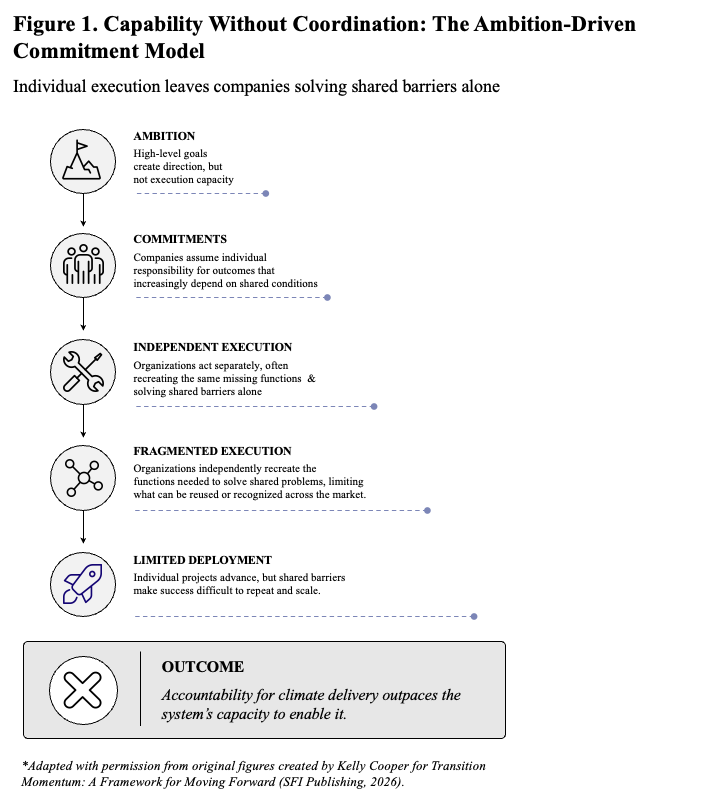
We ask individual companies to set targets, build transition plans and account for their own progress. But some of the hardest delivery constraints now sit outside the organizations being held accountable for overcoming them. More internal effort cannot solve a systemwide limitation.
Amazon, Google and Microsoft have reported rising electricity-related emissions even as they invest aggressively in clean energy and stand behind long-term climate commitments. The obvious question the market is now asking: Can those commitments survive the AI boom?
Look across sectors and a more fundamental question emerges: What happens when every company faces the same problem and each is left to solve it independently?
For AI, the most immediate problem is power. Demand is growing faster than the system can expand, forcing hyperscalers to secure generation and grid access individually — usually with fossil fuels. Power is no longer simply an input to the AI race. Access to it is becoming part of the race itself.
When critical enabling infrastructure is scarce, firms begin competing for the conditions the market depends on — and this rational commercial behavior makes collective climate action harder. Net-zero commitments may not have changed, but the conditions for delivering them have.
If the conditions determining the outcomes of corporate commitments increasingly sit outside companies, why are so many of our sustainability standards and frameworks still designed to evaluate what happens inside them?
We designed for accountability. Not execution
We’ve become better at measuring corporate climate commitments than enabling the conditions required to fulfill them. The result is a broken loop: We demand outcomes, leave companies to compete for or re-create what they need to produce them, and then scrutinize performance when conditions fall short.
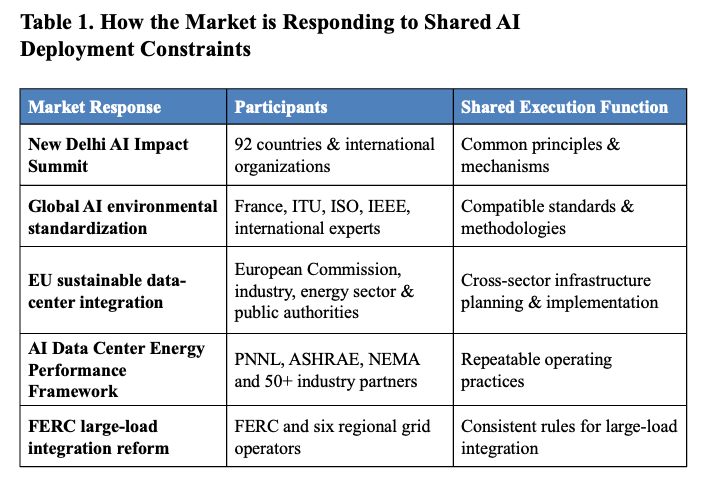
The response emerging around AI sharply highlights these constraints while offering new models. Governments, regulators, standards bodies, infrastructure operators and companies have started to build common rules, repeatable practices and coordinated approaches to overcoming shared constraints.
From fragmented execution to shared capacity
The significance is not that a wave of AI coalitions has arrived. It’s the recognition that competing more effectively over a shared constraint does not remove it. The emerging response is to build deployment capacity across multiple organizations and sectors rather than leave each company to navigate the constraint alone. This demonstrates what’s possible when markets strengthen the conditions everyone depends on, rather than simply determining who gets access first.
The scale and speed of AI are unique, but the fragmentation the technology exposes is not. Our research with more than 200 practitioners across climate deployment finds the same pattern well beyond AI: Demand and capital remain disconnected, diligence and validation must repeatedly be re-created, risks sit where individual actors cannot absorb them, and informal workarounds emerge where durable execution infrastructure is missing.
AI has made shared constraints commercially urgent. But the fact that markets are building this capacity only after those constraints began limiting commercial growth exposes the costs of fragmented execution: slower or stalled deployment, duplicated effort and capital, unrealized commercial value, and emissions reductions delayed or lost. Persistent gaps bet
Read More