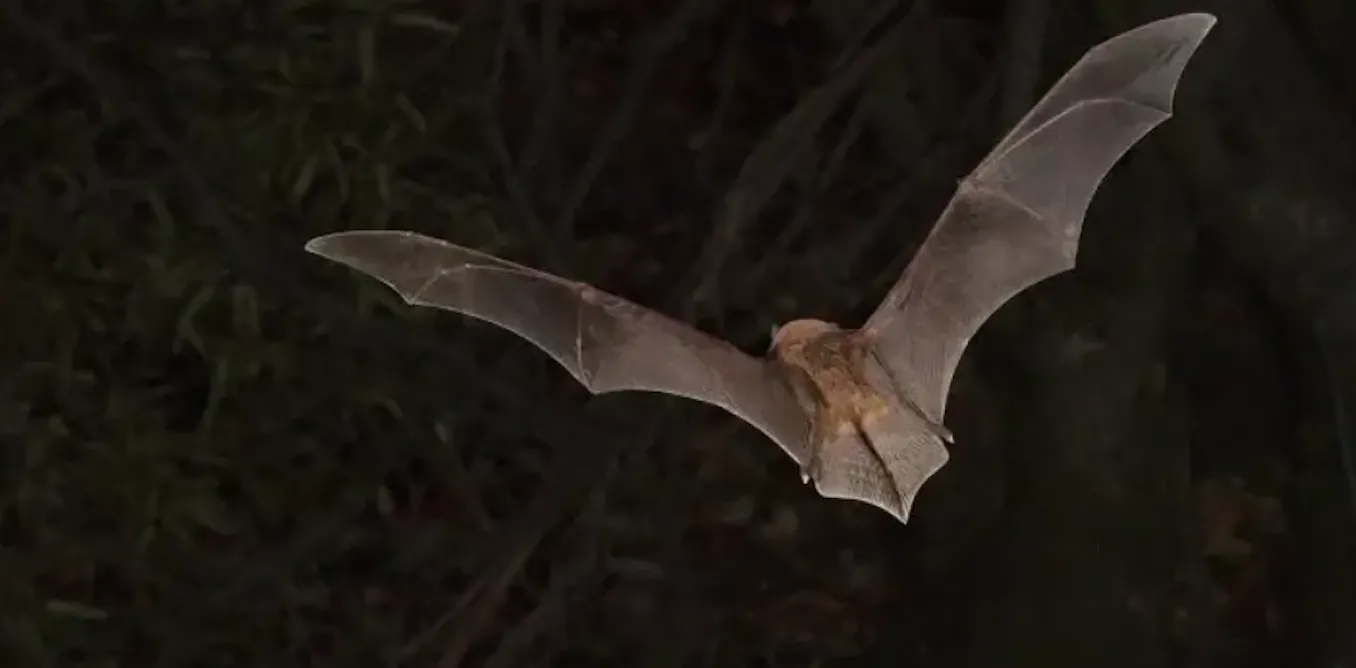
Climate change and changes in the way land is used are the two biggest threats to wildlife because they change the environment in which animals survive and thrive. Knowing how species respond to these pressures is central to planning conservation actions.
A number of studies have modelled how climate change will affect vertebrate distributions. But little is known about bats from tropical and subtropical regions, especially in Africa.
Bats are particularly sensitive to changes to their environment because of their slow reproductive rates, dependence on stable roosts, and sensitivity to climatic extremes that shape insect availability – their main source of food.
They therefore need both suitable foraging landscapes and the availability of caves for roosting. Research has been done on how bats will be affected by the effects of climate change such as rising temperatures. What has been overlooked is the fact that cave-dependent bats can’t survive in climatically suitable areas without access to suitable roosts.
So even if a future landscape has the right temperature and rainfall, it may be of little use to a bat if there is nowhere suitable to roost. That led us to a simple question: what happens when the places with the right climate aren’t the places with caves?
Having studied bats since 2017, I have spent much of my research career investigating their ecology and dependence on particular habitats. This experience led me to question where climate change might push wildlife. I wanted to understand whether Africa’s cave-dwelling bats would actually be able to find somewhere to live as the climate changes.
My co-author Mark Keith and I set out to answer this by building a model that brought together future climate conditions and the availability of caves and rocky roosting habitat across sub-Saharan Africa. We used cave-dwelling long-fingered bats called Miniopteridae as our study group to explore how these two essential pieces of the puzzle might overlap in the future.
Long-fingered bats are found widely across Africa and depend heavily on caves for shelter. They also commonly occur alongside other cave-dwelling bat species, making them a useful group for understanding how climate change could affect bats that rely on caves.
Our findings suggest that Africa’s cave-dwelling bats face a double challenge. Climate change could shrink the areas where they can live, but even where future conditions remain suitable, there might not be caves.
Places need to found where three things come together: the climate remains suitable; there is somewhere for the bats to live; and they can move between the places they need.
These could become critical safe havens for bats as the climate changes.
Modelling where bats can survive
We used an existing database of 551 reliable records showing where these bats have been found across sub-Saharan Africa. We then used these records to ask where conditions could remain suitable for them as the climate changes. Using a computer model, we matched each of these places with its local climate, such as how hot, cold or wet it gets, to work out what conditions the bats need. We then asked the model where those conditions would still exist around 2070, if the world carries on warming at a moderate rate.
We found
Read More