
KEY TAKEAWAYS
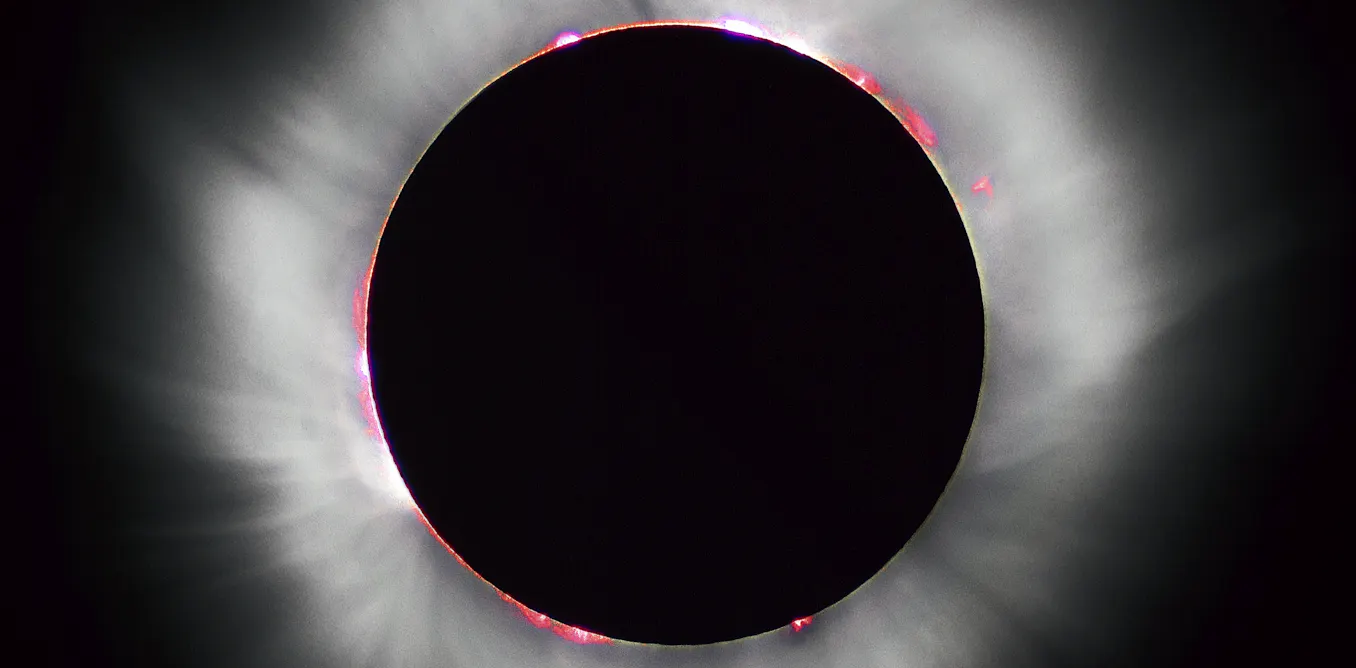
On August 12 2026, a total solar eclipse – one of the most spectacular astronomical events in Europe since the one in 1999 – will be visible in France and Spain.
-
Find out how this phenomenon occurs and why it doesn’t occur every month.
Eclipses have always fascinated people and have given rise to numerous myths and major scientific discoveries.
What is a total solar eclipse? Simple: the Sun disappears – so it’s night-time in broad daylight! An inevitably awe-inspiring event that gave rise to many myths. As the Sun is the source of life, its disappearance was seen as a sign of misfortune all over the world, except among a few Aboriginal tribes in Australia (for whom a modest veil was then cast over intimate encounters between husband and wife, the Sun and the Moon). To resolve the problem, special, noisy ceremonies had to be held to scare off the monster or demon attempting to swallow the Sun. Even today, it is hard to remain indifferent when darkness falls – our hearts instinctively sink. Relief then comes a few minutes later when the light returns: just like the birds that greet this return, we may feel the urge to sing, as we breathe a sigh of relief…
Where do eclipses hail from? The basic principle behind them is common knowledge: the Earth orbits the Sun and the Moon orbits the Earth. So, from time to time, an alignment of the Sun, Moon and Earth occurs. In this case, the Moon blocks the Sun’s rays, much like a parasol casts a shadow. The Moon’s shadow stretches out in a long cone behind it, and the Earth cuts right across the tip of it: this means that, unfortunately, only a small part of the globe will be able to enjoy the spectacle.
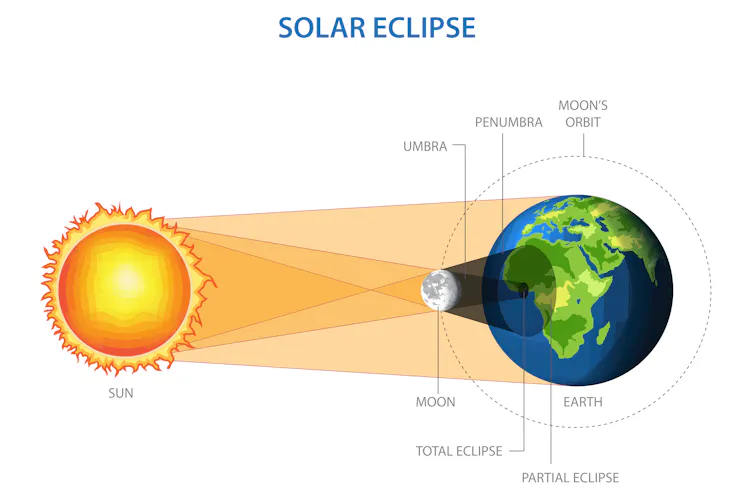
And this is where a stroke of luck comes into the equation: the Moon is 400 times smaller than the Sun, but also 400 times closer to the Earth. As a result, when viewed from Earth, both appear to be the same apparent size (also known as “angular” size). In other words: the Moon covers the Sun exactly! This makes the spectacle even more fascinating, as an eclipse allows us to observe not only the outline of solar flares at the Sun’s edge, but also the atmosphere surrounding it, known as the Sun’s “corona”. As it is very faint, it is only visible during eclipses – when there isn’t an eclipse, astronomers create artificial ones in their telescopes using a specific masking technique so that they can see it.
Why isn’t there a solar eclipse every month?
Of course, you might think that every time the Moon orbits the Earth, it would block out the Sun. That would result in an eclipse every month, but unfortunately, this is not the case, due to a slight difference (5°) between the plane of the Earth’s orbit and that of the Moon’s orbit. For an eclipse to occur, a perfect alignment is required, which only happens if the celestial bodies line up along the line where these two planes intersect. The Earth is in this position twice a year, so we have two eclipse seasons each year. The rest of the time, the Moon is just a little too high or too low for the alignment to take place. Further clarification: the orbits are not circles, but ellipses.
Consequently, the factor of 400 mentioned above is an average. Sometimes, the Moon is slightly further away and the Sun a little closer, so the Moon is no longer able to completely block out the Sun: we then observe what is known as an annular eclipse, as we can still see a bright ring around the darkened Moon… It is worth noting that this will become the norm in the future, as the Moon is moving away from the Earth at a rate of 4cm per year.
Myths and realities surrounding solar eclipses
These impressive eclipses have given rise to numerous tales of yore. The first concerns nothing less than the birth of science! In 585 BCE, a war was raging between two civilisations in Asia Minor: the Lydians and the Medes. Suddenly, in the midst of battle, the Sun was obscured. Frightened by this “celestial sign”, the soldiers on both sides immediately ceased fighting, paving the way for peace negotiations.
But Herodotus, who recounts this episode, adds that the Ionians – another people of Ancient Greece who had not taken part in this conflict – were not afraid, as the famous Thales had forewarned them. And there you have the first “classical” victory of reason over superstition. A lovely story, but one that is heavily questioned today. Without direct sources, it is difficult to fact-check, but we do know that time has a tendency to embellish certain things…
Another eclipse: the Easter eclipse. Although less well known than the Star of Bethlehem, this celestial event nevertheless features prominently in many scriptures depicting the crucifixion. Passages from the Bible do speak of darkness falling upon the Earth, but there is a serious problem: Christ’s martyrdom is said to have taken place at the Jewish Passover, a festival that occurs… at the full moon. A solar eclipse, however, can only occur at the new moon – that is, in the opposite configuration, half a lunar revolution later! Add to that the fact that it is impossible to find an eclipse that “fits” with the year and the location. In short, it’s more a matter of symbolism – admittedly, traditional depictions show the moon and Sun eclipsed on either side of the cross, yet it is obviously impossible for both to occur at the same time…
There is also a famous ec
Read More