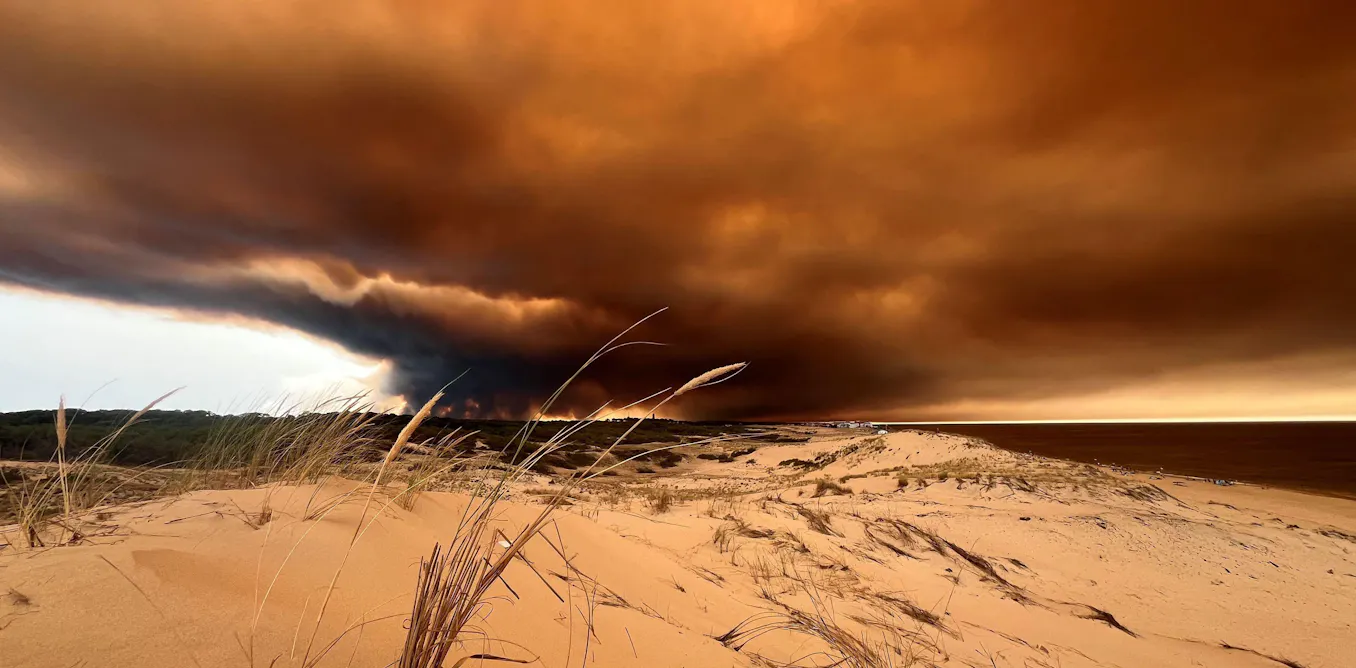

The front page of the Times on July 25 carried a photograph of three people sitting under a striped parasol on the sand near Lacanau in southwest France, looking out to sea. Beyond them, the sky was rust-orange as a wall of wildfire smoke climbed above the treeline. The caption described it as a “dramatic view”.
Above the photo, the lead news story was on how the UK’s net zero policy risks blackouts. It reported a whistleblower’s claim that the expansion of wind and solar had left officials struggling to gauge supply and demand.
The rest of the front page offered barbecuing tips and 25 of the best summer wines. The full story of the fire that has displaced more than 110,000 people in southwest France didn’t appear until page five.
This was met with cries of hypocrisy on social media. But exploring how these contradictions can sit on the same front page tells us a lot about how climate change is narrated in the UK, and why climate reporting differs so much from country to country.
Over the same weekend, other UK newspapers reported on the fires gripping Europe. The Mirror led with the headline “Summer of chaos”, reporting that wildfires were forcing Britons to flee holiday resorts. While the i’s headlines were more nuanced online, its print lead was “Tourists flee France inferno”. The Financial Times led with “Europe ablaze”, while in Scotland, the Herald newspaper led on the evacuation of a village in the Cairngorms.
Europe’s fires were written up as a combination of holidays spoiled, energy policy rows, domestic civil protection issues and continental emergencies. All the articles were true, but what separates them is how far back each story begins. A fire can be explained by today’s barbecue, yesterday’s wind direction, by a dry spring, by four decades of land use change, or by a century of emissions.
Deciding how a story of a wildfire is placed in history, and in the climate change narrative, is often determined by one of three things. First, which desk the story lands on: travel and news desks usually seek stories of disruption, while environmental desks look for causes. Second, how far away the fire is, and third, where the news outlet stands on decarbonisation.
Climate change doesn’t fit a news cycle
News runs on novelty – something must have changed since yesterday for it to qualify as a story. That is why the moment of ignition is reportable, but the conditions that led to that ignition are usually not.
A drying trend across successive springs has no single day on which it happens. It generates no announcement, no casualty figure, no photograph. In the newsroom, it lacks what is know as a news peg. Stories without pegs are much harder to get published.
As a result, the fast, visible end of climate change – the flames, evacuations and cancelled flights – is covered heavily and often well. But the slow, cumulative build-up is covered thinly or not at all. Readers get a great deal of incident and very little process, which is close to the opposite of what would help them understand what is happening.
This is compounded because each fire arrives as breaking news, without always having the context of the last one. Coverage regularly restarts from zero.
Wildfires destroyed 2.2 million hectares across the European region in 2025, up from 1.4 million in 2022 – a rise of 57% in four years. No report on a single fire can carry that figure convincingly, and no reader is going to assemble it themselves across months of separate stories. A trend of that scale has to be stated outright, not left as an exercise in mental arithmetic.

When reports do not explain why conditions made a fire more likely, other explanations can move in – including rumours of arson, blame aimed at farmers or land mangers, or simply politics.
Reporting fire as a sudden foreign emergency can also make it harder to recognise slower versions of the same conditions closer to home.
In the UK, drought had already been declared in north Wales and the upper Severn before the Times front page went to press. The Cairngorms fire drew more than 500 personnel to fight it, and forced the evacuation of residents from a village called Nethy Bridge. Yet for many people in the UK, the fires in France are watched at a distance, as if unconnected with these domestic events.
The French perspective
In the UK, there have been calls for improvements to coverage of climate change. Scientists have written to the BBC, ITV and other media about the absence of climate narratives in their heatwave coverage. But change is slow to arrive.
However, France – the country that is currently burning on many UK front pages – offers a glimpse of what might be possible.
Looking at how French media report extreme weather, we can see real change in both language and prominence. Bulletins that once described a canicule exceptionnelle — an exceptional heatwave, an oddity — now routinely call these occurrence
Read More