



New report says rising cooling demand across Asia may increase emissions if electricity grids remain dependent on fossil fuels.
As Asia braces for more extreme weather in the coming months, a growing dependence on air conditioning to cope with rising temperatures could unintentionally intensify the climate crisis it is meant to address, according to a new report by MSCI Institute.
The report, published on Monday, 22 June 2026, warns that while air conditioning is becoming an increasingly important adaptation tool across the Asia-Pacific region, its widespread use on electricity grids powered largely by coal and natural gas risks creating a cycle of higher emissions and even greater warming.
Researchers describe the trend as a form of “maladaptation,” where efforts to respond to climate change ultimately worsen the underlying problem.
RELEVANT SUSTAINABLE GOALS



Cooling Demand Expected to Triple by 2050
Global demand for air conditioning is set to surge over the coming decades, driven largely by Asia’s biggest economies.
According to MSCI Institute’s Transition Finance Tracker report, projections from the International Energy Agency (IEA) show that the worldwide stock of air conditioning units is expected to increase from approximately 1.6 billion in 2016 to 5.6 billion by 2050.
China, India and Indonesia are expected to account for much of that growth.
The report notes that the electricity required to power these cooling systems could eventually rival the energy demand of data centres supporting artificial intelligence (AI).

Fossil Fuel-Based Grids Could Turn Cooling Into a Climate Risk
The report cautions that increased use of air conditioning on coal- and gas-dependent electricity grids comes with significant environmental costs.
According to MSCI Institute, cooling systems powered by fossil fuel-heavy grids contributed more than 1 gigatonnes of carbon dioxide and its equivalents in greenhouse gas emissions in 2022.
The report describes the situation as a “self-reinforcing loop that is the definition of maladaptation.”
“Whether air conditioning’s role in adaptation reinforces or undercuts the transition depends almost entirely on how these risks are managed,” MSCI Insights said.
Investors Face Both Opportunity and Transition Risk
The rapid expansion of cooling demand presents both opportunities and challenges for investors, according to the report.
MSCI Insights said increasing demand for air conditioning reflects the growing need for climate adaptation in a warming world, while also highlighting the transition risks associated with meeting that demand through carbon-intensive energy systems.
“For investors, demand for cooling signals both the scale of adaptation need in a hotter world and the transition risk that managing it can create,” the report stated.
Asia Continues to Drive Global Air Conditioning Demand
MSCI Insights expects Asia to remain the world’s largest market for air conditioning.
The report cited United Nations data showing that the Asia-Pacific region is warming at twice the global average rate, increasing the need for cooling across households, businesses and industries.
Adding to the challenge, the World Meteorological Organization (WMO) expects the onset of the El Niño weather phenomenon, driven by warmer ocean waters in the Pacific Ocean, to push global temperatures even higher from now until August.
Asian Companies Lead Expansion of Cooling Capacity
The report found that companies across Asia are playing a dominant role in expanding global air conditioning capacity.
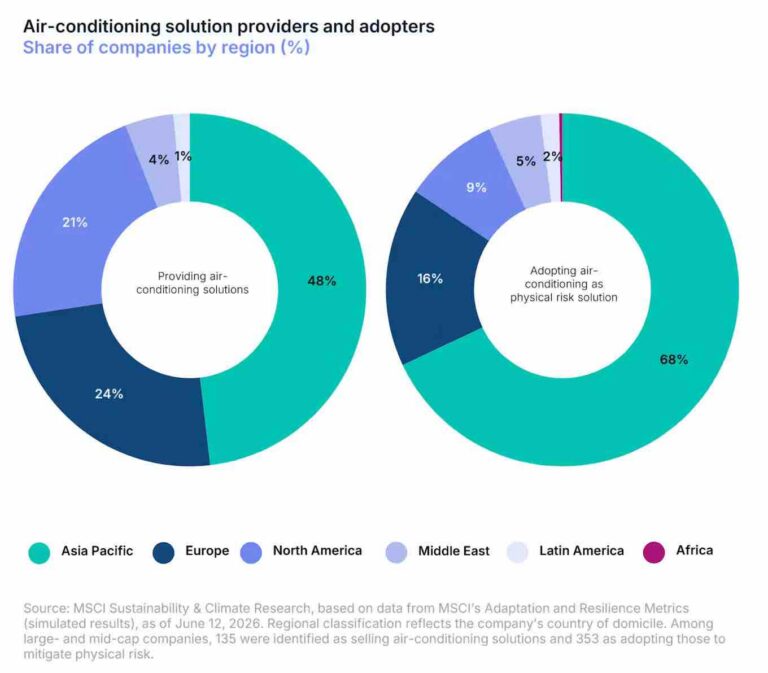
Businesses in the region provide 48 per cent of the world’s air conditioning solutions, according to MSCI’s research.
More notably, they account for 68 per cent of companies building additional air conditioning capacity specifically as a response to rising temperatures.
The figures underscore how businesses across Asia are increasingly viewing cooling technologies as part of their climate adaptation strategies.
Different Perspectives Outside Asia
The report found a different pattern in other parts of the world.
In the United States, companies supply 22 per cent of the world’s air conditioning solutions. However, only 9 per cent of firms identify air conditioning as an adaptation measure.
According to MSCI Insights, this difference reflects “lower concern with the risk of extreme heat than in the Asia Pacific region.”
Businesses are also beginning to acknowledge the operational challenges posed by higher temperatures.
A Japanese chipmaker told MSCI researchers that the company “recognise the potential for physical risks,” including rising air conditioning costs resulting from increasing outdoor temperatures.
The report suggests that as temperatures continue to climb, businesses across the region will face growing pressure to balance the need for reliable cooling with the challenge of reducing greenhouse gas emissions.
Managing Cooling Demand Will Shape Climate Adaptation
The report concludes that air conditioning will remain an essential tool for protecting people and businesses from intensifying heat across Asia. However, whether cooling contributes to climate resilience or accelerates climate change will depend largely on how electricity is generated and how the associated transition risks are managed.
As demand continues to rise across the region, the report warns that expanding access to cooling without addressing emissions from power generation could undermine broader climate adaptation efforts rather than strengthen them.
You may also be interested in :
Thailand Faces Prolonged Dry Spell As El Niño Raises Risk of Drought, Heatwaves, and Extreme Weather