


New satellite analysis reveals signs of recovery, but scientists warn conservation efforts must continue.
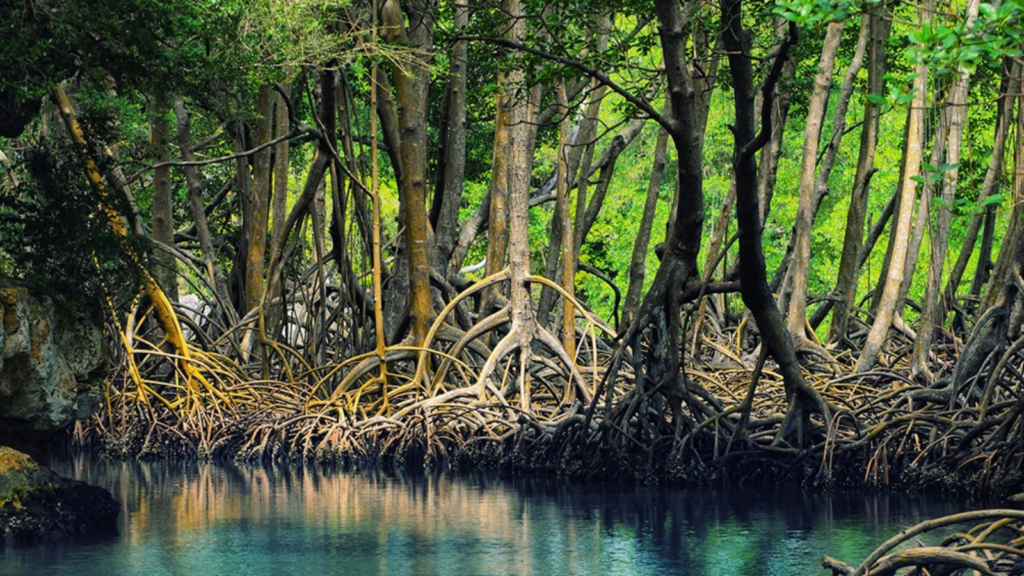
The world’s mangrove forests, long regarded as one of the planet’s most threatened coastal ecosystems, are showing encouraging signs of recovery after decades of decline, according to a study published in June 2026 by scientists at Tulane University in New Orleans, United States.
The research found that global mangrove losses have slowed significantly over the past decade, allowing many forests to recover naturally. While mangroves continue to face pressure from human development, climate change and natural disturbances, researchers say their findings provide new evidence that these ecosystems can rebound if deforestation is halted.
RELEVANT SUSTAINABLE GOALS


Four Decades of Satellite Data Reveal a Turning Point
The study analysed satellite data spanning nearly four decades and discovered that mangrove expansion and regrowth began offsetting global forest losses around 2010.
According to the findings, the rate of mangrove gains has nearly matched losses, resulting in only about a cumulative 1 per cent global decline since the 1980s.
Researchers found that the recovery has been driven mainly by mangroves expanding into new areas rather than by the regeneration of previously existing forests.
Unlike many earlier studies that relied on radar imagery, which often struggles to distinguish mangroves from other vegetation, the research developed a 30-metre resolution annual global dataset using Landsat satellite images. The dataset mapped mangroves from 1984 through 2023 with greater accuracy

Mangrove Forests Are Becoming Denser
Beyond expanding in area, mangroves are also becoming healthier in many locations.
The study found that closed-canopy mangrove forests, which are denser and store more carbon while providing stronger coastal protection, have increased steadily over time.
Closed-canopy forests accounted for about 50 per cent of global mangroves during the 1980s. By 2023, that figure had risen to approximately 58 per cent.
Lead author Zhen Zhang, a postdoctoral scholar at Tulane University School of Science and Engineering, said the findings challenge previous assumptions about mangrove recovery.
“Our study shows some new ideas about [mangrove] recovery. We find that deforestation and degradation rates are slowing down,” Zhang said.
Human Activity Remains the Main Threat
Mangrove forests have declined globally because of extensive human activities, including the development of golf courses, agriculture such as rice cultivation, and housing projects.
Natural disturbances, including cyclones and coastal erosion, have also contributed to forest degradation.
Despite the encouraging trend, concerns remain significant. The IUCN Red List of Ecosystems reported in 2024 that about half of the world’s remaining mangroves are classified as vulnerable, endangered or critically endangered.
Southeast Asia’s Recovery Marks a Major Shift
From the beginning of the study period in the 1980s until around 2010, the world lost nearly 3,000 square kilometres of mangrove forests, an area roughly equal to the US state of Rhode Island.
Most of those losses occurred in Southeast Asia.
Global mangrove decline reached its highest levels between 1990 and 2005, largely driven by intensive deforestation in Myanmar and Indonesia.
Over the past 16 years, however, global trends have reversed, producing a near net gain in mangrove habitat.
Researchers suggest that this turnaround likely reflects a combination of restoration projects, stronger legal protections and natural regeneration.
Mangroves have also naturally colonised newly formed coastal mudflats in river deltas where sediment conditions are favourable. The study notes reports of mangroves expanding into abandoned aquaculture ponds as well.
“I think we systematically underestimated the ability of mangroves to expand by themselves,” Zhang said.
Recovery Remains Uneven Across Regions
While Southeast Asia has experienced notable improvement, the recovery has not been uniform worldwide.
West and Central Africa continue to experience increasing losses, driven largely by mangrove decline in Nigeria since 2002.
The Niger Delta has become a hotspot for mangrove degradation because of crude oil production in the region.
Researchers say continued efforts to restore and conserve mangrove forests remain essential.
Mangroves Play a Critical Role in Climate Change
Scientists emphasise that mangroves are among the world’s most important natural carbon stores.
Although they occupy relatively small areas compared with ecosystems such as the Amazon rainforest, mangroves contain much higher carbon density than many other woody ecosystems.
“If you compare mangroves to tropical rainforests, mangroves may hold four or five times more carbon stock compared to rainforests,” Zhang said.
“If we have limited money to restore forests, based on carbon, we think mangroves are more important because they have more carbon density.”
The researchers argue that conservation policies should prioritise stopping deforestation while supporting the natural regeneration of mangrove forests rather than focusing primarily on intensive tree planting.
Co-author Daniel Friess, a professor of Earth and Environmental Sciences at Tulane University, said the study offers a more optimistic outlook for mangrove conservation.
“We hope that this more optimistic story will help conservation by focusing on the successes we’ve already had in reducing deforestation, and by showing how mangroves can grow back if we give them the chance,” Friess said.
Nevertheless, the researchers caution that global recovery does not mean mangroves are no longer under threat.
According to Zhang, “our study doesn’t mean that mangroves are totally healthy globally. In many local regions we still see deforestation going on. That’s why we need to conserve them.”
Climate Change Brings Both Opportunities and Risks
The study also found that climate change may be influencing mangrove expansion in different ways.
Louisiana has experienced a significant increase in mangroves, a trend scientists attribute at least partly to rising temperatures.
However, warming conditions are not universally beneficial.
In Indonesia, increasing temperatures may affect mangroves’ ability to photosynthesise efficiently.
Researchers also pointed to extreme weather linked to climate change as an ongoing threat, including mangrove dieback in Texas following a severe freeze in 2021 and damage caused by Hurricane Ian in Florida the following year.
Shoreline erosion and continued human-driven deforestation also remain persistent challenges.
Despite the continuing risks, the study concludes that mangrove forests possess a remarkable natural capacity to recover when given the opportunity.
Researchers say the future of these ecosystems will depend largely on whether efforts to reduce deforestation continue.
“All of this is not guaranteed in the future. It all depends on how we continue to halt deforestation,” Zhang said. “If we can halt deforestation to control their loss and degradation, then mangroves have a very strong ability to recover.”
You may also be interested in :
Restoring Nature Delivers Up to $47 for Every Dollar Invested, Landmark Study Finds