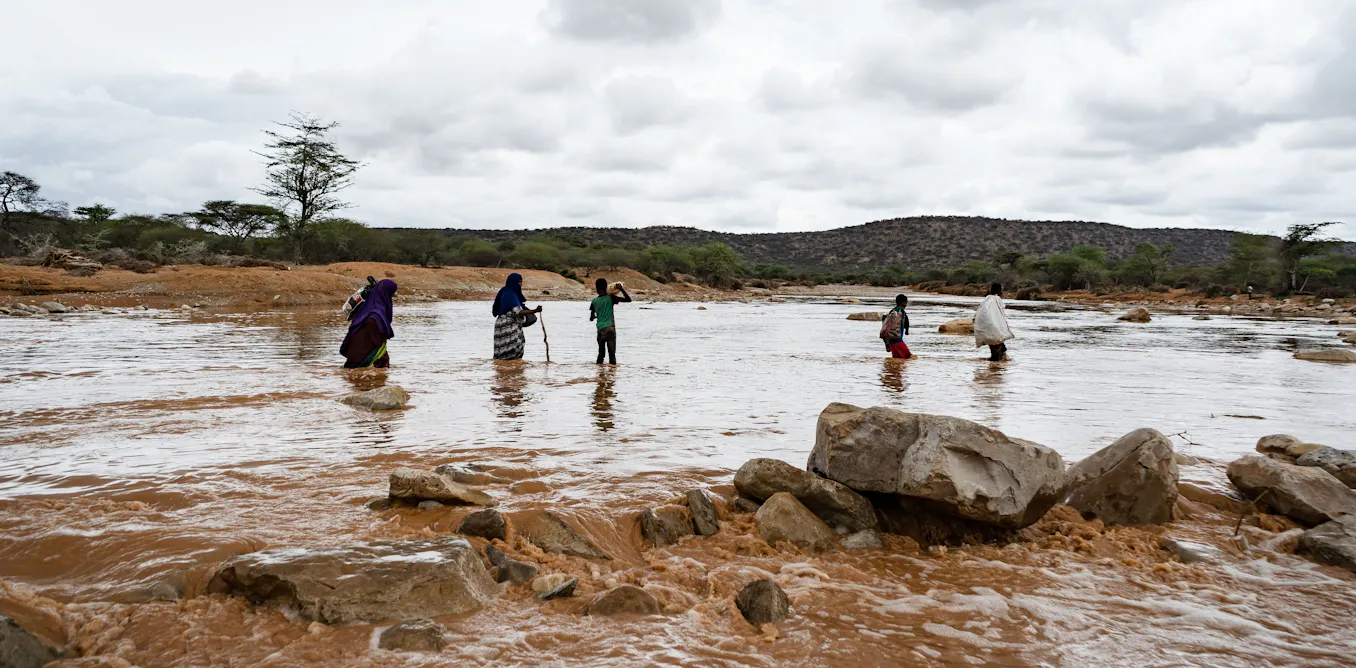

Images of families displaced by floods, prolonged droughts or extreme storms have become a distressingly regular feature of the daily news. As the impact of climate change intensifies, so does concern over its effects on human mobility. Ongoing changes to the world’s climate now raise a salient, apparently simple question: to what extent does climate change cause migration?
The answer is anything but simple.
Over recent decades, the relationship between climate change and migration has become an active, dynamic field of research. But far from producing a unified view, the topic is still plagued with major conceptual, methodological and political discrepancies.
Our new research project, published in the journal Papers, aims to better understand the discord. To conduct our study, we first interviewed international experts in the field of migrations, climate change, development cooperation, law, and public policies. We then analysed the results using the Delphi technique, a method designed to identify levels of consensus among specialists.
The results paint a picture as telling as it is disturbing. Despite growing academic and political interest in climate-induced mobility, there is still limited consensus on some of the fundamental issues surrounding it.
Does climate move people?
For years, discussion was polarised between two positions: that climate change was a direct cause of major population displacements, or that it only acted alongside other economic, social, or political elements.
Today, most specialists seem to hold a position somewhere between these two extremes. Although extreme climate events (such as hurricanes, floods and fires) can cause immediate, clearly identifiable displacements, slower processes (like desertification, soil degradation, and gradual loss of water resources) tend to intersect with other pre-existing vulnerabilities. As a result, it is difficult to map out a singular cause-and-effect relationship.
Our Delphi investigation confirms this trend. All the experts consulted in the study regard climate change as an additional factor that compounds other causes of migration, as opposed to an isolated element that can explain population movements by itself.
Read more: Who moves away when climate change hits? The hidden household politics of migration
Internal migration is the first resort
One of the scientific literature’s most consistent conclusions is that the majority of climate-related displacements happen inside national borders. People who move for climate reasons usually go from rural areas to cities or to other regions of the same country instead of undertaking long-distance international migrations.
In terms of research, this presents a challenge. A lack of shared definitions and good statistical systems means that there is no way to accurately measure how many people migrate internally for climate-related reasons, or exactly what paths they follow.
In addition, the lack of consensus over the definition of concepts like “climate migrant” and “climate refugee” continues to hamper both research and the design of public policies.
Adaptation or survival?
Another hotly debated issue is whether migration can be understood as a strategy for adapting to climate change.
Some international organisations have argued that displacement can be an effective way to manage environmental risks. Migrating enables people to diversify household revenue and gain access to fresh economic opportunities, while reducing the pressure on increasingly vulnerable territories.
But this view has its critics, too. Many people do not want to leave the land to which they have cultural, family, and community ties. Not all migrations are voluntary, nor are they all planned.
The study’s findings point in precisely this direction. For the experts interviewed, migration can be an adaptive strategy when the migrant has decision-making capability, resources, and a plan.
However, in many cases it is simply a survival strategy, the only alternative available when living conditions become unsustainable. The distinction is importa
Read More