
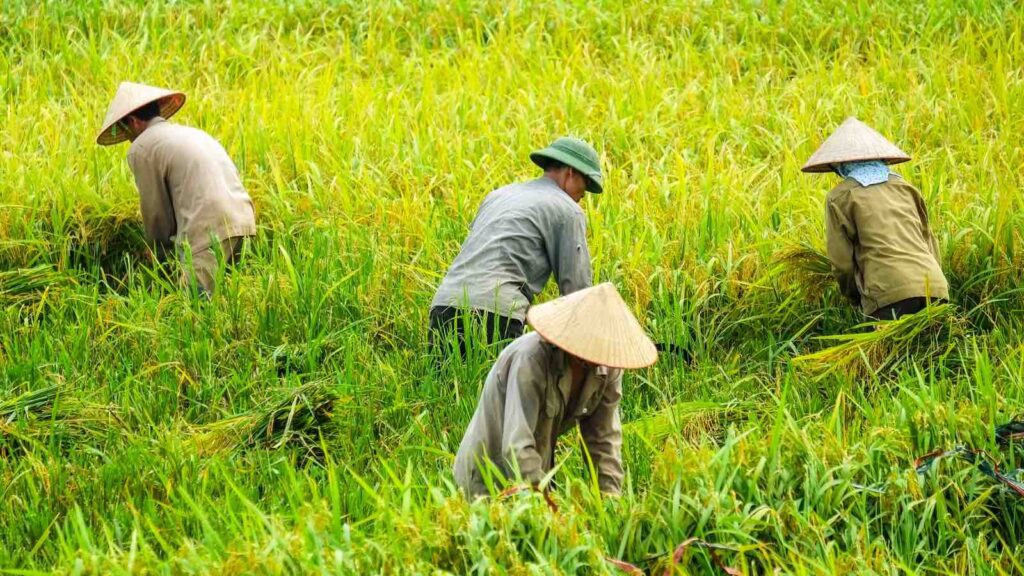

Across the project’s three completed cropping seasons, Vinarice has worked with more than 11,000 farming households on a cumulative area exceeding 48,518 hectares. Vinarice emerges as leading enterprise in sustainable rice production initiative.
A major low-emissions rice farming initiative in Vietnam’s Mekong Delta is showing strong economic and environmental results after three cropping seasons, with Vinarice emerging as the top-performing enterprise in the project.
According to an independent verification report by Regrow Agriculture, the “Transforming Rice Value Chains for Climate Resilient and Sustainable Development in the Mekong Delta” (TRVC) project has demonstrated measurable success in promoting high-quality, low-emissions rice production across southern Vietnam.
The project, funded by the Australian government and the Netherlands Development Organisation in coordination with Vietnam’s Ministry of Agriculture and Environment, is increasingly being viewed as a potential model for climate-resilient agriculture in Southeast Asia.
RELEVANT SUSTAINABLE GOALS
Low-Carbon Rice Farming Expands Rapidly Across the Mekong Delta
At an awards ceremony for the 2025 summer-autumn crop season held on May 19 in Cần Thơ, participants cited Regrow’s findings showing that Vinarice ranked first among participating companies in implementation scale, emissions reductions and award value.
The company recorded 27,003 hectares under implementation during the latest crop cycle, achieving average emissions reductions of 3.8 tonnes of CO2 per hectare.
Farmer profit margins exceeded 49 per cent, while total prize money awarded to the company reached AUD$339,784, or approximately US$243,000.
The scale of Vinarice’s operations has grown rapidly since joining the initiative.
During the first season in summer-autumn 2024, the company began with just 997 hectares as a pilot project. By the winter-spring 2024–2025 season, the project area expanded to more than 20,518 hectares.
For the 2025 summer-autumn crop, the figure surpassed 27,000 hectares, underscoring the rapid scalability of low-emissions rice farming models in Vietnam’s key agricultural region.

More Than 11,000 Farmers Participate in Climate-Smart Rice Production
Across the project’s three completed cropping seasons, Vinarice has worked with more than 11,000 farming households on a cumulative area exceeding 48,518 hectares.
This represents 57 per cent of the TRVC project’s total implementation area.
Total emissions reductions achieved by the company reached 183,977 tonnes of CO2 equivalent, accounting for 57 per cent of the project’s total greenhouse gas reductions.
The broader TRVC initiative forms part of Vietnam’s national strategy to develop one million hectares of high-quality, low-emissions rice cultivation linked to green growth in the Mekong Delta by 2030.
The programme is being implemented across An Giang Province, Đồng Tháp Province and Kiên Giang Province between 2023 and 2027.
Sustainable Farming Methods Deliver Economic and Environmental Benefits
Since August 2023, participating enterprises have applied a range of sustainable agricultural practices designed to reduce emissions while maintaining productivity and profitability.
These include improved input management, straw management systems, alternate wetting and drying irrigation techniques, and cultivation practices aligned with Vietnam’s low-emissions rice development programme.
According to Regrow Agriculture’s independent assessment, the 2025 summer-autumn crop generated strong economic, environmental and social outcomes.
Average farmer profit margins reached 49.3 per cent in Đồng Tháp Province and 51.6 per cent in An Giang Province.
The overall project average reached 50.8 per cent, significantly exceeding the programme’s minimum target of 30 per cent.
Total emissions reductions during the season amounted to 164,494.4 tonnes of CO2 equivalent.
All 10 enterprises participating in the third completed crop season met the programme’s requirements, including minimum farmer profit levels, greenhouse gas reduction standards, and policies supporting gender equality and social inclusion.
Climate-Resilient Agriculture Gains Momentum in Vietnam
At the awards ceremony, SNV Country Director Christie Getman said the project has demonstrated that large-scale transition toward low-emissions rice production is achievable through close cooperation between businesses, cooperatives, farmers and development partners.
“Participating enterprises have piloted various advanced rice production models, promoting more efficient use of seeds, fertilisers and irrigation, while contributing to greenhouse gas emissions reductions without compromising productivity and profitability,” Getman said.
The project is increasingly attracting attention as governments and agricultural producers across Asia search for ways to strengthen food security while reducing climate-related emissions.
Rice farming remains one of the region’s most emissions-intensive agricultural sectors, particularly due to methane emissions from flooded rice paddies.
Carbon Credits Emerging as New Opportunity for Vietnam’s Rice Sector
Vietnamese agribusiness groups involved in the initiative are now looking beyond productivity gains toward new revenue opportunities linked to carbon markets.
PAN Group and its subsidiaries, including Vinaseed, Vinarice and VFC, are continuing to develop integrated solutions aimed at building a sustainable, high-quality and low-emissions rice industry.
One major focus is the future development of carbon credits tied to emissions reductions in rice production.
Nguyễn Thị Trà My, chief executive officer of PAN Group and chairwoman of Vinaseed, said transforming Vietnam’s rice industry requires a full value-chain approach that includes seeds, cultivation, crop protection, procurement, processing, branding and market development.
“If value chains are organised systematically and meet international standards, emissions reductions can be recognised as carbon credits, creating new value for Việt Nam’s rice industry and generating additional income for farmers,” she said.
As global demand grows for sustainable agricultural products and climate-smart food systems, Vietnam’s Mekong Delta is increasingly positioning itself at the centre of the region’s transition toward low-emissions farming.
You may also be interested in :
Optimising Greywater Use in Agriculture: A Sustainable Solution For Indonesia Amid Climate Change
