The opinions expressed here by Trellis expert contributors are their own, not those of Trellis.
Imagine you’re at the store picking out a bottle of wine for a dinner party. You see two Reds that claim to have the same tasting notes, but one is $25 and one is $5. Which are you more likely to buy if you want to impress your guests?
Social and marketing psychology studies have consistently found that people associate higher-priced goods with higher quality, even if they’re identical. You can literally measure that association in our brains because scientists have found that telling people something is more expensive stimulates activity in their medial orbitofrontal cortex, the part of our brain that’s associated with pleasant experiences.
Marketers have long exploited this phenomenon, called the price placebo effect. But the trend is also present in carbon credit markets, where we see misperceptions of “quality” getting priced into the market and buyers starting to believe that higher prices mean higher quality.
Similar quality, differing perceptions
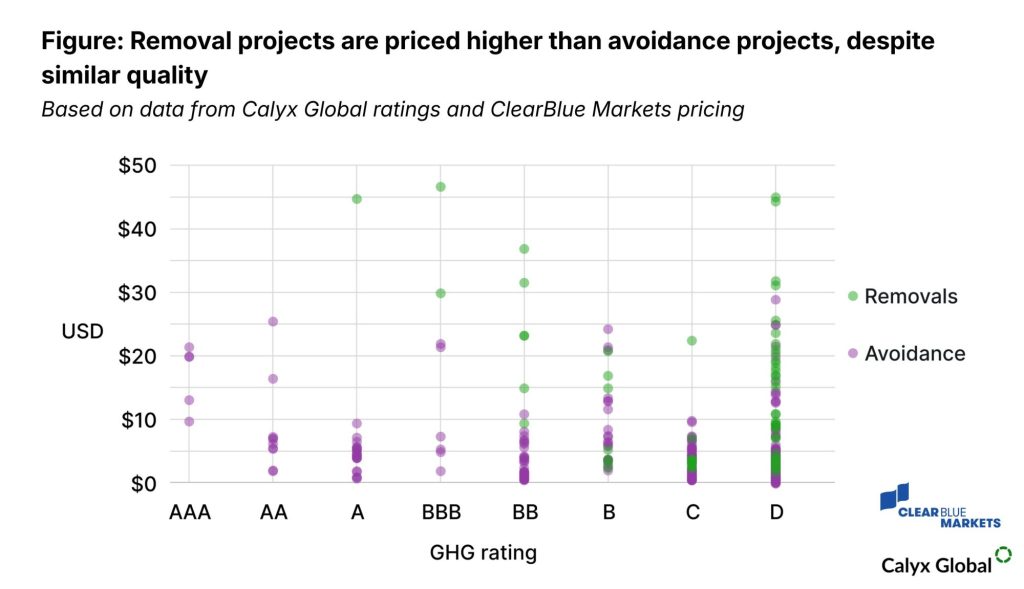
Removal-based credits (projects that suck CO2 out of the atmosphere), for example, are generally priced higher than avoidance credits (those that prevent emissions), perhaps because they feel more tangible. But the atmospheric math is actually the same — whether you avoid putting a molecule of CO2 into the atmosphere or suck one out, the impact on global warming will be the same.
This has led to some projects marketing themselves as removal-based, even when the majority of the mitigation is actually avoidance. Consider cement projects that remove a very small amount of CO2 (by storing it in the cement). Yet the vast majority of the climate benefit claim is related to avoiding emissions by using less cement.
Another highly-priced credit type is engineered removals, such as taking CO2 from the atmosphere and storing it in geological formations. These are technologies that we will need for a safe planet because we’re likely to “overshoot” on emissions. However, these processes can be very expensive — credits often cost well over $100 per tonne — but don’t necessarily produce a higher climate benefit than, for example, reducing the use of fossil fuels or destroying methane from landfills, mines, manure treatment facilities or wastewater. There are, as one can see from the image above, higher-quality (AAA, AA, A) credits at prices under $10 per tonne.
Psychology studies show the perceived connection between price and quality “is most pronounced under conditions of uncertainty and limited information” and that price is less likely to affect perceptions of quality once you actually try a product. In this regard, the price placebo effect is a custom design problem for carbon markets. The market has serious issues with transparency and limited information. And buyers rarely get to “experience” their purchase to determine its quality in the same way that you taste a glass of wine. When you purchase an offset, you’re often going on faith that the corresponding greenhouse gas emission reduction will take place halfway around the world.
Finding high-quality credits
Instead of relying on price perception, companies can use a strategy based on four principles:
Don’t use price as a proxy for today’s market
Today’s market doesn’t always have strong price-quality correlation. There have been a lot of studies and articles on forestry credits, so we are starting to see that higher prices do, in fact, signal higher quality for forest carbon credits. However, credits related to the reduction of non-CO2 gases from landfills, refrigeration, air conditioning or insulating foams are not well understood by the market. These “super pollutant” credit types are becoming more popular, but have poor price-quality correlation.
Focus on the science, not the hype
Buyers often select credits based on the stories they can tell about them. This has resulted in charisma playing a larger role in credit selection than science. Credits that protect mega-fauna in forests or generate human-interest stories are often preferred by credit buyers. Protecting biodiversity and improving lives are excellent objectives, but differ from the climate benefit that carbon credits claim.
Build a portfolio
In my view, a portfolio approach is the best approach for offsetting because it can integrate multiple climate actions that the world
Read More