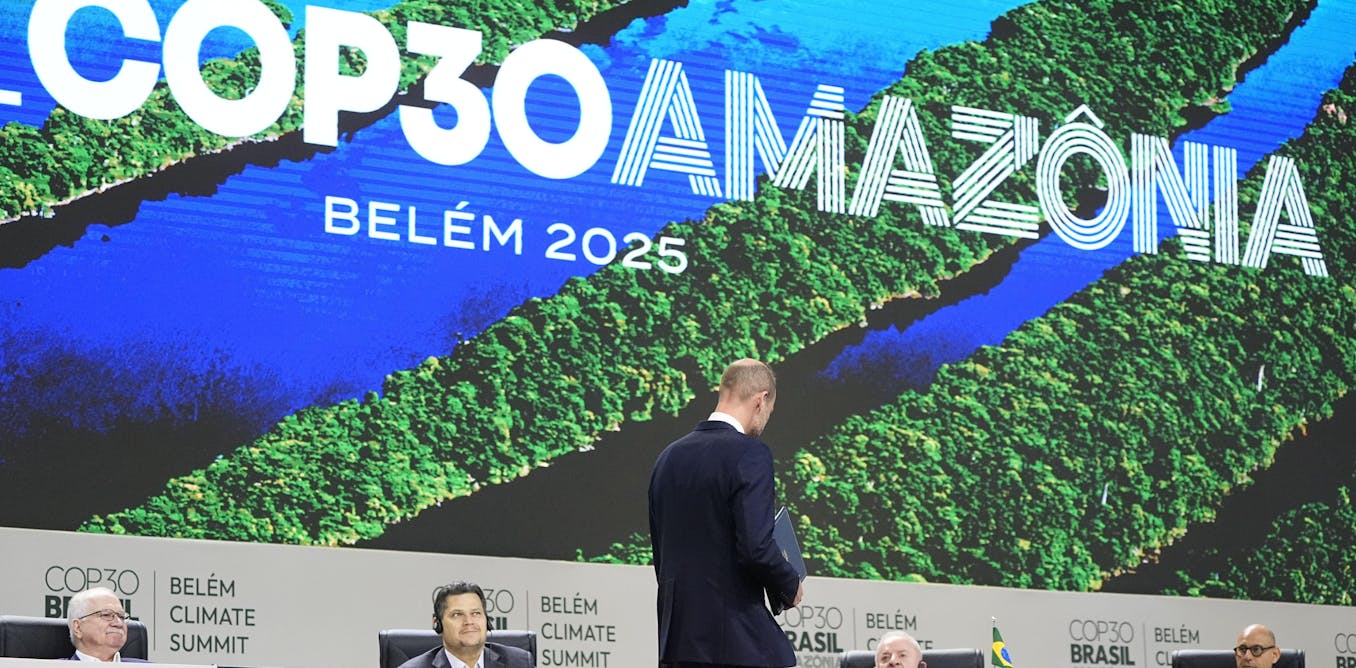

It is easy to be cynical about the annual circus of UN climate negotiations that takes place at “Cop” – the Conference of the Parties to the UN’s climate convention.
As delegates gather in the Amazonian port of Belém, Brazil for this year’s Cop30, familiar complaints have returned: the summits are too big and bureaucratic, and aren’t making enough progress. After three decades of annual conferences, global emissions are still rising – and critics say the process is failing.
But that misses the point. Emissions are rising much more slowly now than they would have been without the UN regime. In 2009, climate scientists were warning that, if countries did not curb their emissions, the world would face up to 6°C of warming.
Before the Paris agreement in 2015, the “business as usual” forecast was down to around 4°C. Today, the UN projects that without additional policies, the world will warm by around 2.5°C.
This steady decline has happened because, contrary to popular belief, the world really is acting on climate change.
Over the past 15 years the dramatically falling costs of renewable energy, particularly solar and wind, have led to an astonishing rise in their use. This year or next, renewables will generate more electricity than coal for the first time.
The same rapid transition been happening with electric vehicles, which now represent more than a fifth of global car sales.
Sceptics say this is due to technological innovation, not UN conferences. But innovation doesn’t just “happen”: it is driven by policy which makes it profitable.
Over the past 20 years, governments all over the world have introduced fuel efficiency standards, renewable energy targets and subsidies that have spurred companies to improve the new technologies.
As prices have fallen – particularly since China started mass producing green technologies in the 2010s – the targets could be tightened, leading to still lower costs. It has been a virtuous circle: policy driving innovation and vice versa.
The quiet power of the Paris agreement
This is why the UN climate process matters. The Paris agreement obliges every country to produce ever-stronger climate targets and plans every five years.
Without this coordinated international framework, there would have been little chance that so many countries – with different political cycles and economic circumstances – would move simultaneously in the same direction. It is this global commitment that drives the growth of low-carbon markets.
But, continue the critics, the national plans are not enough. Around 2.5°C of warming may be better than 6°C, but it will still be catastrophic.
It is true that the Paris agreement has a fundamental (though politically necessary) flaw: it sets a global temperature goal, but then leaves it to each country to decide what they will do to meet it. When the new set of national pledges are added up, they don’t yet align with the 1.5°C-2°C target. The resulting “emissions gap” seems to prove the critics correct.

But that conclusion would be too hasty. The national pledges, known as “nationally determined contributions” or NDCs, are not forecasts.
Under a legally binding treaty, countries do not wish to set targets which unforeseen events mean they might not meet. But many, including China, see NDCs as floors not ceilings – a political statement of minimum intent.
China’s new NDC is a case in point. Many commentators described it as “disappointing”. But in announcing it, President Xi Jinping has explicitly said that the country would strive to exceed its targets. Its record over the past 15 years shows it tends to do just that.
Read more: When China makes a climate pledge, the world should listen
Another reason for optimism is that developing countries still don’t know how much financial support they will receive. But that will become gradually clearer over the next few years. At Cop30, Brazil and last year’s host Azerbaijan will present the “Baku to Belém Roadmap”, a plan to raise US$1.3 trillion (£1 trillion) a year in international climate finance by 2035.
If even part of this is delivered, many emerging economies will be able to cut emissions faster (and do more to adapt to climate change) than their current plans suggest.
The summits have done their job
Finally, climate action is increasingly taking place outside the formal negotiations. The 2015 Paris agreement already established the architecture. Now, progress depends less on negotiating new rules and more on implementing them.
That’s why Brazil has described Cop30 as the “implementation Cop”, with a focus on the “real world” of economic development, poverty reduction, green technologies and investment finance. The conference is due to see announcements of major new initiatives in – among other areas – tropical rainforest protection, sustainable fuels, regenerative agriculture, carbon markets, methane emissi
Read More