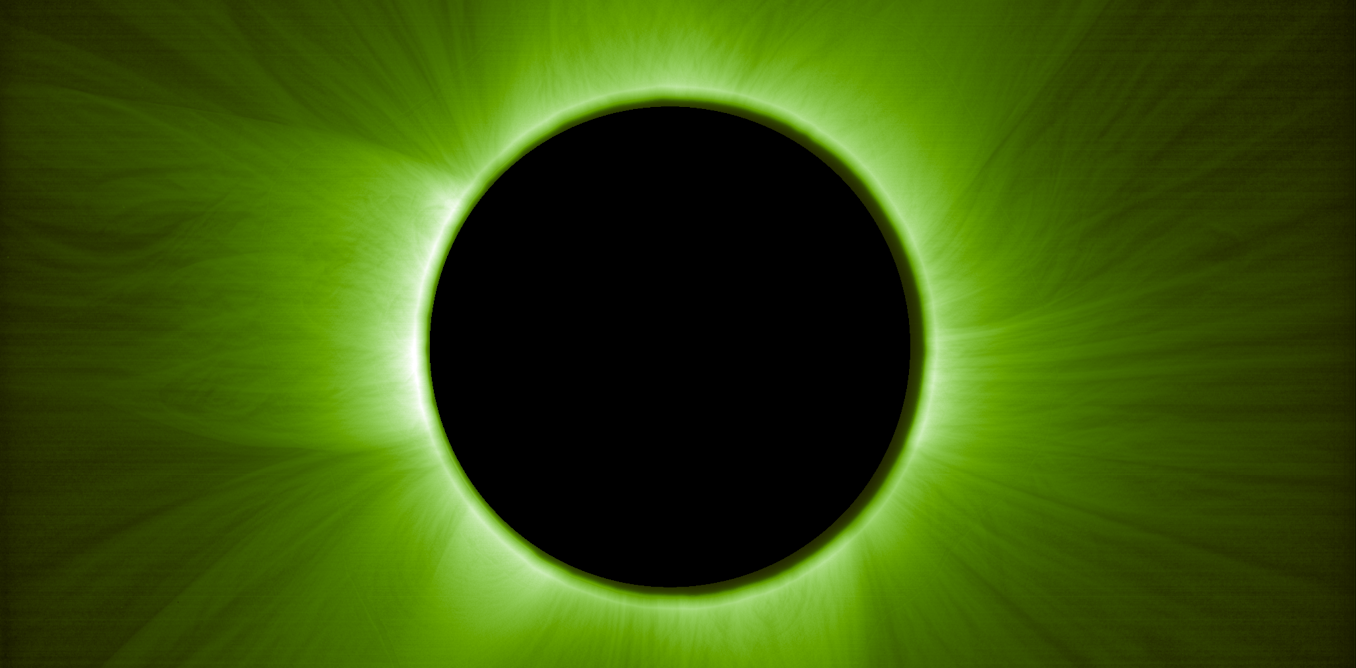

When a solar storm strikes Earth, it can disrupt technology that’s vital for our daily lives. Solar storms occur when magnetic fields and electrically charged particles collide with the Earth’s magnetic field. This type of event falls into the category known as “space weather”.
The Earth is currently experiencing one of the most intense solar storms of the past two decades, reminding us of the need for ways to understand these events.
An international team of researchers (including us) is working on a spacecraft mission that would enable researchers to study the conditions that create solar storms, leading to improved forecasts of space weather.
The proposed mission, known as Mesom (Moon-enabled Sun Occultation Mission), aims to create total solar eclipses in space. This would allow researchers to view the Sun’s atmosphere in more detail than ever before.
The need for a better understanding of solar storms is evident from looking at past disruptions. In 1989, for example, the Canadian province of Quebec was forced into a nine-hour electricity blackout by a coronal mass ejection (CME) – a huge burst of hot plasma and magnetic field thrown off from the Sun’s atmosphere towards space.
The event, which affected both Canada and the US, is estimated to have cost tens of millions of US and Canadian dollars – both in lost business productivity and the need to replace damaged power equipment.
In May 2024, a succession of similar solar eruptions caused thousands of satellites in low-Earth orbit to abruptly drop in altitude. GPS outages cost US farmers alone an estimated US$500 million (£370 million).
But these storms were significantly weaker than one in 1859, also the result of a CME, which is known as the Carrington Event. Electrical currents flowing through telegraph wires caused a range of effects in telegraph offices across North America and Europe. Operators received electric shocks – with one in Washington DC receiving a serious injury – and sparks triggered small fires in some telegraph offices.
Today, a Carrington-like event would have far more dramatic consequences on our technology-dependent world, as has been recognised by different UK governments since 2012.
Yet, our view of the Sun’s outer atmosphere, the solar corona – from which CMEs and other adverse space weather events originate – remains dazzled by the bright light emanated from the Sun itself. A new UK-led spacecraft mission aims to change that by recreating total solar eclipse conditions in space.
Better forecasting
During total solar eclipses, the incredibly high-intensity radiation emanating from the visible surface of the Sun is occulted (covered) by the Moon, leaving behind a faint glow of light that comes directly from the outer layers of the Sun’s atmosphere, the corona.
Observing the physical processes in the corona at different timescales and wavelengths is key to enabling better forecasting of space weather – a crucial part of protecting Earth against Carrington-like events – as well as solving longstanding mysteries of our star. These include how the hot plasma of its volatile atmosphere is confined and released by the evolving magnetic fields that thread through it.
Unfortunately, total solar eclipses are predictable yet rare events that only last for a few minutes. All total eclipses predicted in the 21st century will last less than seven minutes each, and will occur only once every 18 months, on average.
Total solar eclipse measurements from the ground are also subject to weather conditions and suffer from distortions and loss of detail, caused by the interaction of the faint coronal light with the Earth’s atmosphere.
For decades, scientists and engineers have observed the corona by artificially covering the Sun using clever optics and instrument design inspired by the pioneering work of Bernard Lyot, a French astronomer who first come up with the idea of a “coronagraph”.
Coronagraphs are telescopes equipped with an occulting disk to block out the overwhelming radiation emanated from the visible surface of the Sun, along with optical stops and filters that are positioned to suppress the light diffracted (scattered) by the disk itself.
In a coronagraph, the faint coronal light can finally reach the instrument’s focal plane, where it is converted into digital signals using photoelectric sensors. This is the working principle of the Large Angle and Spectrometric Coronagraph (Lasco 3) onboard the Solar and Heliospheric Obser
Read More