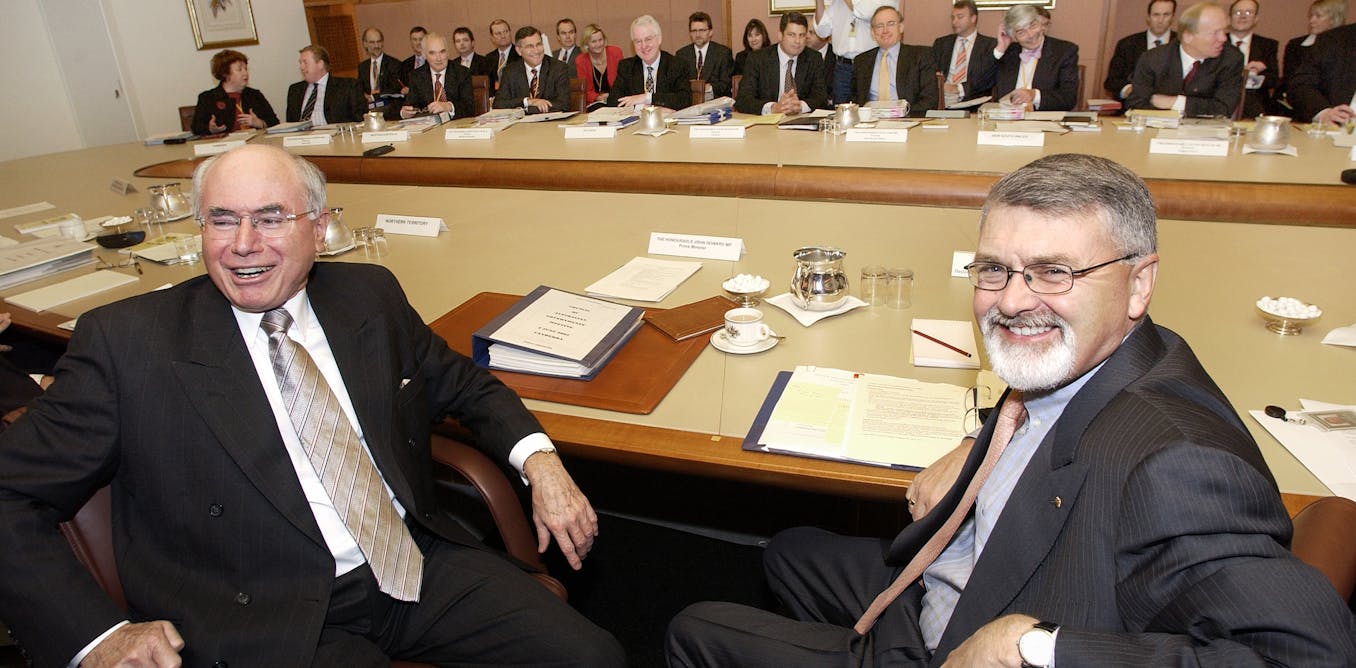

Today, the National Archives of Australia (NAA) released a key selection of records of the Australian Cabinet and its National Security Committee from 2005.
The election in October 2004 had given the Howard government a commanding majority in the House of Representatives. From July 2005, it also obtained control of the Senate, a rare accomplishment for any Australian government.
Freedom from having to negotiate with the Senate cross bench on legislation emboldened the cabinet in several directions. Most significant was the government’s plan to initiate the comprehensive reform of Australia’s industrial relations laws.
Introduction on WorkChoices
In March 2005, Cabinet agreed with suggested reforms that would encourage a more direct relationship between employers and employees. The reform package approved by Cabinet sought to replace separate state and federal industrial relations systems with a unified national system. It was known as WorkChoices and, once passed, the act would come into effect on March 27 2006.
The new system dispensed with unfair dismissal laws for companies under a certain size. It also replaced the “no disadvantage test” (NDT), a provision that required workers be no worse off under new enterprise agreements as compared to any relevant law or award. This was superseded by a more limited safety net of five conditions that could be bargained away. The new system also restricted trade union power by limiting workers’ ability to strike and allowing them to bargain for conditions without collectivised representation.
The new industrial relations laws sparked a major campaign of resistance. Defence of employees’ rights was led by the Australian Council of Trade Unions (ACTU). The ACTU’s “Your Rights at Work” campaign would play a significant role in the Howard government’s defeat in 2007.

Security and regional issues
Industrial relations reform was the key issue for the remainder of Howard’s fourth term. But security and regional issues continued to be important.
The tsunami that devastated countries in the Indian Ocean region in December 2004 killed 290,000 people and displaced more than one million. Howard attended a Special Leaders’ Meeting of the Association of Southeast Asian Nations (ASEAN) on January 6 2005. There he promised that Australia would “do its bit” towards regional efforts to establish a tsunami warning system in the Indian Ocean.
Indonesia had a pressing need for reconstruction assistance. By providing such assistance, Australia was presented with a unique opportunity to improve a relationship with Indonesia soured by East Timor’s winning of independence in 2002.
Cabinet reached the decision in February 2005 to provide $1 billion for relief and rehabilitation, with a focus on Sumatra. Later, in June 2005, it agreed to recommendations by Minister for Foreign Affairs Alexander Downer to extend cooperation with Indonesia in defence and combating terrorism and people-smuggling.
2005 was a critical year for the extension of Australia’s commitment in Afghanistan. Australia had made a military contribution to US-led operations in Afghanistan in 2001-02 through the deployment of Special Air Service (SAS) elements. But in 2002, the SAS Task Force was withdrawn.
By 2004, with the Taliban resurgent, the US Central Command was requesting a further contribution of Australian special forces to the US-led Operation Enduring Freedom. Defence Minister Robert Hill advised Cabinet that a further Australian contribution in Afghanistan “may enhance our already strong relationships with the US and the United Kingdom, and develop our relationship with NATO”.
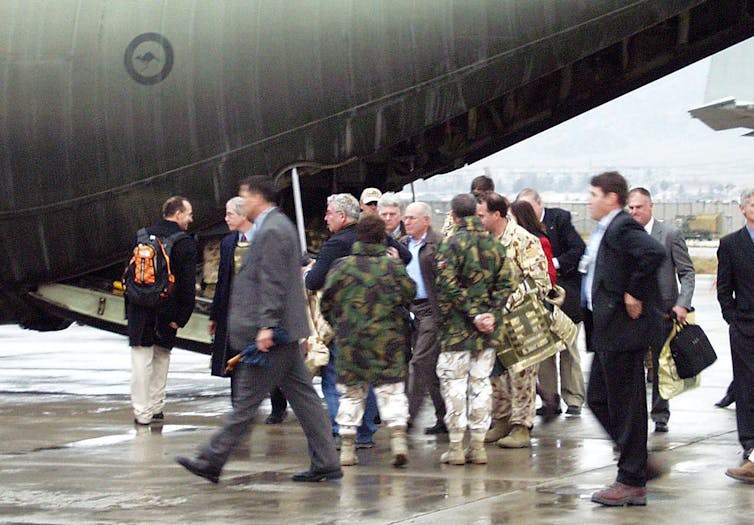
The National Security Committee agreed to Hill’s submission to deploy a Special Forces Task Group within the Combined Forces Command – Afghanistan. The SAS would stay in Afghanistan until 2021 in what became 20 rotations involving 3,000 personnel.
Australia’s close relationship with Japan had much to do with the Cabinet agreeing in 2005 to an Australian military contingent providing a secure environment for the Japanese Iraq Reconstruction and Support Group, which was operating in the Al Muthanna province in southern Iraq.
The increasing tempo of the insurgency in Iraq was highlighted in May 2005, when Australian engineer Douglas Wood was kidnapped. Howard insisted Austr
Read More