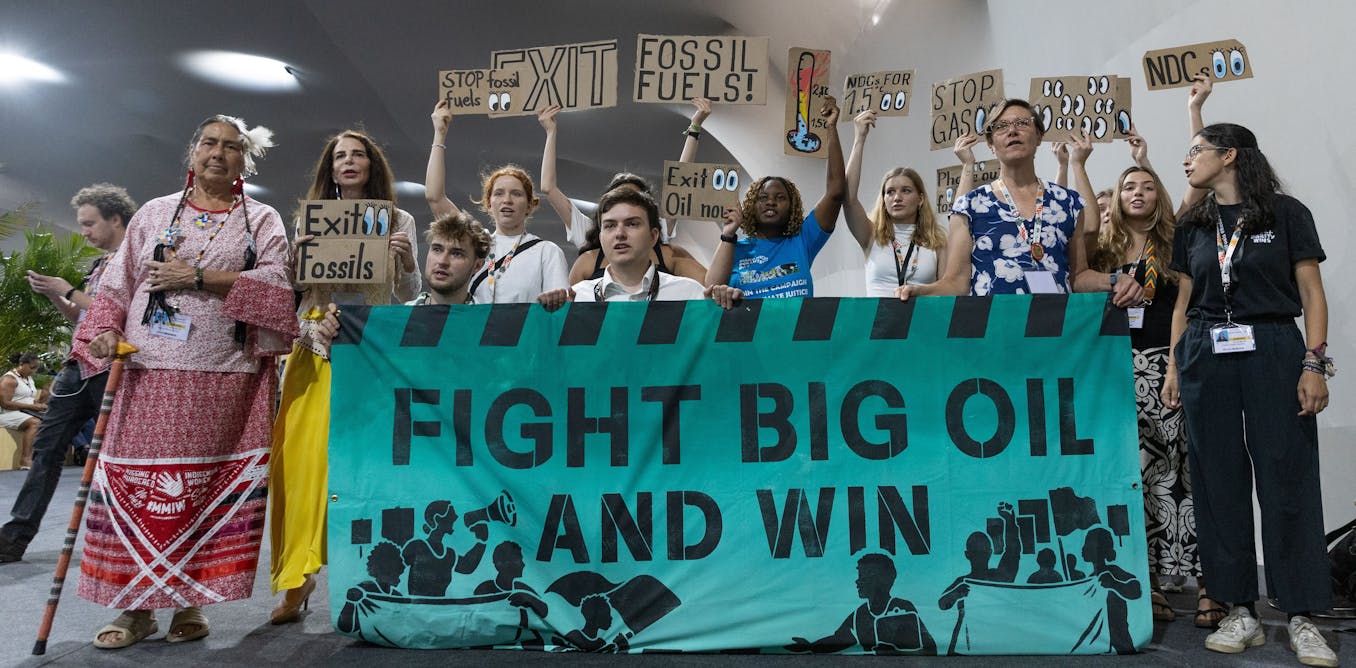

The latest United Nations climate summit (COP30) was held between 10 and 21 November in Belém, Brazil. Although the event did not end with any significant progress towards the goals of mitigating global warming or advancing climate finance, it did leave us with one positive outcome: a group of countries has launched an initiative to phase out fossil fuels.
This summit was groundbreaking for two interrelated reasons. The first is that, in contrast to the three previous conferences, which were heavily policed, the streets of Belém were filled with protests. Thousands of demonstrators, including a large number of indigenous people, gathered to demand environmental justice, a term that refers not only to the consequences of climate change, but also to the need to protect territories and lives from the local impacts of oil extraction activities.
The second reason is that, for the first time, the need for a roadmap to abandon fossil fuels played a prominent role. Despite their key role in climate change, fossil fuels have been absent from COP decisions. Only the final agreement of COP28 in 2023 mentioned a vague intention to “transition away from fossil fuels”. This disappeared the following year at COP29, mainly due to pressure from Saudi Arabia.
But at COP30, more than 80 countries – led mainly by Colombia (itself an exporter of coal and oil) and Spain, and including most European Union countries – have called for a roadmap to phase out fossil fuels.

Oil producers resist climate action
The 2015 Paris Agreement led countries to adopt greenhouse gas emission reductions targets, or “nationally determined contributions” (NDCs). These measures are clearly insufficient to achieve their goal of mitigating climate change by limiting global warming to 1.5C.
States were also required to subsequently update their NDCs, but any revisions have either been very tentative or non-existent.
In 2024, the average temperature increase compared to pre-industrial times already exceeded 1.5C, and the latest United Nations report on the emissions gap indicates that, even if current national commitments were strictly met, the future increase would still be well over 2C.
Oil-producing countries, led by Saudi Arabia and Russia, fiercely opposed even mentioning the term “fossil fuels” in the COP30 final statement. In doing so they are not showing opposition to a particular type of climate policy, but rather blocking the one essential condition for the Paris Agreement’s goal to be met: a rapid and radical decrease in fossil fuel extraction.
Read more: Fossil fuel supply: the elephant in the room at climate change conferences
Phasing out fossil fuels
Reducing fossil fuel supply will not be easy, and must be approached equitably. This means the areas at greatest environmental and social risk must be made a priority, local communities need to have a say, and financial compensation must be established where necessary.
One cannot simply expect national policies that affect demand for fossil fuels – such as the promotion of renewable energy or carbon pricing – to cause a corresponding reduction in the extraction and sale of fossil fuels. This outcome is by no means guaranteed, and such measures may even cause some governments and companies to accelerate the extraction of fossil resources in anticipation of worse times for business – the so-called “green paradox”.
Supply and demand are both key, and must be managed in the most multilateral way possible.
A COP of contrasts and contradictions
COP30 saw massive demonstrations by indigenous people, but there were also, as in previous COPs, huge numbers of lobbyists present. They not only represented the fossil fuel industry, but also the agricultural and livestock businesses that are destroying the Amazon.
The host country itself is a testament to these contradictions. Its president, Lula da Silva, made it a priority to create a fund against deforestation for tropical forests, but he has also approved new oil exploration by Brazil’s state-owned company Petrobras in the Amazon, ignoring cries from the country’s indigenous populations of “Our land is not for sale.”
This all occurred while Brazil’s Minister of the Environment, Marina Silva, urged all countries to have the courage to address the need to phase out fossil fuels.
No new climate finance
Climate financing involves payments from wealthy countries, who are historically responsible for global warming, to the poorest countries most affected by it. When talking about this, the official language of COPs has always avoided the term “climate justice”, and “reparations” even more so. However, there is talk of “differentiated responsibilities” and “equity”.
Read more: How colonialism's legacy makes it harder for countries to escape poverty and fossil fuels today
The Paris Agreement proposed mobilising around $100 billion annually for climate mitigation a
Read More