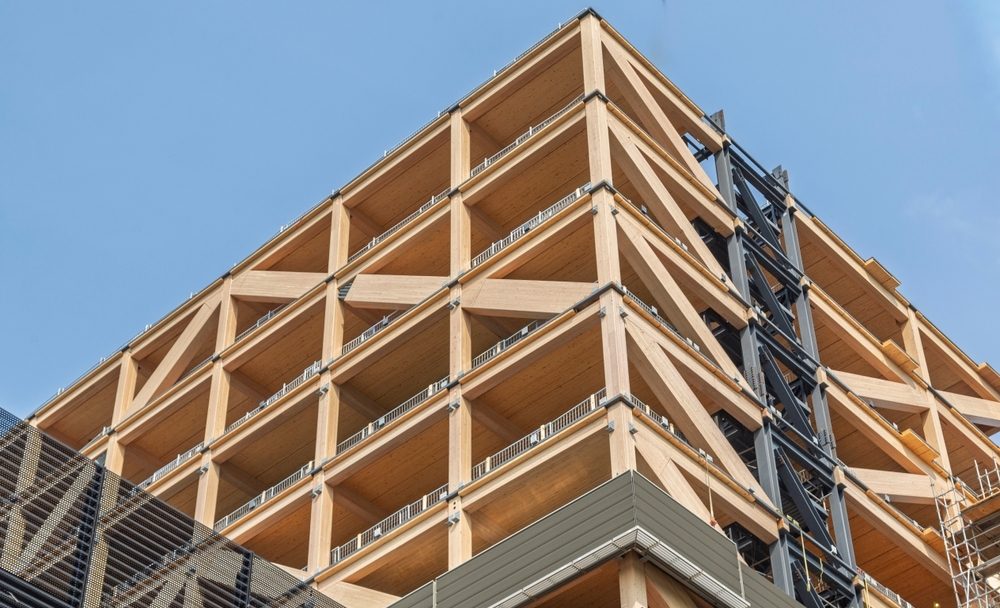
While sustainable solutions are facing drastic funding cuts and even outright opposition, mass timber as a sustainable construction material is steadily gaining traction across the United States.
Construction using mass timber began in 2015 in the U.S., and since then the number of projects has grown about 20 percent annually. Today, over 2,500 mass timber projects are built or in progress in the U.S., including corporate offices for companies such as Google, Microsoft and Under Armour.
This is a “pivotal year” for mass timber construction, wrote Ricardo Brites, director of engineering and virtual design and construction at Mercer Mass Timber, on Woodworking Network.
Made of structurally engineered timber beams, these buildings are not only climate-friendly, but also beneficial for employees: They offer substantially lower embodied carbon along with noticeable positive impacts on occupants.
“We have lots of tech firms and big companies that say, ‘Hey, we’re battling it out for workers. We want the best space possible,’” said Bill Parsons, chief operating officer at WoodWorks, a non-profit industry organization for timber construction. “A good office has been really important to people, and those tend to be wood offices.”
How mass timber stacks up
Buildings and construction account for 37 percent of global greenhouse gas emissions, according to a 2023 report by the United Nations Environment Program. The production of cement and steel for construction accounts for 11 percent of global emissions.
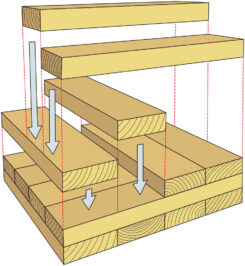
Mass timber is made of layers of lumber glued together to form a single, strong beam. The two most common varieties are cross-laminated timber, where lumber boards alternate directions as they are stacked, like a Jenga tower, and glue-laminated timber where boards are stacked in parallel.
Replacing conventional building materials with mass timber has the potential to reduce global emissions by 14 percent to 31 percent, according to the U.N. report.
The new Under Armour building in Baltimore saved over 69 percent on embodied carbon by replacing steel and concrete with mass timber, according to Gensler, the architecture firm that designed the building.
“The use of mass timber was a lead contributor in reducing the site’s carbon emissions and supported a quicker, more seamless construction process,” said Kathy Blessington, vice president of real estate at Under Armour, in an email.
While some builders and regulators are wary of supposed fire risk with mass timber buildings, regulations in the U.S., France and elsewhere have gradually shifted to accept multistory wooden buildings, which, in fact, perform comparably to steel and concrete buildings in regard to fire resistance.
Mass timber’s inherent fire-resistant properties have been well-established, said Edward Becker, associate professor of architecture at Virginia Tech. “The evidence of the success of these fire tests and the safety for the general public is evidenced in the international building code changes over the last couple of years.”
It is paramount, though, that mass timber is sourced responsibly. The Forest Stewardship Council (FSC) and Sustainable Forestry Initiative (SFI) provide certification for products that come from responsibly managed forests with safeguards that prevent deforestation.
Designers, architects and construction managers “should check with the supplier,” said Becker. “It’s critical to look for things like FSC sourcing and SFI sourcing. That’s an easy way to make sure that it’s ethically sourced.”
Mass timber’s popularity boom
Legislation that promotes and programs that fund mass timber, such as the Mass Timber Federal Buildings Act and the Wood Innovations Grant Program from the USDA, are still progressing, for now. But wider repercussions from government funding cuts are affecting the industry.
“While we haven’t seen specific cuts to mass timber programs themselves, the broader forestry infrastructure that supports our industry is facing significant reductions,” said Nick Milestone, chief operations officer at Mercer Mass Timber.
Data from the 2024 International Ma
Read More