
Like many fast-growing companies betting on artificial intelligence, Salesforce is pacing far behind its climate action plan.
The $38 billion enterprise software business said in 2021 that it would halve absolute emissions by 2030. Four years later, the company can point to solid progress on cutting emissions from electricity use. But those gains have been entirely canceled out by emissions growth elsewhere, including in the data centers that power its AI products.
Against that backdrop, the company has dramatically shifted how it intends to cut the biggest part of its carbon footprint. In the latest installment of Chasing Net Zero, our in-depth series that includes profiles of emissions progress at ArcelorMittal, Nestlé and GSK, we unpack the forces behind the move and explain why some observers are asking whether the switch has weakened Salesforce’s ambition on climate action.
Salesforce is now basing its Scope 3 target — which includes data centers and other sources outside its immediate control, such as goods from suppliers — on improvements to emissions intensity rather than absolute reductions. Using this measure (Scope 3 emissions divided by the company’s gross profit) leaves open the possibility that the company’s absolute emissions could increase even if it meets its goal.
What’s more, an analysis by Trellis of the company’s new intensity commitment suggests it will likely hit its goal just a year after setting it, raising questions about the depth of its ambition.
Salesforce describes its decision to lean into emissions intensity, outlined in its most recent stakeholder impact report, as a “more actionable and pragmatic” route to net zero. “For a high-growth company like Salesforce, this approach is more practical given that growth may outpace the global rate of decarbonization,” said Sunya Norman, senior vice president of impact.
Leadership legacy
Salesforce became one of the earliest companies from any industry to embrace net zero when co-founder and CEO Marc Benioff signed a splashy 2015 pledge organized by fellow billionaire Richard Branson.
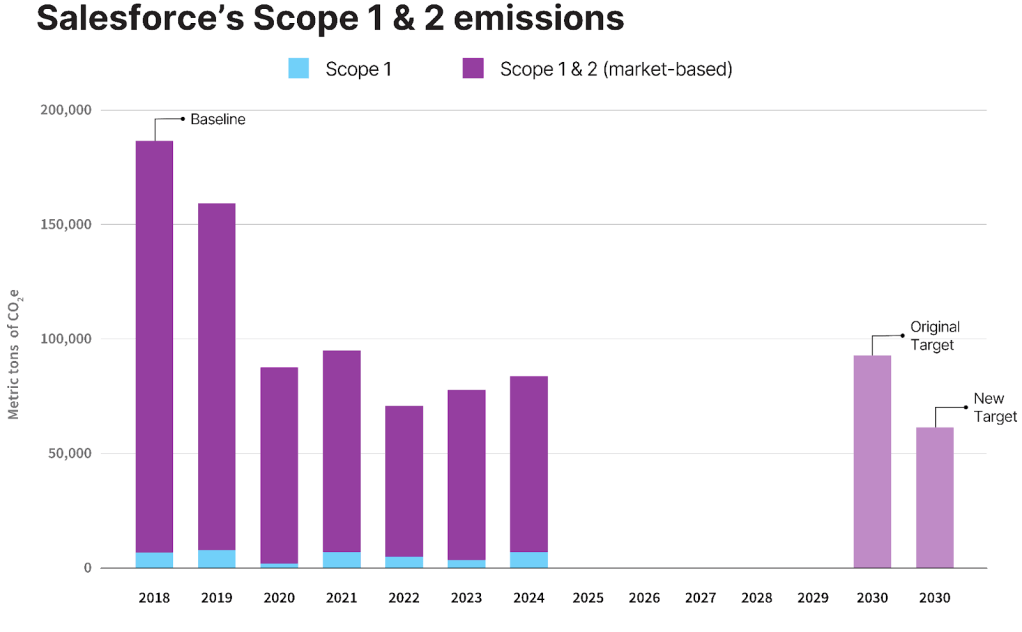
Its initial plan, validated by Science Based Targets initiative (SBTi) four years later, called for halving emissions from operations and electricity use (Scopes 1 and 2) by 2030 — a commitment Salesforce achieved several years early thanks to investments in renewables. Subsequently, it has upgraded to a more ambitious 2030 target for Scope 1 and 2.
The 2019 plan also targeted a 50 percent cut to emissions from use of fuel and energy elsewhere in the company’s value chain. In a 2021 climate action plan, Salesforce expanded that commitment to all upstream and downstream Scope 3 emissions, including electricity consumed by data centers that run its software, but which the company doesn’t own. (The company did not have that broader pledge validated by the SBTi.)
To shrink its biggest emissions source — purchased goods and services, including the cloud capacity it sources from Amazon Web Services and Google — and meet a 2019 goal of having 60 percent of Scope 3 emissions come from suppliers with science-based targets, the company uses contracts that require strategic suppliers to cut emissions. Salesforce also turned its climate strategy into a source of business, packaging the system it built to track its emissions into a product called Net Zero Cloud, priced at $210,000 annually.
Yet progress on overall emissions has been a victim of financial success. Since setting its first science-based targets, Salesforce has acquired data analytics software provider Tableau and messaging software firm Slack. It’s also merged with AI management player Informatica. The moves helped triple revenues — and contributed to absolute emissions staying stubbornly flat.
In 2024, the company’s emissions were just 1 percent below its 2018 baseline inventory of roughly 1 million metric tons. While the company reached its 2030 reduction goals for Scope 1 and 2 two years ago, overall emissions from Scope 3 activities — which made up more than 90 percent of its 2024 emissions — swelled 10 percent between 2019 and 2025. The company also fell short of its Scope 3 fuel and energy use goals, as well as its supply chain coverage goal.
Reboot required
Salesforce undertook a cross-company review in 2024 to reconsider its science-based targets as part of SBTi’s five-year review requirements. It dedicated a data scientist to analyzing progress and forecasting future scenarios, using internal metrics such as headcount adjustments, expansion plans and revenue projections alongside third-party data including grid decarbonization forecasts.
The company’s market-based reduction targets for Scope 1 and 2 are now more ambitious: A 67 percent drop by 2030, compared with the 50 percent reduction previously sought and already delivered, followed by a 90 percent cut by 2041.
But it’s in Scope 3, which contributes the large majority of Salesforce’s total emissions, where things get more complicated. Instead of another absolute goal, the company is targeting emissions intensity cuts of 68 percent by 2031 and 97 percent by 2041.
Around 80 percent of companies with SBTi-approved plans have absolute reduction goals — and this method is what many investors and stakeholders expect. Still, the initiative’s Corporate Net Zero standard allows Scope 3 intensity goals in high-emitting sectors where growth is projected to be sector-wide and significant.
Salesforce is not the first tech company to make the switch: Design software firm Adobe opted for a Scope 3 emissions-intensity target when it updated its commitments in August 2024. Other well-known software developers are considering this option as part of the near-term target reviews that the SBTi requires every five years, according to insiders.
The megatrend underlying this thinking: Predictions of soaring energy use in AI data centers, which could consume 12 percent of all U.S. electricity by 2028. That’s driving an uptick in natural gas plant construction and is one reason why the three biggest software companies racing to claim AI leadership — Amazon Web Services, Google and Microsoft — have all seen recent increases in emissions.
“You could view these economic intensity targets as a way of managing emissions in the short term as we are waiting for mitigation technologies to scale,” said Emma Armstrong, executive director for North America at consulting firm Anthesis. “They can be challenging to achieve and, for most companies, will require a very meaningful decoupling of emissions from growth.”
Both of Salesforce’s new goals for emissions intensity are above the minimum required by SBTI, Norman said. “The way to think about our [old] targets versus our new targets is these Scope 3 targets are much more comprehensive, and they’re completely aligned to science-based target methodology that didn’t exist five years ago,” she said.
The idea of emissions intensity often resonates with business leaders outside the sustainability function, said Armstrong. “Ten years ago, companies could set a target, it could be very ambitious, but there was less high-level scrutiny,” she said. “Those days are 100 percent gone. You cannot take a target to senior management unless you can tell them exactly what you’re going to do to deliver.”
Easily achievable goal
How likely is it that Salesforce will reach its new near-term pledges?
The company won’t start offici
Read More