
The corporate climate “actionists” who converged in New York last week for the 16th annual Climate Week NYC are resigned to the reality that federal policy won’t favor their agendas for at least another three-plus years.
Even so, the majority of corporations with net-zero aspirations are not retreating from their top-level commitments. They’re just not talking about them as loudly.
At least three research analyses published to coincide with Climate Week NYC suggest that companies committed to reducing emissions and conserving nature and biodiversity are actually doubling down on that agenda:
- The number of U.S. companies with net-zero commitments rose 9 percent in the past 12 months, according to the Net Zero Tracker’s 2025 stocktake, which did note that most of those pledges aren’t very robust.
- A focused study that included 75 top companies by market capitalization found that while roughly 13 percent retreated from programs between April 2024 and May 2025, nearly one-third increased their investments.
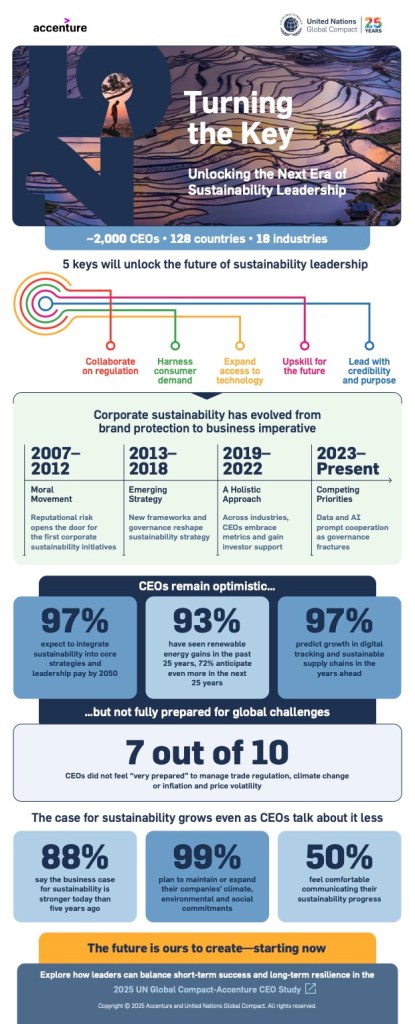
- Close to 90 percent of CEOs think the case for sustainability is stronger now than five years ago, according to research by Accenture and the United Nations Global Compact, which represents more than 20,000 member companies. Almost all of 2,000 surveyed executives expect to include these metrics in their core strategies and compensation structures by 2050.
“That makes sense, because being a business leader is not about opinions from one day to another, it’s about building, it’s about investing, it’s about transformation,” said Ingka Group CEO Jesper Brodin, referencing the Global Compact data during a panel discussion at the Nest Climate Campus. Ingka, IKEA’s largest retailer with $47 billion in revenue in 2024, is on pace to meet its 2030 target to halve emissions. A cross-functional committee of business leaders that meets at least eight times annually manages this strategy.
Only half of the CEOs responding to the UN Global Company survey, however, felt comfortable communicating this agenda — a refrain discernible in the other analyses.
“I think the corporate sector has gotten pretty quiet on these issues, whether or not they are moving forward,” said Patagonia CEO Ryan Gellert during a panel discussion at the Nest Climate Campus. “I think there’s a real lack of leadership right now from the business sector, a real lack of leadership response to what we’re navigating.”
Here are three themes of note from the weeklong industry gathering:
Real work continues
Some 100,000 people came to New York to attend more than 1,000 summits, panels, receptions, climate tech pitch sessions and countless face-to-face meetings.
“This week for me, is about finding new people that I have not known before, hearing about new climate initiatives,” said Kate Heiny, vice president of sustainability for Booking Holdings, the company behind travel sites including Booking.com, Kayak and Open Table. “I often look to other industries and not the one that I’m in. I think that learning from other places has always been something that I would look to for growth. So it’s people, it’s ideas.”
That need for connection, validation and fresh perspective was echoed in many of my interviews throughout the week. “I think it has just been great to see that the majority of companies are just plowing on like we are,” said another chief sustainability officer, speaking on background.
“I see very serious people doing really extraordinary things, continuing at full force and momentum,” said Andrew Mayock, who headed the federal government’s sustainability strategy under President Joe Biden.
Mayock was appointed the inaugural vice chancellor at the University of Colorado Boulder in March. He’s already shaping new master’s programs for integrating sustainability into business, engineering and policy. Mayock is also coordinating development of a new classification from the Carnegie Foundation for the Advancement that will recognize colleges and universities that include climate action as part of their mission.
“I’m really buoyed by being here,” he said.
AI debate gets more nuanced
Plenty of companies in attendance were willing to talk about how artificial intelligence stands to accelerate both their company’s environmental agenda and revenue growth.
Packaging company Ranpak, which counts Amazon and Walmart among its many big-name customers, is already deploying AI for applications such as rightsizing packages or detecting how much cushioning is needed to protect items in them. “What excites me, frankly, is the stuff that we haven’t figured out yet … the problems that haven’t even been identified yet that can be solved with all of this data,” said David Murgio, chief sustainability officer at the company.
NVIDIA’s head of sustainability, Josh Parker, downplayed ominous predictions abou
Read More