
The pathway from climate change to violent conflict is not simple. There are the obvious immediate effects of global warming like water scarcity and crop failure. But beyond these, climate stress can pave the road to violence through indirect channels – a gradual rise in food insecurity and growing social tensions that set the stage for more armed violence.
We are a team of researchers who investigate the links between climate change, food systems and conflict. We set out to explore the relationship between climate variability, child malnutrition and violent conflict.
Read more: Climate and mortality rates in Kenya, Mali, and Malawi: what we found
Our study focused on Nigeria. The country has faced rising temperatures, recurrent droughts, and one of the highest burdens of food insecurity and conflict in Africa. Its northern and north-eastern regions in particular have fragile agrifood systems, limited public services, and ongoing insecurity. This makes them especially vulnerable to the impacts of climate shocks.
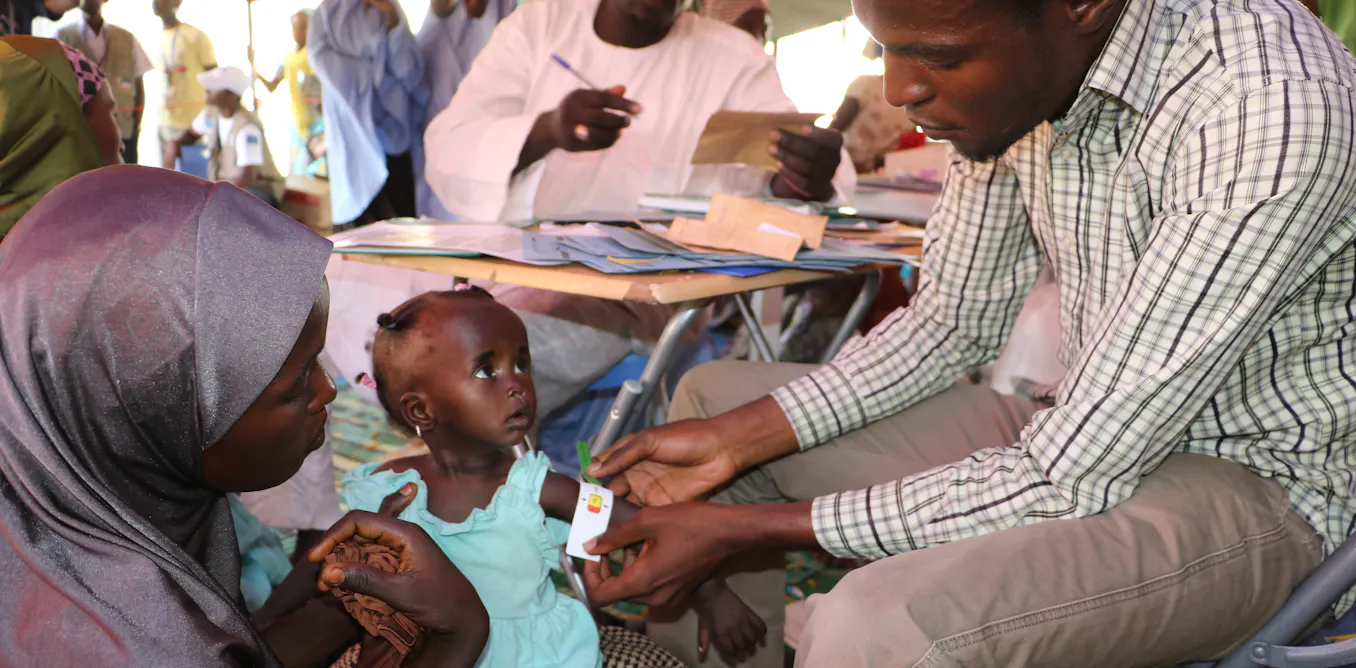
In north-eastern Nigeria, 8.8 million people are threatened by a nutrition crisis. About 12,000 children in the Lake Chad area suffer from acute malnutrition as a result of resource depletion, climate change and insecurity.
For our research, we used household data from the Nigeria demographic and health surveys and combined this with information on climate and conflict. We applied a system of equations to separate the role child malnutrition plays in climate-related conflict from other factors that aren’t easily observed but which contribute to shape the climate-conflict link.
From this, we found that rising temperatures don’t immediately trigger violence. Instead, they set off a chain reaction: heat stress on the planet over time stresses food systems. As crops fail and household incomes fall, the youngest and most vulnerable are often the first to show signs of distress and become malnourished.
Read more: The Lake Chad Basin is a security nightmare. 5 guidelines for finding solutions
Climate change contributes to higher rates of acute child malnutrition, or wasting. This is where children have very low weight for their height, usually because of sudden food shortages or illness. Wasting is one of the clearest signs that a child is not getting enough to eat.
In Nigeria, formal safety nets are limited. This means that the social strain of malnourished communities can become a powerful driver – or justification – for engaging in violence, mostly as a desperate alternative source of income or safety. People who aren’t getting the food they need may be increasingly inclined to support or be recruited by armed groups to ensure food security, shelter and physical protection.
One of the study’s key contributions is its use of child malnutrition indicators to trace the indirect effects of climate stress on conflict. Our research shows that acute malnutrition – especially wasting – is an early warning signal of social breakdown in fragile settings.
Read more: Malnutrition among children is rife in Nigeria. What must be done
We recommend that systems that give early warnings of conflict should analyse nutrition in climate change-affected areas and use the levels of malnutrition as a way to predict potential conflict. Taking nutrition into account is a practical way to anticipate and prevent violence before it erupts.
Malnutrition as a hunger signal
Think of climate-driven conflict like a tangled web. We’ve managed to trace one clear thread – malnutrition – and show how it is linked to violence. But even after accounting for that thread, the web still holds tight. That’s because other forces, like economic shocks, migration, or institutional breakdown, are still tugging at the system.
We carefully mapped the indirect role of malnutrition through a method that helps identify how one factor (climate stress) affects another (conflict) through an intermediate pathway (malnutrition), while also taking other factors into account. This enabled us to calculate the contribution of
Read More