
Technologies to remove carbon from the atmosphere have progressed rapidly. Unfortunately, early-stage funding has not kept pace.
In 2022, non-profit Terraset set out to close this gap using philanthropic dollars. It has since deployed several million dollars purchasing durable carbon removal from more than a dozen projects that typically aim to capture and store carbon for millennia. Its latest initiative is a revolving fund created to give other carbon removal buyers a pathway to support early-stage projects without taking on early-stage risk.
Terraset launched its revolving fund in May with a seven-figure anchor grant from the Schmidt Family Foundation. Earlier this month, the non-profit announced the first round of pre-purchases from the fund. Once project developers deliver the verified credits to Terraset, the non-profit will resell to other buyers and return the sale proceeds to the fund to pay for new pre-purchases.
Purchasing carbon removal from Terraset’s revolving fund is like moving money into an earlier stage of project development, where it can be more catalytic, says Adam Fraser, Terraset’s CEO. “Corporate buyers could look at this as a way of purchasing credits in the same way they might purchase via any platform or direct procurement … but we will plow that money back in to support earlier, riskier projects.”
The power of pre-purchase
To stay on track with Paris-aligned climate outcomes, we’ll likely need to pull some 7 to 9 billion tons of carbon dioxide out of the atmosphere annually by mid-century, according to the Intergovernmental Panel on Climate Change. Offtake agreements — commitments to purchase credits in the future — are one of the best tools for building the carbon removal industry, as they provide a strong demand signal to the market. But few offtakes include upfront payments. That leaves project developers scrambling for capital to build their facilities and expand operations to fulfill the offtake.
But without a playbook for commercial operation of most carbon removal pathways, low-cost capital to cover early development remains scarce. It’s a chicken-and-egg problem: as more projects successfully make it to the finish line, and deliver verified carbon removal credits, investors will gain confidence and the cost of capital will come down. But until then, the lack of early-stage capital remains a major blocker to scale, according to an industry survey Terraset published earlier this year.
The cost curves of many removal pathways exacerbate the problem, as projects have high setup costs and take several years to produce verified carbon credits.
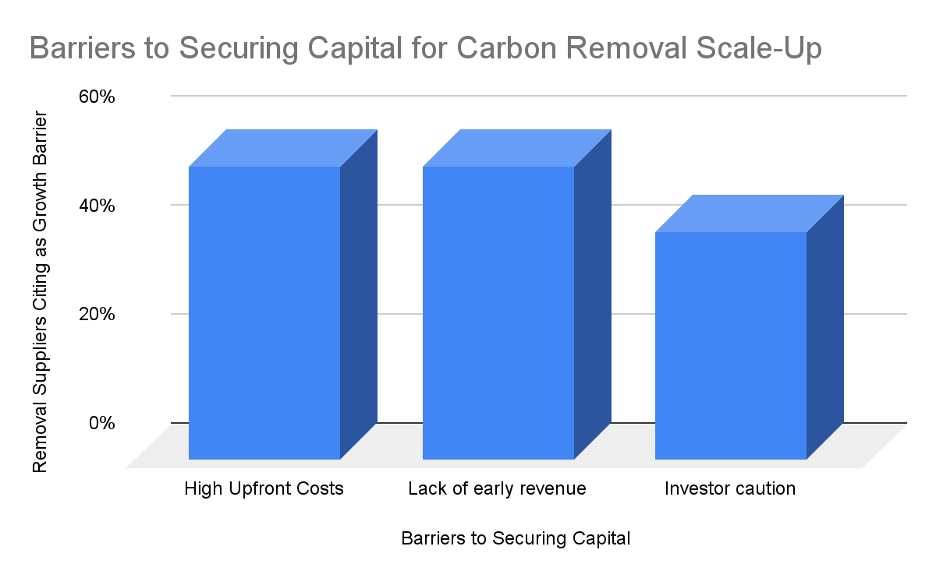
Source: Terraset survey of carbon removal suppliers, 2025
Despite the need for early-stage funding, Terraset’s conversations with corporate buyers made clear that most aren’t ready to take on the risk of putting down money before credits are ready for del
Read More