The 2024 emissions numbers released this past February by Nestlé would have been the envy of many companies. The world’s largest food manufacturer’s first milestone on its journey to net zero — a 20-percent emissions reduction relative to a 2018 baseline — was due to be reached this year. But the Swiss company, which generates more than $90 billion in annual revenue through flagship brands such as Nescafé and KitKat, said it hit its target a year early.
For the first installment in Trellis’ Chasing Net Zero series — a company-by-company look at progress toward 2030 climate goals — we examined Nestlé’s emissions data and spoke with sustainability experts who have studied the company. Several praised Nestlé for its sustainability work, particularly its focus on agricultural emissions. But others raised concerns about its use of carbon removals, a central pillar of its decarbonization strategy. A review of statements made to investors raised additional questions about Nestlé’s future plans.
Compared to its peers, Nestlé has done much to earn its reputation; but the full story of the company’s journey to net zero is more fraught than its emissions data implies.
Track record
Nestlé’s net-zero target was validated relatively early — in 2020 — by the Science Based Targets initiative (SBTi). Five years later, many in the sector are still trying to catch up: Only 44 percent of the largest food, beverage and agriculture companies have net zero targets, and 23 percent have no target of any kind, according to the Net Zero Tracker, a data source maintained by four research organizations.
Other sector comparisons are similarly positive. In a benchmarking exercise released in May by Ceres, a nonprofit focused on the business case for climate action, researchers found that Nestlé was following several best practices that are rare in the sector, including setting climate requirements for suppliers. The company is also one of just three peers — with Campbell Soup and Danone — to have set targets for methane and other non-carbon dioxide agricultural gases in its supply chain.
The work behind this progress is overseen by Chief Sustainability Officer Antonia Wanner, a 24-year company veteran who moved from procurement into an ESG role in 2020 and joined the C-suite in January of this year. Wanner and other leaders have short- and long-term compensation bonuses that are tied to emissions reductions.
Wanner’s boss, CEO Laurent Freixe, took the helm last August; his predecessor was ousted after what The Wall Street Journal described as “slowing sales growth and a slumping share price.” Nestlé stock has fallen slightly since Freixe’s arrival and is now down close to 30 percent from a January 2022 peak.
Nestlé’s biggest challenge: Scope 3
Like many other food and beverage companies, particularly those that source dairy and livestock ingredients, Nestlé faces an emissions challenge that is essentially a Scope 3 challenge: Of the 75 million metric tons of CO2 equivalent emissions (tCO2e) the company generated in 2024, 71 million tCO2e — 95 percent — stem from the company’s value chain. These include 13 million tCO2e of methane emissions from its ingredient sourcing.
Nestlé’s Scope 3 emissions have fallen steadily since 2021, the earliest year for which the company provided data in its most recent sustainability report, as have direct emissions from the company’s facilities and its electricity purchases. If progress continues at the current rate, Nestlé will achieve its goal of halving emissions by 2030.

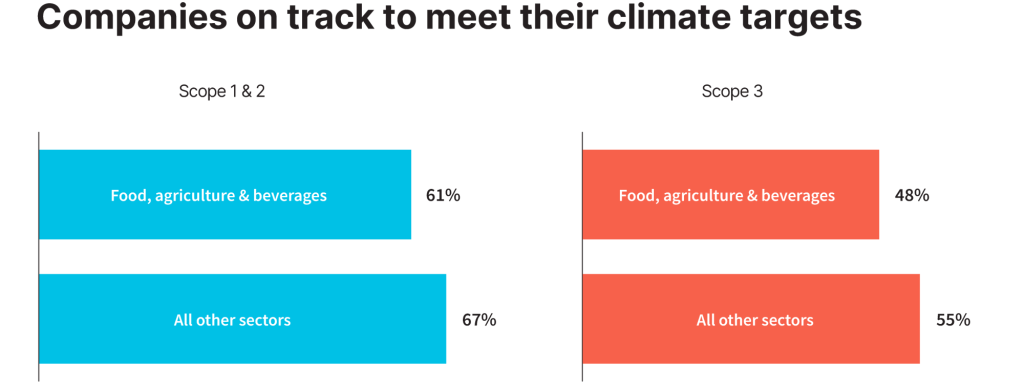
The reductions are notable given that decarbonizing dairy and livestock emissions ranks among the “toughest tasks” for food companies, according to David Linich, a sustainability partner at PwC. Linich declined to comment on Nestlé specifically, but a 2024 PwC survey of emissions disclosures shows that just over half the company’s peers are not on track to hit Scope 3 goals.
Nestlé has achieved these reductions using tactics that include training producers to improve the productivity of their farms, preventing deforestation in its supply chain and reducing methane emissions from cattle, according to its most recent Net Zero Roadmap, which was published in 2023.
Achieving the remaining cuts that Nestlé needs to stay on track for 2030 — notably lowering emissions from sourcing ingredients by 5 million tCO2e, were the company to reduce all greenhouse gases in proportion — will be challenging. The company is pursuing this on multiple fronts, including the use of food additives for cattle, which the company projects will reduce methane emissions by 3.2 million tCO2e by its target date.
Nestlé is also a member of the Dairy Methane Action Alliance, a collaboration between Ceres and the Environmental Defense Fund, which requires members to create action plans for reducing methane emissions. “We think Nestle is demonstrating that they’re putting plans and steps in place in order to make progress,” said Carolyn Ching, director for food and forests research at Ceres.
More uncertain: The role of removals
A second component of Nestlé’s past and future progress is more controversial. The company hit its 2025 target a year early in part because it removed 1.6 million tCO2e from the atmosphere in 2024 and deducted this figure from its total annual emissions. Nestlé did not break this total down, but removal mechanisms highlighted in its latest sustainability report include planting vegetation around water sources, no-till and other regenerative practices, and integrating trees into cropland.
The approach is particularly pertinent for Nestlé because the company’s use of removals will increase eightfold to hit 13 million tCO2e by 2030, according to its Net Zero Roadmap.
SBTi rules allow removals to be subtracted from total emissions in this way, but the practice has been contested because of uncertainties surrounding the reliability of nature-based removals. The science on the ability of soils to sequester carbon remains unsettled. Carbon
Read More